The Five Phases of a University Presidency: An Overview of Each Phase

A few days ago, I started my third university presidency, and a colleague asked me how it felt to be the “new” president again. The question got me thinking about the arc of this role, and I quickly found myself conceptualizing the five distinct phases that many university presidents encounter.

After 40 years in higher education, I’ve seen these phases play out in many presidencies, including in my own. The five phases are marked by common and general characteristics, but the actual lived experiences that each leader navigates within these phases are anything but.

The Five Phases of a University Presidency

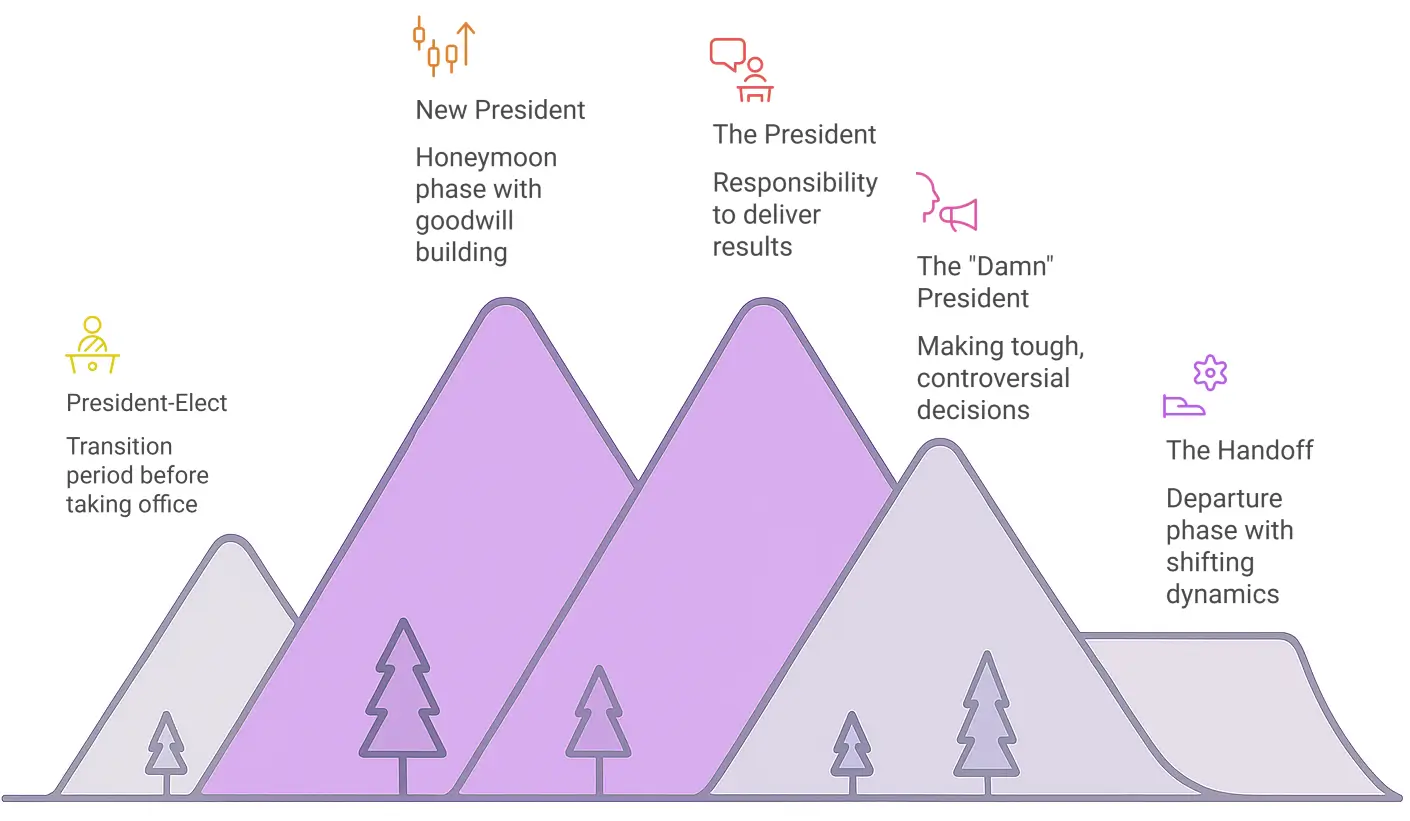
From what I have observed and experienced, the five phases of a university presidency include the following:

  1. The President-Elect Phase—I don’t know you; you don’t know me
  2. The New President Phase—the honeymoon period, where I am getting to know you and you are getting to know me
  3. The President Phase—settling in and delivering results
  4. The “Damn” President Phase—making the hard calls
  5. The Handoff Phase—leaving the institution

You might cycle through some phases more than once, or find yourself thrust into a later stage faster than you’d like, but most presidents do find themselves going through all or most of these phases during their tenure.

Each carries its own energy, challenges, and opportunities. Some phases you’ll love—others will test every ounce of resolve you have. But understanding these phases yourself and making them explicit to members of the community is a healthy way to think about, talk about, and live into the role. 

Phase 1: President-Elect—I Don’t Know You; You Don’t Know Me

This behind-the-scenes phase starts the moment your appointment is announced and ends when you officially take the helm. You’re operating without formal authority, which means you make no official decisions and respect the fact that a university has one president at a time—and it’s not yet you.

Your days are filled with discovery work: reviewing websites, budget reports, accreditation documents, enrollment data, anything that helps you understand what you’re inheriting. I always tell new presidents to keep a running list of emerging questions—these will guide your early conversations with your senior team.

In a situation I know well, the president-elect inherited an institution under accreditation scrutiny, with a peer review team scheduled for a “special visit” within her first sixty days. To ready herself for that high-stakes visit, she spent her transition period reading the former accreditation reports, familiarizing herself with commission standards, and mapping out areas to highlight during that crucial campus visit. That preparation aided her in leading the campus through a stressful interim review.

Phase 2: New President—Getting to Know You, Getting to Know Me

This is often the sweetest phase of all—what many call the “honeymoon period.” Typically spanning your first 12–18 months, this phase is marked by mutual goodwill and curiosity. You’re giving everyone the benefit of the doubt, and they’re extending the same generosity to you.

You’ll spend these months on learning tours: meeting faculty and staff in their offices, attending donor receptions, and visiting with community leaders. It’s your chance to offer “early observation” and “a sense of what you are experiencing” without committing yourself or the institution to anything prematurely.

During one presidency, I launched what I called a “Possibility Fund” in this phase. It was a boutique fundraising campaign where donors contributed money that I could then “give” to faculty and staff via a grant program. Faculty and staff submitted short proposals for a high-impact, low-cost improvement that they were willing to implement on campus. I was then able to award small grants ($500-$2,500) to those with the most viable ideas. It was a great way to build community and morale early in that presidency.

Phase 3: The President—Settling In and Delivering

The “new” label drops off after your first full academic year or so, and now you’re simply “the president”—or on some campuses, “the administration.” This phase can last several years as you face pressure to deliver on the intentions you outlined during your early tenure.

In this phase, you design strategic plans, build multi-year budgets, negotiate bargaining agreements, and make the structural changes your institution needs. You’re translating your leadership philosophy to the day-to-day practices associated with shared governance, enrollment management, financial sustainability, and community partnerships.

In reflecting on this stage, I recall conversations I had with three presidents who took office right as the pandemic hit in 2020. Each of their boards suddenly demanded multi-year budget scenarios—something unprecedented for these stable institutions. Two boards gave their presidents time to navigate the uncertainty; one pushed for immediate cuts. The outcomes were not at all surprising. The presidents given breathing room found their footing and built strong relationships with their teams. The third got off to a rocky start that defined much of her tenure.

Phase 4: The ‘Damn’ President—Making the Hard Calls

This phase tests your resolve. The early goodwill has faded, the easy wins are behind you, and now you’re making decisions that will define your presidency—and sometimes your legacy. Depending on your institution’s challenges, this phase can emerge quickly or arrive after years of smoother sailing.

This is a phase where you would find yourself closing programs, cutting positions, realigning departments, or dealing with high-stakes situations that divide your campus. Every decision gets scrutinized, and even well-intentioned moves can spark protests or public criticism.

I know one president who inherited a campus where faculty had voting rights on the governing board, but staff and students had no formal voice in major decisions. After a year-long shared governance review involving task forces and consultants, the board adopted recommendations to give faculty, staff, and students advisory roles—voice but no vote. Many faculty felt demoted; but a number of staff celebrated a change that they saw as overdue. That decision marked the beginning of a “damned if you do, damned if you don’t” phase that lasted the rest of that president’s four-year tenure.

Phase 5: The Handoff—Sitting Duck or Accelerator

Once you announce your departure, organizational dynamics shift immediately. Some constituents start looking right past you, hoping you’ll defer decisions to your successor. Others rush to get their priorities addressed before you leave.

The challenge is walking a tightrope: handling the hot-potato issues that shouldn’t be dumped on your successor while leaving room for the next president to put their own stamp on long-term initiatives. 

One outgoing president I know spent his final year consolidating six academic schools into three interdisciplinary ones. The reconfiguration was meant to eliminate administrative bloat, create salary savings for his successor, and signal an academic shift toward interdisciplinary work. 

What I’ve Learned About Presidential Phases

Not every presidency unfolds in five tidy stages. Some leaders skip phases entirely; others revisit them multiple times. What’s predictable is that most presidencies bring seasons of discovery, connection, pressure, and conflict—though not always in that order, and not always with equal intensity.

To last even a few years in this role, you must be willing to take the highs with the lows, generously accept praise, learn from criticism, and make the complex calls that have some cheering and others screaming. There are places where a long tenure is exactly what an institution needs, but longevity isn’t always the goal.

Sometimes a university needs someone who’ll make changes—set up new systems and structures for someone else to strengthen. What matters most isn’t how long you sit in the chair, but whether you use whatever phases you encounter to move your institution forward in ways that matter.


The Presidential Transition Partner: A New Member of a University President’s Onboarding Team

The early days of a university presidency can feel like stepping onto a challenging new trail—filled with excitement and a bit of trepidation. To help new presidents navigate the trail successfully, most institutions have an official onboarding process coordinated by an ad hoc presidential transition team, sometimes called the “transition committee,” the  “transition advisory council”, or the “start-up guide.” While the titles and names of these teams and processes vary from institution to institution, their primary responsibility is the same: help pave a smooth and navigable changeover path.

This article is written as a complement to the emerging literature on this topic. Given that the presidential transition team is the subject of much discussion, this piece focuses on the idea of adding a new, external member to the team. For now, I have dubbed this member the “Presidential Transition Partner,” describing them as both the president’s cartographer and sherpa. I see the PTP as helping chart the terrain, set a sustainable pace, and point out the critical signposts ahead. In some cases, the PTP may be charged with leading the internal team or serving as the direct liaison between that team and the incoming president.

Who is the Presidential Transition Partner?

The Presidential Transition Partner (PTP) is a recently retired academic president who works side-by-side with the incoming leader for approximately three months before and three months after their official start date. Selected by the president-elect and, depending on institutional culture, approved by the governing board, the PTP provides steady guidance through the early stretch of the presidency. The relationship the PTP has with the internal presidential transition team is usually defined by the president-elect in consultation with the chair of the governing board.

The Unique Role of a Presidential Transition Partner: Not an Advisor or Coach

Best for practices for onboarding today’s university presidents often highlight the value of an advisor or coach. While there is great value-add in engaging such professionals, the Presidential Transition Partner is not exactly an advisor or a coach. The PTP is a “doer,” a delivery person. They come to this unique post with substantial first-hand experience and expertise. With no learning curve or start-up time, they hit the ground running. From day one, they assume responsibility for helping the incoming president undertake foundational work that would otherwise be “left for later” or piled onto the new president’s already heavy load.

Drawing on my experience both serving as and being supported by a Presidential Transition Partner (PTP), I’ve identified several core responsibilities that are essential to the role:

Key Functions of a Presidential Transition Partner

  • Curating essential institutional information from the college website, posted policies, accreditation reports, and public datasets (e.g., federal scorecards).
  • Synthesizing high-level themes from these sources and walking the president-elect through areas of concern or opportunity.
  • Assessing the status of strategic planning and offering guidance on how to engage with current, emerging, or sunsetting plans.
  • Annotating budget materials, ensuring the new president understands key financial challenges and opportunities—or can get the help they need to do so.
  • Summarizing key sections in governing and operating documents such as university bylaws, employee handbooks, and collective bargaining agreements (CBAs).
  • Helping plan a leadership retreat for cabinet members, rooted in the president’s evolving goals and shaped by early insights gathered during the onboarding process.

Why a PTP is Not an Internal Member of the Team?

Brings First-Hand Presidential Experience

A former president understands the breadth of institutional governance, the pressure of external constituencies, and the complexities of internal operations. They bring both professional expertise and lived experience that few current staff members can offer.

Provides Objectivity Without Internal Agenda

Unlike current administrators who understandably may want to impress their new leader, the PTP is not vying for a position, recognition or job security/promotion. They are uniquely positioned to speak hard truths, ask the right questions, and offer honest feedback—without having to do the political calculus of how this may affect them in the long term.

Offers Protective Cover

The PTP gives the new president a neutral way to ask sensitive questions or request clarity.

“The PTP and I are reviewing some of the budget reports. She asked me about a cash flow trend that looked a bit problematic. Can you, [CFO X] please help me understand the details/discrepancies/missing pieces in this report?”

Does More Than Think and Advise

The PTP doesn’t just recommend actions for the new leader—they roll up their sleeves and do some of the work themselves. They review key institutional plans, reports, metrics, governing documents, and employee manuals, then synthesize themes, assess the status of current initiatives, flag areas of concern, and prepare targeted follow-up questions for the president. Together, the PTP and president discuss not only what the information says, but what it means—perhaps collaborating on early drafts of high-level plans to address anticipated challenges and opportunities.

By doing this work before or just as the president arrives on campus, the PTP accelerates the president’s learning curve, equipping them with fact-based insights, data-driven perspectives, and a clearer view of the institutional landscape from day one.

Serves as Sounding Board for Reflection and Strategy

During the first few months of the presidency, some internal and external constituents will want to “casually” meet with the new president. Whether explicitly or implicitly, these stakeholders are interested in positioning their program as important. Following these meetings, the PTP can serve as a sounding board and perspective-shaper for the president. The two of them can revisit conversations through a strategic and long-term lens that is not always in focus during the “meet and greet” engagements.

Builds Board and Confidence

With a seasoned professional embedded in the transition, trustees and other key players gain confidence that early presidential decisions are being shaped with discernment, preparation, and context.

What the PTP Is Not

The PTP is not an executive coach, interim administrator, or crisis consultant. They neither hold line authority, an operational role, nor budgetary control. They function as an engaged and expert contributor—a trusted colleague who rolls up their sleeves to handle early summary, analysis, and review work. Part worker-bee, part presidential whisperer, part leadership “angel.”

Other Key Elements to Consider

Selection & Compensation

The incoming president selects the PTP, usually with governing board approval. Compensation is typically modest—a part-time consultancy funded by the institution or board. Some retired presidents have even expressed willingness to serve in this role pro bono.

Confidentiality & Ethics

The PTP frequently operates under an official nondisclosure agreement and discloses any potential conflicts of interest, especially if connected to prior leadership or major donors.

Evaluation & Feedback Loop

At the six-month engagement mark, the president and PTP review what worked, what didn’t, whether the agreement should be extended, and how the model could be improved for future use.

 Potential to Scale

This model could be adapted across institutions or systems—a “counseling cadre” of experienced presidents offered through associations, leadership development firms, or transition networks. It could also be used as part of the onboarding process for provosts, CFOs, and other executive officers of the university.

Why Adding a Presidential Transition Partner to the Presidential Transition Team Makes Sense

The Presidential Transition Partner supports the incoming president during the most formative phase of their journey: the initial ascent. By adding an action-oriented guide with first-hand presidential experience to the internal transition team, the new leader gains the best of both worlds.

  • From inside: the support, institutional knowledge, and network access of an internal presidential transition team.
  • From outside: the objectivity, presidential perspective, and nuanced insights of a seasoned peer.

Rather than replacing the valuable work of transition committees, advisory councils, or professional coaches and advisors, the PTP enhances and complements those efforts—bridging the gap between offering suggestions and giving advice, and actively assisting the president in early tasks such as reviewing policies and bylaws, analyzing budgets, and summarizing key articles in faculty and staff handbooks or collective bargaining agreements. In this way, the PTP becomes one more integral member of a larger onboarding ecosystem, ensuring that the president’s early months are anchored in both collaboration and informed decision-making.

Distributed Leadership in Higher Education: Antioch University as a Model of Remote Leadership

The COVID-19 pandemic accelerated the shift toward hybrid and remote work in higher education. Once rare and prevalent only in online universities, remote work became the sector-wide norm overnight as faculty, staff, and administrators assumed their respective responsibilities via Zoom-enabled technology. The rapid move from a physically cohesive workspace to a dispersed, remote one made it essential for university leaders to develop a set of “distributed leadership” skills that were rarely used by academic administrators prior to the pandemic.

Five years later, many universities are approving hybrid work schedules for at least some employees and managers. Still, many institutions have yet to develop a tailored distributed leadership model to equip chairs, deans, and vice presidents for leadership success in a remote work environment. “Approving” or “allowing” remote work isn’t nearly enough—institutions must intentionally design a distributed leadership model aligned with their unique culture. 

To do the latter, we can learn from institutions whose administrators have honed remote leadership long before the pandemic reshaped the workplace. This blog spotlights Antioch as one such university.

With five physical campuses across the country, three academic schools, a robust online presence, interactive hybrid modalities, and an adult degree completion program, Antioch’s infrastructure has long required its leaders to be both geographically dispersed and tightly aligned. Long before the global pandemic forced a virtual pivot, Antioch was hiring and preparing faculty, staff, and administrators to lead within a distributed environment. 

As Antioch’s incoming president, I am inheriting a dispersed leadership model that many institutions are only now beginning to navigate. Over the past three months of my president-elect tenure, I have read extensively and listened carefully to my soon-to-be colleagues about leading from a distance. This blog shares some of the lessons I’ve gleaned. I hope they will resonate with other higher education officials seeking to lead remotely without becoming disconnected.

Remote Leadership Is Not Remote Control 

The first thing I’ve learned from my Antioch “study” is that leading across geography is not about delegating from afar or keeping things moving on autopilot. In line with insights from global leadership studies (Zander, Mockaitis, & Butler, 2012) and virtual team management research (Gilson et al., 2015), Antioch’s leaders are not less present—they are present in different, intentional ways. 

Antiochians build and sustain genuine relationships that allow them to show up consistently across “schools” and “campuses.” They foster trust by being responsive and reliable. Antioch vice presidents, deans, and faculty leaders regularly hold one-on-one and small-group meetings with colleagues working from home offices spread across time zones. They participate (most often, virtually) in academic and university events that are frequently “bookended” by a meet-and-greet, a check-in, or a debrief with participants logged in from around the country. 

Presence here is not defined by physical proximity but by meaningful engagement. Antioch’s leaders are connected to, not detached from their teams. They lead, not by flicking an “automatic pilot” switch but by having their fingers on the pulse of activities and interactions.

Lead with Values, Not Just Schedules 

When leadership is geographically dispersed, clarity of purpose is vital. A tightly shared sense of mission, vision, and values acts as the connective tissue for distributed teams operating across multiple zip codes. 

A compelling finding from Choudhury, Foroughi, and Larson (2021) in the remote workforce literature is that distributed organizations outperform others when they cultivate and reinforce a values-based culture. Antioch has a palpably mission-driven culture. It centers on social justice, student-centered learning, and community impact. As president, an early and ongoing responsibility will be to clearly articulate and visibly embody Antioch’s defining mission and values, ensuring they remain the glue that binds us across time and space.

Communication Is Key in Distributed Leadership

One of my long-standing apothegms is that “communication is to higher ed what location is to real estate.” In real estate, it’s location, location, location. In higher education, especially in distributed environments, it’s communication, communication, communication. 

Though I have always understood how important communication is in a university setting, my new colleagues have emphasized that strong and timely communication is even more critical when your team is dispersed. That sentiment aligns with the enduring 2004 recommendations developed by Kirkman, Rosen, Tesluk, and Gibson for distributed teams that aimed to be high-performing:

  • Be predictable: Establish regular rhythms—weekly updates, monthly reflections.
  • Be transparent: Share successes and shortcomings with clarity and honesty.
  • Be supportive: Send a thank-you email or make a call to acknowledge work done well.

In my first 90 days, I’ll host Zoom-based Leadership Learning Sessions with faculty, staff, and students across all campuses. These will not be dog-and-pony shows or top-down updates. They will be mutual learning forums—spaces where people feel heard and leaders feel approachable.

Context Matters: Leading Distributed Teams Where You Are 

Antioch executives do not lead from a single campus or within a single structure. As mentioned above, our university’s context is a layered one. We operate campuses in Seattle, WA; Santa Barbara, CA; Los Angeles, CA; Yellow Springs, OH; and Keene, NH. We also house three academic schools: the School of Interdisciplinary and Professional Studies; the Graduate School of Nursing and Health Professions; the School of Counseling, Psychology, and Therapy.

This means executive leaders (at the cabinet level) must work with and solicit input from campus-based and school-based leaders alike. Campus leaders are experts on the local student experience, operational oversight, and regional community engagement. School leaders understand the interests, concerns, and aspirations of faculty and staff in the various disciplines (often spanning multiple campuses) that make up their school.

My role as president will be to nurture the distinct strengths of both groups while ensuring their efforts are aligned with Antioch’s overarching strategy and values.

Adaptive leadership theory (Heifetz, Grashow, & Linsky, 2009) reminds us that strong central leadership is not about making every decision—it’s about creating the conditions that allow others to lead effectively within their contexts. That’s especially true at Antioch, where our contexts are varied, our geography is broad, but our mission is shared.

Be Visible through Impact

Perhaps the most subtle challenge of remote leadership is being emotionally in tune when you can’t be physically present. Leaders in distributed organizations can become visible by sending handwritten notes to colleagues, participating in a synchronous classroom discussion, starting small group meetings with thoughtful check-ins, and giving a public shout-out in system-wide Zoom meeting.

These personal touches may be small, but they go a long way in signaling personal attentiveness and appreciation. They show that leading from afar can be a deeply connected practice, not a mechanical maneuvering.

I’ve always been moved by the phrase, “Change occurs at the speed of trust.” As I prepare to take the helm at Antioch, I am adding the italicized words that will make that maxim even more instructive “
and trust must travel well—across schools, across campuses, and across the miles between us.”

Look to Institutions That Have Led in this Space

Antioch’s distributed model is not just an artifact of its past—it’s a window into the future of higher education. As hybrid work becomes a permanent part of our sector, great leaders will be those who have a track record for leading effectively in all kinds of environments, including virtual ones. Indeed, future deans, directors, vice presidents, and presidents will be asked not just whether they can lead—but whether they can lead from anywhere.

I look forward to reading more on the topic, and to connecting with those of you who have been leading in this space for years. As I begin this leg of my journey, I aim to lead from all kinds of spaces and places—without ever losing sight of our students, the faculty who teach them, and the staff who support them.

Embedded Consultants: Why Higher Ed Needs Them Now

Today’s Higher Ed Leaders Are Drinking from a Fire Hose

Leaders at colleges and universities today are drinking from a fire hose. They are leading through the myriad issues and opportunities that confront academic leaders on a routine basis. At the same time, they are being bombarded by a number of pressing challenges. Key ones include these: shifting accreditation standards; heavy state and federal mandates; new financial-aid policies; and politicized interference in everything from curriculum, tenure, diversity initiatives, and presidential appointments. One of the ways that leadership teams can keep pace with the volume and velocity of these issues is to partner with an embedded consultant.

What Types of Leadership Teams Can Use an Embedded Consultant?

In this moment, leadership teams—especially those at smaller universities with shallow leadership benches—need help. And there’s no shame in asking for it. Even seasoned leaders can benefit from support as they navigate unfamiliar terrain and work to position their institution for long-term strength and success.

In my experience, these academic leaders don’t need a distant observer or a contract with a firm of highly intelligent professionals who have never held the post or done the work. They need a close partner: someone who brings an outside perspective but works inside the community; someone who has imagined the possibilities being entertained and mapped out the steps necessary for bringing them to life; someone who is willing to share the ups and downs of lessons they have learned first hand.

I refer to this “someone” as an embedded consultant.

Embedded Consultants: A Familiar Concept in a New Context

The term “embedded consultant” is not one that many in higher education routinely use. But it’s not a new concept—especially in journalism. In times of conflict or crisis, an embedded reporter lives with the troops and commanding officers—in the communities they build and those they are fighting against. These journalists don’t parachute in for a photo op or quick news brief. They forge relationships, understand the nuances, and capture the contradictions. As a result, their stories go far beyond summary and synthesis; they bring to life the little-known and often invisible reality of war. Rather than gloss over phenomena that many Americans have the luxury to avoid, the work of an embedded reporter or photographer reflects a multidimensional picture. The story they write or the picture they take conveys a deep and authentic “take” on a crisis that is simultaneously personal and far-reaching.

In a similar way, an embedded consultant doesn’t just call or Zoom with university colleagues elsewhere, conducting interviews from afar. Embedded advisors are established professionals who have had “boots on the ground” at one or more “home campuses.” They are now at a point in their careers where they want to do a particular kind of consulting and advising. 

The What and How of an Embedded Consultant’s Work

Embedded consultants, like me, want to come to campus for a couple of extended periods of time to join forces with the university community. We diagnose issues in real time and co-create, with campus leaders and an array of university members, solutions built to last. In today’s environment, many embedded consultants assist our partner colleagues in retooling enrollment strategies, diversifying revenue streams, and reassessing the sustainability of tenure, staffing patterns, and institutional business models for the mid-21st century. 

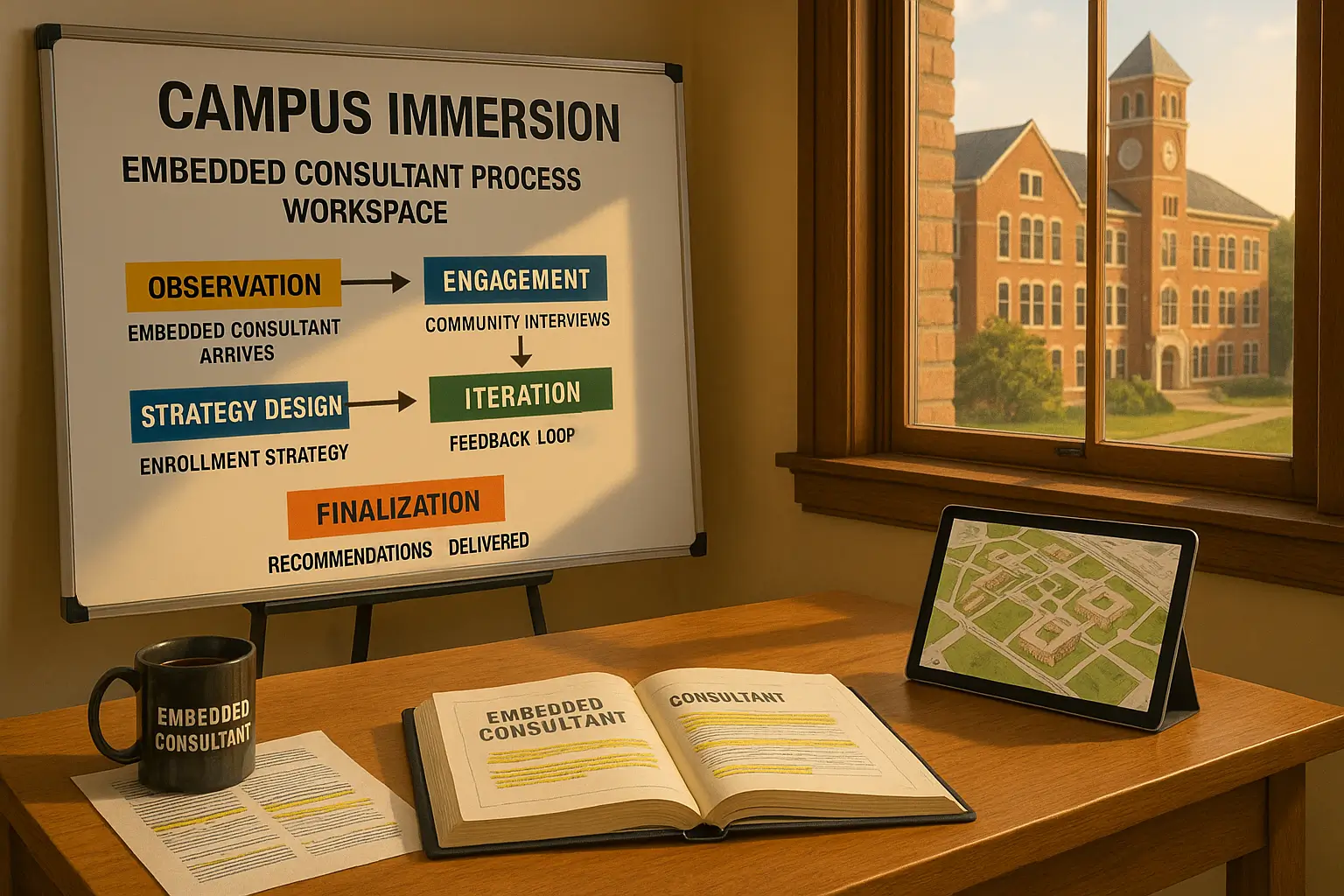
Our work typically includes a number of steps and phases such as these:

  • Visiting the campus they are partnering with for a week or so on a couple or more occasions;
  • Observing the daily work of faculty and staff;
  • Meeting with various university constituents in their own places and spaces to gather input, answer questions, and shape emerging reports;
  • Drafting and sharing iterative draft reports with engaged participants who provide feedback;
  • Providing penultimate reports to those who have weighed in;
  • Using all of the above to craft a final report with recommendations on the topic being explored;
  • Sending that report to university leaders who are expected to share it with campus.

Why the Embedded Consultant Approach Works 

The steps delineated above allow an embedded consultant to sense the rhythms of the campus, to hear what’s said in formal meetings and at informal moments, and to get a feel for the ethos and vibe of the university. This type of genuine presence makes it easier to co-create plans and solutions with campus constituents at various levels and in various departments throughout the institution. And these are the plans, recommendations, and solutions that actually stick.

Embedded Consulting Case Studies

To see how embedded consulting works in practice, read about my recent work at Lake Erie College:

🔗 Lake Erie College embedded consulting case study: Rooted in Input, Ready for Action

🔗 A Step-by-Step Guide to Using an Embedded Advisor for Strategic College Positioning

Frequently Asked Questions

What Is a Higher Education Embedded Consultant?

An embedded consultant (EC) is a seasoned higher education professional—often a retired or transitioning senior leader—who partners with a college or university to provide personalized, project-based consulting services. Unlike consultants who operate primarily off-site, ECs spend meaningful time on campus to better understand institutional culture, history, and context. They combine that immersive experience with hybrid work—balancing in-person discovery with remote research, analysis, and report writing.

Institutions typically engage ECs to explore a complex issue, answer a strategic question, or co-develop a plan—such as a strategic roadmap, enrollment strategy, branding initiative, or academic restructuring plan.

What sets embedded consultants apart is their:

  • First-hand leadership experience (as former presidents, provosts, or VPs),
  • Immersive approach to stakeholder engagement, and
  • Ability to translate discovery into actionable, campus-specific recommendations.

The work of an EC generally includes:

  • Spending dedicated time on campus, often in multi-day or weeklong visits, to build trust and observe context up close;
  • Meeting with faculty, staff, students, board members, and other stakeholders in their own workspaces to gather input;
  • Conducting additional analysis, drafting reports, and iterating recommendations remotely between visits;
  • Sharing and refining drafts in collaboration with campus participants;
  • Delivering a final report with clear, customized guidance; and
  • Encouraging leadership to share findings transparently with the broader community.

Embedded consulting is hybrid by design—on-site enough to earn credibility and context, remote enough to be cost-effective and efficient.

How Much Do Embedded Consultants Charge?

Fees for embedded consultants vary based on project length, complexity, travel requirements, and the consultant’s background.

  • Hourly rates typically range from $100 to $1,000.
  • Project-based fees—the more common model—range from $15,000 to over $100,000, depending on the number of campus visits, stakeholder interviews, and deliverables involved. 

Pricing is usually negotiated after an initial scope of work is defined between the consultant and institution.

What Makes an Effective Embedded Consultant?

There is no formal certification for becoming an embedded consultant in higher education. However, the most effective ECs tend to share five key characteristics that distinguish their impact and approach:

1. Senior Leadership Experience

Most embedded consultants have held senior roles, such as president, provost, or vice president—and bring first-hand experience and knowledge of the strategic, operational, and political dynamics that shape institutional decision-making.

2. Stakeholder Engagement Expertise

Effective ECs are strong listeners and facilitators. They engage with faculty, staff, students, and trustees to surface insights, understand culture, and build trust across the institution.

3. Strategic Communication Skills

ECs are skilled communicators who synthesize complex input into clear, compelling reports. Their deliverables are well-organized, action-oriented, and grounded in both campus realities and national trends.

4. Execution-Oriented Thinking

Beyond crafting high-level recommendations, embedded consultants outline practical steps for implementation. They help institutions translate strategy into feasible action plans with defined timelines and decision points.

5. Institutional Neutrality

As outside experts with insider experience, ECs offer a rare combination of empathy and objectivity. They are not beholden to campus factions or politics, allowing them to speak candidly, challenge assumptions, and build consensus around hard truths.

How do ECs get started?

  • Tap into your higher ed network and professional associations.
  • Define your consulting niche (e.g., shared governance, enrollment management, institutional planning).
  • Develop sample proposals or case studies to showcase your style and strengths.
  • Consider partnering with organizations or firm that match institutions with experienced consultants.
  • Take on a limited project or pilot engagement to build visibility and momentum.

Graduate Programs with Purpose: Antioch University’s National Model for Mission-Driven Learning with Social Impact

Flexible Graduate Programs with Purpose: Antioch University’s Mission-Driven Approach

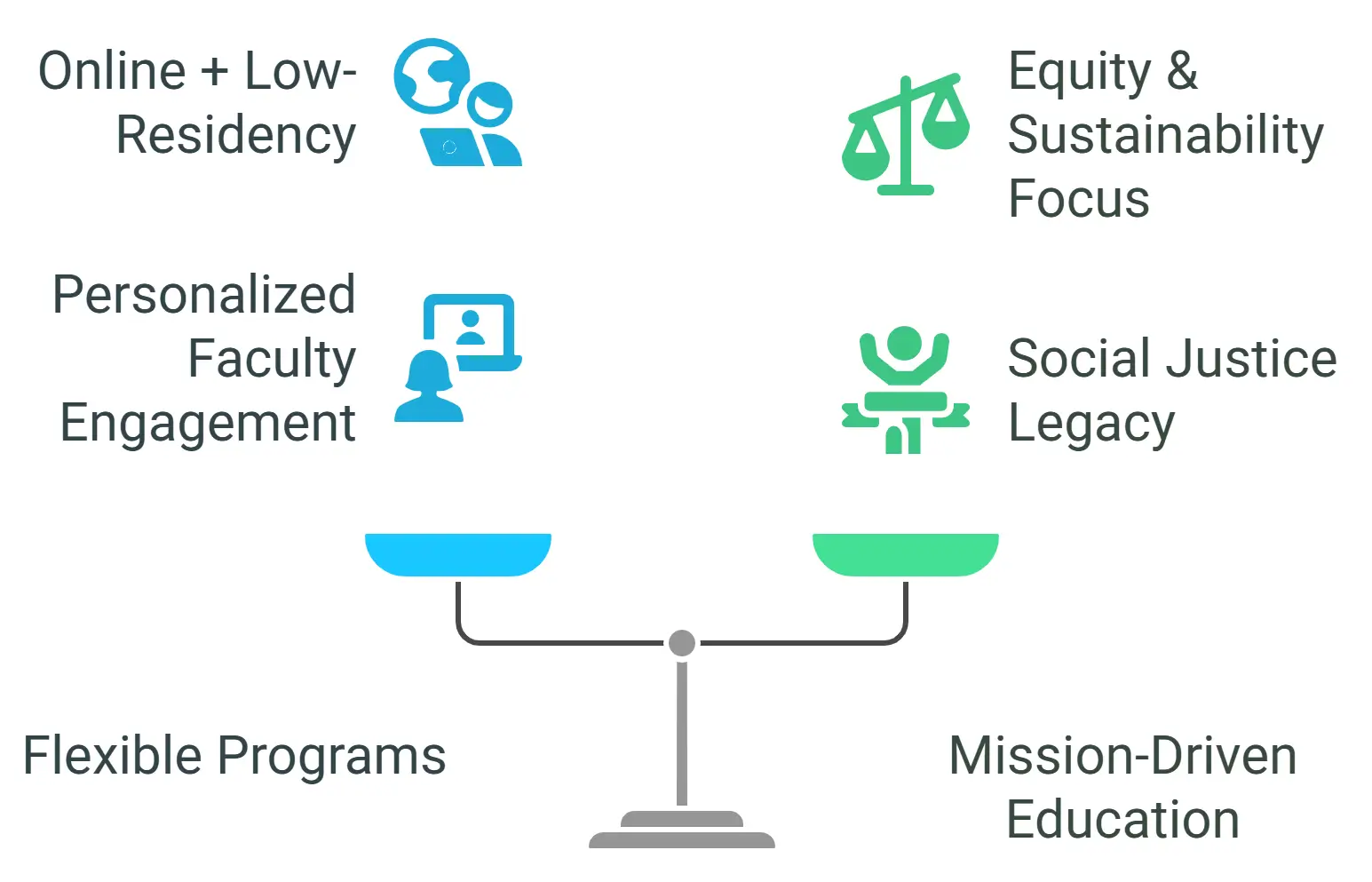
Antioch University’s flexible online and low-residency graduate programs are designed for mission-driven professionals and offered in blended formats through the AU Multi-Campus/National-School model. AU programs emphasize social justice and empower graduate students—in all fields—to become change makers not just degree earners.

When prospective students search for online graduate programs or low-residency options, they’re often seeking flexibility and convenience.But for those who want to both advance their career and improve the work and world around them, flexibility might not be enough. Such students want programs with purpose. Why? Because they are building careers and lives, alike, around equity, sustainability, and systemic change.

The philosophies, pedagogies, and practices of Antioch University are designed for this type of graduate student. With five campuses across the United States, a fully accredited online presence, and a co-founder of a national coalition, Antioch University offers graduate degrees that combine academic rigor with a transformative mission: advancing social, environmental, and economic justice.

Unlike many online or hybrid programs, Antioch’s offerings are explicitly geared towards educators, counselors, business professionals, community leaders, and policy advocates who are ready to lead change—not just learn about it.

What Graduate Programs Look Like at Antioch: Personalized, Practical, and Purpose-Driven

Antioch’s graduate programs for working professionals are not built on standardized templates or generic content, they’re personalized, experiential, and student-centered. Programs like the MA in counseling offer specialized tracks in trauma-informed care, multicultural counseling, and LGBTQ+ affirmative therapy. These options allow students to tailor their coursework to reflect their personal values and serve the communities where they live and work.

Meanwhile, students in both the PhD in Leadership and Change and the EdD in Educational & Professional Practice co-design personalized learning pathways with faculty mentors. Their dissertations aren’t mere academic exercises; they are tools of real-world change. For instance, graduates have transformed concrete practices in areas ranging from community-based health equity and workplace inclusion to inclusive team-building in early childhood education.

This applied, customized approach supports adult learners and working professionals who seek real-world impact while earning their graduate degrees.

Beyond the Books: Social Justice in Every Graduate Program

At Antioch University, social justice isn’t just an academic construct—it’s a concrete component of the curriculum. Every graduate program is anchored in this mission-driven commitment. Courses across the disciplines explicitly address inequality, power, privilege, and transformation.

In the MS in Resource Management and Administration: Sustainable Development and Climate Change, students take classes in science, policy, management, and communication. Faculty work with these students to develop their design-thinking capacities, consensus-building skills, and problem-solving techniques. At degree completion, these graduates go on to shape viable and equitable solutions in the complex geo-political environments in which they live.

Empowered Graduates: How Antioch Builds Leaders for Social Change

The success of Antioch’s graduate programs is best measured by what students do after they graduate. Over 80% of Antioch University graduate alumni go on to work in mission-driven organizations or civic leadership roles (Antioch University, 2023). 

Sure, Antioch’s Master of Science in Allied Health in Exercise and Health Science prepares students for careers in the lucrative heath science field. But it goes way beyond that. How? By prompting students to address the interconnected relationship between physical activity, chronic disease, and systemic health disparities. This social-impact emphasis ensures that AU students hone the skills to design inclusive, culturally responsive interventions that address the needs of diverse populations.

Why It Matters: Today’s Pressures Must be Tempered by Graduate Student Changemakers

The tension in the world, the country, and U.S. higher education is palpable. Amidst the strain, many of today’s adult graduate students want more than a credential that helps them climb the next rung on the career ladder. They want to connect their career with their calling to build an integrated personal and professional life with meaning. They want to work in areas like climate justice, education equity, racial healing, mental health access, and policy reform. They want to contribute to solutions, not conform to a status-quo that does not work for the common good.

Antioch University doesn’t just support that vision. It helps students actualize it at every step of their studies. Don’t forget, the mantra—victories for humanity—that made Antioch known for almost two hundred years, rings loud and clear today.

Whether you’re an experienced nurse looking to scale your impact, a counselor building a more culturally-responsive CBT practice (cognitive behavior therapy), or a civic leader aiming to expose invisible systemic barriers, Antioch’s graduate programs provide the knowledge, skills, and community to help you lead change and make real-world impact. 

Reference

Antioch University. (2023). Graduate Outcomes Survey: Alumni Impact Report. Internal Report.

Lake Erie College’s Repositioning: Rooted in Input, Ready for Action

We write today to give a 30,000-foot overview of Lake Erie College’s academic and branding repositioning effort, which launched with remarkable speed and intention. We want to share our positive experience to assist other colleges undertaking similar work amidst the pressing circumstances squeezing many tuition-driven universities today.

Lake Erie Campus- Embedded Advisor

A Partnership with an “Embedded Advisor” Who Brings Credibility and Concrete Experience

In mid-February 2025, Dr. Lori Varlotta—a two-time college president with a track record of leading institutional transformation—visited campus to initiate a process that was transparent in intent, inclusive in design, and fast-paced by higher education standards. Just three months later, in mid-May, she returned to share her emerging findings and invite another round of input from faculty and staff to shape her final recommendations.

Over this short but intensive period, Dr. Varlotta led a campus-wide process that emphasized listening and learning. The repositioning effort was not conducted from a distance or designed behind closed doors. Aligned with LEC’s values, it centered on face-to-face conversations and personal interactions with the people who know the College best: its faculty, staff, students, administrators, board members, and alumni. The result was a set of actionable recommendations rooted in the College’s culture, context, and aspirations and marked by the fingerprints of many.

Dr. Varlotta had informally visited Lake Erie College during her sabbatical in July 2023 for an exploratory trip that introduced her to some of LEC’s specific opportunities and challenges. At the time, President Schuller was working hard to pave a financially sustainable path forward for the College. As soon as that path was laid, the President invited Dr. Varlotta to lead the College in a fast-paced but inclusive repositioning process.

In short order, President Schuller and Dr. Varlotta decided that utilizing an “embedded advisor” approach—bringing Varlotta in for two week-long, intensive campus visits (one in February; one in May)—was the best way to orchestrate a swift but inclusive process.

Breadth and Depth of Stakeholder Engagement

During her visits, Dr. Varlotta met with over 100 individuals (representing a high portion of our faculty and staff) across more than 25 formal sessions. Participants included:

  • Board leaders
  • Senior leadership and cabinet members
  • Academic deans and department chairs
  • Faculty—tenured, tenure-track, adjunct, and new instructors
  • Staff from finance, HR, enrollment, advising, student services, and facilities
  • Student ambassadors, athletes, and EQ program participants
  • Coaches and athletics staff
  • Trustees and alumni representatives
  • Members of the faculty senate

Strategic Layering of Conversations

Every conversation was thoughtfully designed and adapted to its audience. With students, she prioritized storytelling and lived experience. With faculty, she explored pedagogy, curricular relevance, and scholarly culture. With staff, she focused on operational processes and workplace morale. With the board, she emphasized strategic direction and financial stabilization.

A hallmark of her approach was triangulation: when a theme emerged in one setting—such as questions about morale or clarity of mission—she probed for it in other settings to distinguish isolated anecdotes from systemic issues. This ensured that no single perspective was over-weighted and that trends were grounded in broad input.

Context Matters: No Cookie-Cutter Approach

As a seasoned president herself, Dr. Varlotta emphasized that Lake Erie’s repositioning must be shaped by what the College already does well and what it aspires to do even better going forward. To understand these strengths and opportunities, she immersed herself in the campus community—visiting the Equestrian Center, attending student-centered events, and engaging with the College’s history and regional relevance.

She spoke with campus members in each of these places to better understand what they saw as LEC’s most distinctive features. An overwhelming consensus emerged:

  • We are a small college located just five miles from Lake Erie
  • We are the only four-year institution in Lake County, Ohio
  • We are a place where liberal arts can be practiced, not just studied
  • We are a campus community where DII athletics and a nationally recognized equestrian program define the student experience

Dr. Varlotta used this community feedback to shape practical and highly valuable proposals and recommendations.

The Product: Strategic Framing and Recommendations

The outcome of this swift and collaborative process was a set of strategic identity statements and programmatic priorities tailored to LEC. Rather than prescribing a rigid plan, Dr. Varlotta offered a flexible framework that honors the College’s strengths and prepares it to meet future challenges.

By: Jennifer Schuller, President, Lake Erie College; Jennifer Kinnaird, Provost, Lake Erie College; Jonathan Tedesco, Dean, School of Natural Science and Mathematics, Professor of Chemistry, Lake Erie College

Antioch University: A Model for Promoting Democracy That Is Lived (Not Just Loved)

At a time when U.S. democracy is increasingly fragile due to political divisions, misinformation, and declining trust in institutions, American colleges and universities must do more than lecture about the importance of civic engagement. They need to model it. This is especially true for graduate programs, which prepare mature and world-ready adults to become the next generation of ethical leaders.

Fragile Democracy

The Antioch University system, comprising five schools, plays a critical role in adult learning and graduate education. Why? Because it offers one of the most mission-driven, hybrid, low-residency models available. The Antioch University system has no interest in churning out mass-produced degrees. Instead, it takes great pride in providing a personalized, hands-on experience that develops ethical and socially-minded leaders in fields such as education, leadership and change, psychology, environmental studies, nursing and health professions, business, and more. Since 1852, Antioch’s mission has remained the same: to “win victories for humanity,” a goal that still guides the institution today, 173 years later.

One of the most powerful ways for adult and graduate programs to ensure that students are participating in (not just talking and reading about) democracy is to embed experiential education and community-based research into the core of its curriculum. Rather than just “teach” democracy, these pedagogies require professors and students alike to “take part” in it, expecting teachers and learners to engage with complex, real-world problems alongside the people and communities most affected by them. Relatedly, these pedagogies prioritize listening, collaboration, and long-term thinking. They equip students to become change agents who understand that leadership in a democratic society means more than occupying a position of authority. It means engaging in difficult dialogues, marked by divergent perspectives; co-creating solutions with folks who agree and disagree with you; and committing yourself to a common good that overcomes self interest.

Antioch University: Democracy as a Living Practice

Antioch University has a long history of putting this educational philosophy into practice. With a mission focused on social, economic, and environmental justice, Antioch doesn’t just teach democracy in a classroom. It’s a way of life that’s woven into its graduate programs in leadership, education, business, nursing, psychology, environmental studies, and more. Antioch’s faculty and students partner with communities to develop solutions and improvements that benefit schools, neighborhoods, businesses, and local agencies.

In its Master of Arts in Leadership and Change, students undertake action research projects that examine systemic inequities in areas like education, public policy, and community development. These projects aren’t just hypothetical exercises. Instead, students work with grassroots organizations, municipal leaders, and advocacy groups to pinpoint challenges, develop interventions, and evaluate outcomes. Through this process, they acquire skills in participatory methods, ethical research design, community facilitation, and systems thinking – essential tools for democratic leadership.

This same ethos also shapes Antioch’s graduate programs in education and environmental studies. Here, faculty help students incorporate local, place-based experiences into their research and professional practice. These projects go beyond just meeting course requirements, providing tangible benefits to communities and fostering civic capacity at the local level.

Building a National Community of Practice

Antioch’s commitment to prioritizing experiential education as a way to strengthen democracy is not meant to be practiced alone. With campuses nationwide, Antioch University is well-positioned to share its ideas and model with others. By bringing together and training faculty from institutions worldwide who want to adopt similar approaches, Antioch can easily expand its impact.

Picture a Summer Institute on Experiential Democracy, hosted annually at one of the five Antioch campuses. Domestic and international Faculty—especially those teaching in graduate programs or professional schools—could gather to explore how to incorporate community-based research, civic learning, and justice-oriented leadership into their syllabi and institutional cultures. Participants could leave with concrete tools: sample curricula, partnership models, assessment strategies, and case studies of successful community collaborations.

Equally important, they would leave with a network of like-minded educators committed to keeping democracy alive through education. Antioch would serve not only as a model but as a multiplier that seeds democratic learning across the country: from urban campuses,  to rural campuses, from small liberal arts institutions to large public colleges or universities.

Why This Matters Now

This is a moment when the country urgently needs leaders who go beyond being technocrats or partisans. We need people from various fields – education, psychology, nonprofits, and public service – who can listen to diverse perspectives, collaborate with communities, and find solutions that are inclusive and sustainable. In essence, we need leaders who live democracy, not just in voting or boardrooms, but in everyday settings like classrooms, clinics, city halls, and community centers.

Antioch University is uniquely positioned to lead in this space, thanks to its strong academic foundation, its long history of standing up for what is right, and its national footprint that spans coast to coast. For decades, Antioch has focused on education that benefits everyone, not just a few. Now, with democracy facing uncertain times, this mission is more important than ever.

By focusing on hands-on learning and community-based research in its graduate programs, and by sharing its expertise with others through summer institutes and partnerships with other institutions, Antioch University can provide a practical and inspiring example of democracy in action.

It’s not just a niche. It’s a necessity.