Presidents and the Promise of AI: Six Ways that Senior Leaders Can Assist Faculty in Teaching Smarter, Not Harder

The Presidential Imperative

AI is no longer relegated to tech labs, computer science courses, or futuristic think tanks. At many universities, it is already reshaping how students learn, how faculty teach, and how institutions operate.

Professors, no doubt, are on the front lines of this teaching-and-learning transformation—the focus of this particular blog. But that does not excuse presidents and provosts from playing a key role in co-creating not only the pedagogically possible but the pedagogically probable as well.

The presidential position makes accessible various institutional levers available to precious few. In this case, we have the weighty responsibility of situating our universities on an AI spectrum whose end points might look like this:

Catalyst for strategic advantage —— source of confusion and fear.

 This post offers six recommendations to help presidents position their institutions closer to the left side of that spectrum.

1. Set the Vision and the Vocabulary

Presidents set both tone and tempo. When we talk about AI as a teaching ally rather than a threat, crutch, or shortcut, we give faculty permission to explore responsibly.

Other elements of the AI lexicon are equally important. A president’s early messages should:

  • Frame AI as a pedagogical opportunity and option, not an administrative mandate.
  • Invite faculty to help establish non-negotiable academic guardrails: integrity, creativity, and intellectual fairness.
  • Center faculty voices in the conversation, asking questions such as:
    • What might AI make possible in your discipline that was previously out of reach?
    • How could AI streamline the routine parts of teaching so you can focus more deeply on mentoring and feedback?
    • Where might students use AI to strengthen—not shortcut—their own learning?

Strategically, presidents can connect these discussions to pedagogical aims such as student engagement, access, and meaningful learning outcomes. AI should not replace our academic aims; it should help advance them with more insight, intentionality, and care.

2. Fund the First Steps

Faculty adoption doesn’t happen by rhetoric alone. Presidents can make immediate progress by investing in professional development and small pilot projects that encourage exploration without risk.

A few high-impact moves:

  • Create an AI Teaching Fellows Program that supports cross-disciplinary teams to redesign courses or assignments.
  •  Provide micro-grants for classroom-based AI pilots with built-in assessment of learning outcomes.
  • Sponsor AI-in-Teaching Institutes every semester so faculty can share early results and build confidence.

When faculty see the institution investing in them—not just the technology—they engage more fully and model the mindset we need across the campus.

3. Co-Construct Ethical Guardrails

Presidents should make it clear that AI literacy must evolve alongside academic integrity—not in its shadow and certainly not in its absence. Faculty, who live the daily realities of teaching and learning, are best positioned to ensure that academic innovation moves forward with conscience.

Ethical guidance in this space is not about “finding the middle.” It’s about continually recalibrating between possibility and prudence—between the freedom to explore and the duty to uphold educational standards. The appropriate AI boundary in a psychology lab, for instance, may look different from that in a design studio or a writing seminar. That variation isn’t inconsistency. It’s contextual intelligence: a recognition that each field defines learning, originality, and evidence in its own way.

In psychology, AI might help analyze data or simulate human responses, but ethical lines must be drawn tightly around participant privacy and research validity. In a design studio, by contrast, generative tools may be integral to the creative process; students learn by manipulating them openly and iteratively. In a writing seminar, faculty may emphasize authorship and voice, allowing AI to assist with structure or grammar but not with conceptual framing.

These contrasts remind us that responsible AI use cannot be standardized across the academy. It must be interpreted through each discipline’s values, methods, and learning outcomes. For presidents, the leadership task is not to impose identical rules but to support a governance framework that honors disciplinary nuance while maintaining institutional coherence.

This work is iterative, contextual, and inevitably messy. Ethical practice evolves as understanding deepens, and early guidelines must be elastic enough to stretch with experience. What begins as a caution may, over time, become a best practice—or vice versa. The key is to build a system that is nimble enough to move with the technology it seeks to govern. That is no easy task!

Presidents can begin to build such a system by:

  • Dialoguing rather than decreeing. Encourage the cabinet, deans, and academic departments to hold structured conversations about what “responsible AI use” looks like within their disciplines and to share key insights openly across the institution.
  • Creating protected spaces for ethical experimentation. Make room for pilot projects where faculty can test AI approaches, analyze outcomes, and refine guidelines without fear of premature judgment or reputational risk.
  • Examining what is meant by “academic integrity.” Lead honest conversations about how AI is reshaping long-held understandings of authorship, originality, and evidence. Encourage faculty to explore how the principle of integrity can remain constant even as its expression evolves—demonstrating that ethics, like learning, is a journey shaped by experience, discernment, and evolving understanding.

4. Aim for Progress Not Perfection; Affirm Context not Conformity

Presidents who champion AI in teaching should a) celebrate progress as movement along a spectrum, not as arrival at an endpoint and b) recognize that adoption will vary since disciplines, pedagogies, and professors find their footing at different tempos. Making this variation explicit reinforces that appropriateness, not uniformity, is the higher aim. An art professor who uses generative tools to critique bias in visual media, a psychologist testing AI-assisted transcription for interviews, and a writing instructor guiding students to transform an AI draft into their own voice are all exercising discipline-specific discernment. These examples signal that curiosity and conscience can coexist when context leads the way.

Equally important, celebrate honest lessons learned. When a pilot stalls or a tool disappoints, presidents can model reflective leadership by asking what insight emerged—not what initiative failed. Over time, the culture shifts from “proof of concept” to “proof of learning.” That shift signals an institution led by reflection rather than reaction.

5. Build Systems That Support Ethical Adaptation

Faculty innovation accelerates when experimentation is principled and well-supported. Presidents can use their vantage point to ensure that systems—budgeting, technology, staffing, and shared services—adapt to inquiry rather than constrain it.

That may mean negotiating enterprise licenses that protect privacy while enabling responsible access; funding instructional designers fluent in AI-enhanced learning; or developing shared repositories where syllabi, prompts, and reflections evolve together. Within federations like the Coalition for the Common Good (link), shared services can make these supports scalable across universities while honoring local context.

The aim is not centralization for its own sake. It is to create adaptive infrastructures—strong and malleable enough to reinforce the mission while responding to the ever-evolving dynamics of technology, teaching, and learning.

6. Lead by Learning

Presidents earn credibility in the work of AI integration by modeling the same curiosity and discipline they ask of faculty. When they attend AI workshops, experiment with new tools, or invite instructors to demonstrate classroom applications, they show that leading well requires learning continually. 

This stance dissolves the unhelpful divide between “those who lead” and “those who learn.” It affirms that all of us—faculty, staff, administrators, and students—share responsibility for interpreting technology through the lens of our educational mission. The president’s role is not to pronounce conclusions but to sustain inquiry that remains honest, ethical, and alive to context.

AI may streamline routine tasks, but it cannot reproduce discernment, empathy, or vision. Those remain distinctly human capacities—and precisely the ones higher education most needs from its leaders right now.

Closing Reflection

Artificial intelligence is reshaping not only what students can produce but what educators must design—and what presidents must make possible. The task before senior leaders is to keep courage and care in deliberate dialogue by encouraging experimentation guided by the ethical guardrails co-created at your institution.

Presidents who chart this type of movement guide their universities to one of higher education’s most coveted places—the one where innovation serves mission, where technology deepens understanding, and where humanity continues to define the measure of progress.


Presidential Searches in Higher Education: Strengthening the Process to Secure the Right Candidate and Support Their Success

A Growing Challenge in Higher Education Leadership

Across higher education, the role of the university president has always been a challenging one. But in recent years, it has become what some have called a “position impossible.” The data bear this out. The average presidential tenure has dropped from 8.5 years in 2006 to 5.9 years in 2022. A 2023 industry podcast puts it at a strikingly brief 3.7 years. For boards and campuses, this means costly searches, more frequent leadership transitions, and, at times, institutional drift.

Why Presidential Search Strategy Matters More Than Ever

The stakes of a presidential search have never been higher. Selecting the wrong leader—or conducting the right search in the wrong way—can leave a university vulnerable at precisely the moment when stability and strategy are most needed. When searching for a new president, boards and search committees may feel pressure to advance the kind of candidates that vocal groups want rather than identifying the type of leader the institution needs at this moment. The mismatch between stakeholder desires and institutional needs can make it difficult, if not impossible, for a new president to address what needs to be done in today’s “new normal.”

As someone who has served in the presidency at more than one university, I know, firsthand, that the search process itself shapes the presidency ahead. A search conducted without sufficient strategy, transparency, and foresight can unintentionally set up a new president for struggle rather than success. The chances of such struggle increase exponentially if the board wants and hires a particular type of leader when the campus wants another.

Understanding the Two Critical Phases of Presidential Search

In this blog series, I will explain the means and ends of specific phases: the stakeholder input phase and the announcement and launch phase. I will not only describe the “what is” but will also recommend “what should be.”

The Problem with Current Search Practices

In a nutshell, it is frequently the case that these two phases are not only treated as routine but also as “reassurance rituals.” 

The stakeholder input phase becomes a stage for making nice with the campus community—offering people the chance to voice what they want, even when they may not have the full picture of what the university needs to survive and thrive. 

The announcement and launch phase is similarly orchestrated to make the new president and the university look good. Flowery press releases, campus receptions, and community celebrations abound. Yet rarely are these moments used to call attention to the pressing issues awaiting the new leader.

Moving Beyond Superficial Search Exercises

A presidential search must do more than generate warm feelings or ceremonial consensus. When key phases of the search are exercised for comfort and optics, they miss the chance to ready both the institution and its incoming president for what is needed at this particular place at this particular moment. 

To be clear, the search should prepare both the community and the candidate for the real work ahead—the tough decisions, the unpopular changes, and the strategic pivots that are often unavoidable. 

The Essential Question for Search Committees

There is a question boards should ask before they even commence the search. It is this: if the university presidency is now seen as ‘position impossible,’ how can we reimagine our search processes to give both our incoming leader and our institution the best chance to thrive?

Three Recommendations for Improving the Higher Education Presidential Search

1. Leverage Board Authority and Direction

    Best practices associated with the presidential search process require boards to engage directly in developing the leadership agenda and profile. The board has the presidential hiring authority and fiduciary accountability for the long-term direction of the institution. Before the search commences, trustees should be fully aligned on what they want this person to do and what qualities and characteristics they expect this person to embody.

    2. Question Traditional Input

    Many presidential selections are largely informed by the desires and comments of stakeholders who contribute input into the search process and by search committee members appointed to this critical committee. Much of the search process input comes from a genuine (albeit often narrow) vantage point. Few faculty- and staff-at-large have access to or training in the types of data that would allow them to develop an informed perspective of what the university needs from a fiscal leadership, community and fundraising, or technological perspective.

    3. Rethink the Purpose of Key Stages 

    To identify and support leaders who are equipped to do today’s heavy lifting and campuses that are willing to help carry the load, there must be a fundamental shift in how we approach presidential searches. By reimagining these processes as strategic tools rather than ceremonial exercises, boards can better prepare their institutions, its leader, and the campus constituents at large for the changes necessary for long-term success. 

    3 Ways to Elevate Higher Ed Presidential Searches – Download the PDF

    Coming Soon

    Stay tuned for Blog 2, where I will examine how boards can move beyond an approach that generates only superficial stakeholder input to one that yields deeper, more honest insights into what the university requires in its next leader.

    Frequently Asked Questions

    1. How long does a presidential search process take in higher education?

     The typical presidential search process takes 12 months from start to finish. The search begins with the formation of a search committee and the gathering of input from stakeholders (months 1-2). This is followed by candidate recruitment and initial screening (months 3-5), finalist interviews and campus visits (months 6-8), and final selection (months 9-10). The process concludes with contract negotiation (months 11-12). Many searches aim to have the new president start on or around July 1st to align with the academic year.

    2. What qualifications are required to become a university president?

    It is still the case that the majority of university presidents come from academic backgrounds. Common qualifications include a doctoral or terminal degree, executive experience at a university or nonprofit, proven fundraising ability, demonstrated financial acumen, proven crisis management skills, strong communication abilities, and a lived commitment to shared governance. Many highly selective universities require a track record in teaching and/or research.

    3. Who selects the university president and how is the search committee formed?

    The Board of Trustees has ultimate responsibility for selecting the university president; their decision is typically shaped by the input or recommendations of a presidential search committee. These committees are typically large and highly engaged: 12-15 members that include board trustees (~4-5), faculty representatives (3-4), a student or two, staff (1-2), and a representative from the alumni or community. It is best practice for the Committee chair (a board leader) to appoint committee members in consultation with governance bodies, ensuring diverse representation while maintaining confidentiality expectations.

    4. What are the most important personal attributes and past experiences search committees look for in presidential candidates?

     It is increasingly the case that search firms and search committees look for candidates who have demonstrated visionary leadership, fundraising expertise, change management success, financial acumen, enrollment management skills, and crisis mitigation. Relationship savviness, political awareness, emotional intelligence, and empathy are also highly valued in a world where more and more faculty, staff, and students feel vulnerable and underappreciated.

    5. How can stakeholders participate in the presidential search process?

    Many universities provide multiple opportunities for stakeholder participation. These may include the following: listening sessions with faculty, staff, and students; online community surveys to gather input on desired presidential qualities; and representation on search advisory committees. At some universities, the search is “open” such that campus members can participate in candidate forums during finalist visits and submit surveys after candidate interviews. At other campuses, the process is “closed” to protect the privacy of sitting executives who will need to go back to their home campus if they are not chosen during the search. 

    A President’s Perspective: How AI Can Empower Faculty and Support Students in Higher Education

    Unlocking the transformative power of artificial intelligence as a pedagogical partner in modern universities and colleges.

    Key Takeaways: The Future of AI-Powered Higher Education

    • AI serves as a pedagogical partner that enhances rather than replaces faculty expertise
    • Adaptive learning platforms provide personalized education at scale through data-driven insights
    • Virtual teaching assistants offer 24/7 student support while freeing faculty for complex interactions
    • Personalized content delivery addresses diverse learning styles and preferences
    • Successful AI integration requires proper faculty training, support, and ethical guidelines
    • The competitive advantage goes to institutions that thoughtfully blend AI innovation with human connection

    Introduction: Embracing AI in Higher Education Without Losing Human Connection

    In colleges and universities throughout the world, educators are weighing the promise of artificial intelligence in higher education against the apprehensions that many of us are experiencing. On one hand, most of us can see how AI tools for university faculty equip professors with powerful capabilities to tailor classroom prompts, examination questions, homework problems, and academic support to the unique needs of every student. On the other hand, we worry that computer-generated exam questions, auto-graded assignments, and canned feedback may distance professors from their students and undermine the trust that anchors healthy student-professor relationships.

    As educational leaders, the issue is not whether AI will enter the academy—it already has—but how we will help our faculty and staff meaningfully integrate these transformative educational technologies into the learning environment.

    Why AI Partnership Matters in Higher Education

    As a three-time university president, I have seen that the most successful use of new academic tools happens when they are designed to enhance, refine, and elevate the faculty role. Therefore, I suggest that academic leaders position AI as a pedagogical partner that assumes select instructional duties and assessments so that professors can dedicate significantly more time to mentoring students and individually preparing them for the steps they take at and beyond college.

    Used in this way, AI becomes less about replacing human judgment and more about strengthening the faculty-student connection that remains at the heart of a high-quality university experience. The challenge, of course—and the theme for an upcoming blog—is ensuring that faculty are given the training, support, and freedom to experiment with these tools in ways that fit their disciplines and teaching styles. When that happens, AI is not a threat to the professor but a partner that helps faculty cultivate rigorous and responsive learning environments.

    Adaptive Learning Platforms: AI as a Partner in Instructional and Assessment Customization

    What Are AI-Powered Adaptive Learning Systems?

    One of the most promising applications of AI in education is the development of adaptive learning platforms. These systems draw from multiple streams of student data analytics to analyze how each individual learns and to adjust the pace, content, and assessment of instruction accordingly.

    Three Types of Data Driving Personalized Education

    Typically, adaptive learning platforms rely on three types of data:

    • Student performance metrics on quizzes, tests, and assignments which reveals error patterns and mastery levels
    • Student engagement indicators such as login frequency, time on task, and interaction history
    • Student context information such as prior coursework, language proficiency, or accessibility needs

    How AI Enables Personalized Learning at Scale

    By integrating these data points, adaptive platforms customize learning in ways that reflect a student’s strengths and areas for improvement. Faculty can then focus their attention where it is needed most—serving as coaches in areas where students require development and as motivators in areas where students excel.

    For example, in a first-year math class, the system might detect that one student struggles with algebraic formulas while another breezes through those but falters with applied word problems. The platform would then adjust supplemental instruction—offering tailored readings, videos, resources, or homework problems—to meet each learner where they are.

    Importantly, the professor is not sidelined. Instead, the system becomes a partner in helping the instructor pitch problems at the right level, enabling students to build confidence and prepare for the next stage of their studies.

    Virtual Teaching Assistants: AI as a Partner in Supplemental Assistance

    24/7 Student Support Through AI Teaching Assistants

    To extend faculty reach, AI can also offer 24/7 course-specific support through virtual teaching assistants (VTAs). One of the best-known examples is Jill Watson,” created by Georgia Tech’s Design Intelligence Lab. At any time of the day or night, Jill responds to student inquiries about the class presentations, course videos and transcripts, textbook materials, and study guides associated with several online courses at Georgia Tech.

    Students can log in from their computers or mobile devices, pose questions, and receive guidance drawn from instructor-approved courseware.

    Research-Backed Evidence of AI Teaching Assistant

    Emerging research shows “preliminary evidence that Jill Watson may support deeper understanding of the subject matter 
.and that Jill positively impacts student performance.” These early results need to be explored further.

    Even so, Jill’s presence highlights the way AI can serve as a partner who handles basic questions so faculty can devote more time to complex discussions that spark curiosity. Faculty can also spend more hands-on time mentoring students to ready them for disciplinary careers and graduate studies.

    Read more about Georgia Tech’s breakthrough study on Jill Watson – an AI teaching assistant that successfully served 1,300+ students with 97% accuracy using ChatGPT and retrieval-augmented generation (RAG).

    Personalized Delivery Modes: AI as a Partner in Multiple Modalities

    Addressing Different Learning Styles with AI

    Beyond adaptive platforms and virtual teaching assistants, AI can also align the delivery of instruction with the needs of different learners. Not all students absorb material most effectively through lectures or textbook readings. Some learn best through videos, visualizations, interactive puzzles, or simulations. Others benefit from narrative explanations, case studies, or collaborative problem-solving scenarios.

    Smart Content Recommendation Systems

    AI-powered systems can analyze engagement patterns and recommend formats—text, video, audio, or experiential activities—that resonate with a particular student. A classroom that incorporates these diverse modalities offers students more than one pathway to mastery, and AI becomes a partner in expanding access to those learning options.

    A Partnership in Practice: Faculty and Administrators Guiding AI for Educational Good
    The Future of AI-Enhanced Teaching

    I cannot imagine that AI will replace professors in the near future. It is likely, though, that professors who completely shun AI will see lower enrollments than those who engage with it in thoughtful and ethical ways. In a competitive marketplace, serious students are drawn to courses that balance academic rigor with technological innovation.

    Setting New Standards for Excellence in Higher Education

    Faculty who learn to weave AI into their teaching without compromising human connection will not only maintain relevance but may also set new standards for excellence in higher education.

    As I will discuss in a forthcoming blog, the duty of educational leaders is to prepare faculty for this work—positioning AI not as a threat to professors but as a partner in helping them do their best teaching.

    Frequently Asked Questions About AI in Higher Education

    How can AI improve student learning outcomes?

    AI enhances student learning through personalized instruction, adaptive content delivery, and real-time feedback systems that adjust to individual learning patterns and needs.

    What are some of the concerns about using AI in the classroom?

    Common concerns include maintaining faculty-student connections, ensuring academic integrity, teaching students how to use AI ethically and responsibly, pinpointing misinformation or even “system biases,” protecting student privacy, and preventing over-reliance on automated systems.

    How should universities prepare faculty for AI integration?

    Universities should provide sophisticated training programs, create clear ethical guidelines, offer technical and research support, and encourage experimentation within established boundaries.

    What types of AI tools are most effective for higher education?

    Some of the effective AI tools include adaptive learning platforms, virtual teaching assistants, intelligent tutoring systems, and AI-powered content recommendation engines.

    Will AI replace university professors?

    Not likely. AI should be designed to augment and support faculty rather than replace them. An effective use of AI enables professors to focus on personalized mentoring, high-level critical thinking development, and individualized student guidance.

    The transformation of higher education through artificial intelligence will not occur in the future—it’s happening now. Universities that embrace AI as a collaborative tool while maintaining their commitment to human-centered learning will lead the way in educational excellence.

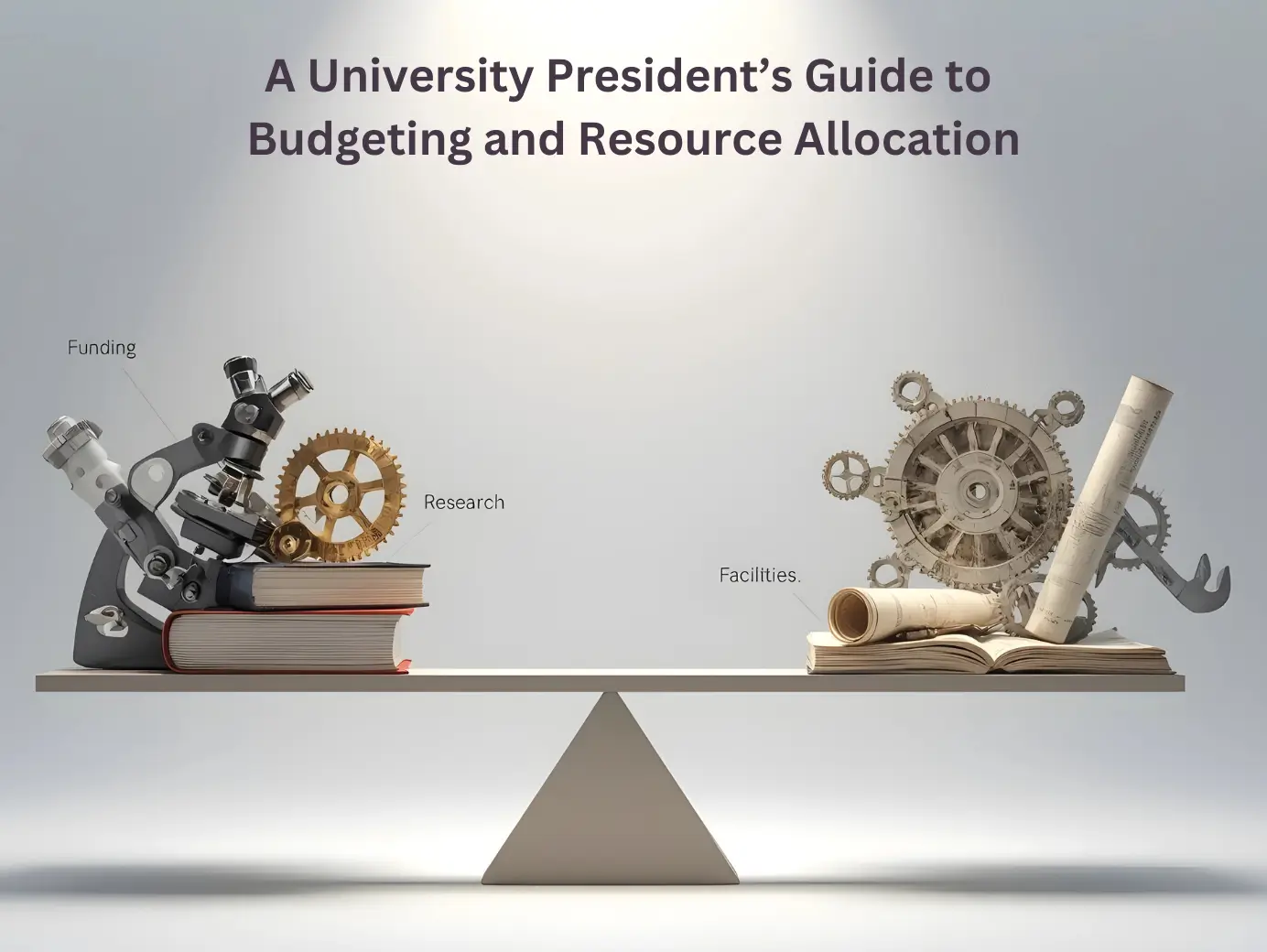
    A University President’s Basic Outline to Budgeting and Resource Allocation

    A. The Both/Ands of Resource Allocation

    • Brake and accelerate simultaneously
    • Rely on both the ethical and legal imperatives of a fiduciary
    • Set expectations for hard and necessary tradeoffs

    University leaders rarely face clear-cut choices in the budget and resource allocation process. More commonly, they navigate “both/and” realities that demand speed and restraint, innovation and tradition, in investments and curtailments. At every turn, the president’s fiduciary responsibility requires balancing legal and ethical imperatives with institutional mission. Hard tradeoffs are unavoidable: expanding a high-demand program may require downsizing another, or investing in technology may delay facility upgrades.

    Modeling candor and courage, leaders must set the expectation that budget and allocation conversations will be difficult but necessary. Leaders must ensure that resource allocations are done in responsible, principled ways, preparing all the while for decisions that are not uniformly satisfactory to members of the community.

    B. The Three “Ends” of Resource Allocation— Mission-Alignment, Long-term Institutional Sustainability, and Student Success

    • Financial stewardship responsibilities
      • Reinforce institutional viability over departmental preferences
      • Align strategic priorities with resource realities
      • Take some calculated risks with contingency plans ready to go
    • Mission alignment, institutional sustainability, and student success as the guiding lights
      • Make decisions through the institutional purpose lens
      • Put and keep students first
      • Plan for the long term not merely the short term

    Every budget decision should advance at least one of three ends: mission alignment, long-term sustainability, or student success. Financial stewardship means looking beyond immediate pressures to ensure that today’s choices bode well for future sustainability. This involves prioritizing innovations with mission fidelity and maintaining traditions with a positive student impact.

    The changes adopted and the history preserved should jointly support student learning and achievement. By using these three ends as touchstones, leaders reinforce clarity in decision-making, allow for measured risk-taking, and demonstrate that difficult tradeoffs ultimately serve the institution’s higher purpose and enduring excellence.

    C. The Principles and Processes of Budgeting and Resource Allocation

    • Performance-based allocation principles
      •  Make data-driven decisions
      • Reward individuals and departments that are constructive
      • Decide which financially unstable programs will be sustained as “loss leaders” and which will be paused or sunsetted
    • Transparent decision-making processes
      • Provide criteria and rationale early and clearly
      • Engage constituents with appropriate experience and expertise
      • Share and document final decisions

    The process by which budget and resource decisions are made is as important as the outcomes themselves. A student-centric performance-based allocation framework, grounded in data and mission alignment, ensures that resources support programs with strong recruitment, retention, and reputational outcomes. Such a framework still allows for measured support to struggling areas that are mission essential.

    Transparency throughout the process is critical. Leaders should clearly communicate criteria and rationales broadly while working closely with stakeholders who are equipped to offer input and recommendations. Leaders at all levels can and should be cooperative without ceding any decision-making authority that comes with their particular position. Describing and documenting the process and the outcomes build trust, reduce speculation, and promote accountability.

    D. The Philosophies That Undergird Resource Allocation

    • “Fair” resource allocation
      • Define what “fair” means in this context
      • Be clear: in resource allocation, like in DEIJ, “fair” is not the same as “equal.”
    • Consider some quantitative models for “fair” distribution
      • The legal philosophy of fiduciary duty
      • Underscore duties of care, loyalty, and obedience
      • Act in the institution’s overall best interests rather than the interests of a few departments

    The budget and resource allocation process is shaped by two essential philosophies: fairness and fiduciary duty. In budgeting, like in DEIJ, fair does not necessarily mean equal. “Fair,” from a budget perspective routinely means allocating according to mission priorities and the potential for return. It does not mean making across-the-board cuts or equal investments. Mathematical models of various sorts can augment the DEIJ-like principle to ensure that some quantitative measure help to distribute resources in reasonable and rational ways.

     Equally vital is the fiduciary framework: the duty of care, loyalty, and obedience. In assuming these required duties, presidents act in the institution’s best interests, not those of individual departments or vocal stakeholders. Accordingly, presidents must put institutional sustainability over Department A’s and B’s aspirations even though faculty and staff in A and B may be disappointed that their departmental interests are secondary to the interests of the “whole.”

    Together, these models and philosophies keep leaders grounded in principle while navigating the competing pressures of limited resources, diverse needs, and institutional responsibility.

    E. Individual Interests vs. Institutional Wellbeing in Resource Allocation

    • Faculty and staff interests vs. institutional wellbeing
      • Build trust through honest communication
      • Manage to disappointment while maintaining engagement
      • Acknowledge the sacrifice needed at times
    • Protection of student programs and services is paramount
      • Set and achieve ambitious retention and graduation rates for
      • Allocate resources with the above in mind
      • Focus more on long-term sustainability than short-term wins

    When budgets tighten, presidents encounter heightened tensions between faculty, staff, and students, each with legitimate but competing interests. No employee wants their retirement benefits to be cut or their health insurance premiums to increase. But if the institution is running a deficit budget, cutting these expenses is typically more defensible than cutting student programs and services in recruitment, retention, and graduation. Particularly when the least worst choice needs to be made, honest and consistent communication helps constituents see that the tradeoff was not between “good” and “bad” but between “bad” and “worse.” 

    At times, faculty, staff, and administrators may need to make very personal sacrifices to keep the university positioned for the long term. When this occurs, it is constructive and healthy for faculty and staff to air their disappointments and angst internally with their supervisor and the university leaders. But “airing dirty laundry” externally (in the press and with the public) can easily backfire. Drumming up negative media coverage and spotlighting disappointing decisions can quickly and negatively affect enrollment. If enrollment goes down, deeper cuts and further reductions to the things employees justifiably value are likely to occur.

    F. The Communication and Engagement during Resource Allocation

    • Proactive and transparent approach
      • Expose the context in which the decisions are embedded
      • Communicate early and often about potential changes
      • Solicit feedback before decision is made and provide updates once it is finalized
    • A constructive place for conflict
      • Recognize not hide conflict
      • Create space for respectful disagreement
      • Establish and enforce “civil” engagement rules

    When resource cuts or reallocations are on the horizon, silence breeds distrust. If faculty, staff, or students first hear about reductions through the rumor mill, a news article, or a broadcast email, leaders lose credibility. To maintain credibility, presidents should unearth the financial context/position early, pinpoint the challenges, outline the financial pain points behind them, and invite structured feedback from those with expertise and experience before decisions are finalized. Not every opinion will shape the outcome, but stakeholders should feel heard.

     Conflict—over benefit cuts, program consolidations, or tuition adjustments—will emerge. To manage it productively, leaders might create some type of discussion opportunity complete with a set of ground rules. A neutral facilitator could be invited to lead the discussion and enforce the ground rules, acknowledging all the while the emotional impact of the situation. The goal of such forums is not to reach consensus but to demonstrate respect and engender trust when decisions are hard and outcomes are painful.

    G. Shared Governance and Data Utilization Should be Parts of the Resource Allocation Process

    Proactive and transparent approach

    • Develop a Budget or Resource Allocation Process that leverages Shared Governance
      • Clear governance structures and decision authority
      • Advisory committees vs. decision-making bodies
      • Balancing consultation with timely action
    • Evidence-based resource allocation models
      • Activity-based costing and performance metrics
      • Regular budget reviews and adjustments
      • Hybrid models combining traditional and performance-based funding

    Shared governance works best when everyone knows who advises, who recommends, and who decides. Presidents should invite faculty, staff, and student leaders into budget conversations but be transparent about the boundaries of advisory versus decision-making authority. Without this clarity, consultation can slide into gridlock and participants should be informed that this is not a direct democracy where everyone gets a vote that is tallied at the end. It is common, even best practice, for the president to establish a university budget advisory council that reviews data and provides input. At some universities, this committee also makes recommendations regarding allocations. Almost always, however, the final budget and allocation decisions are made by the president and approved by the full board. Making these roles explicit gives stakeholders a voice without creating false expectations of unanimity or consensus.

    Data-driven budgeting strengthens shared governance by grounding conversations in facts rather than perceptions. A president may decide to use cost-center-based budgeting, student-centric performance metrics, and/or trend analyses to shape decisions about difficult tradeoffs. Presidents can reinforce accountability by scheduling regular budget reviews that adjust for enrollment, revenue, and expense shifts. Hybrid models—blending traditional allocations with performance-based funding—help institutions adapt to changing realities without abandoning mission-centered commitments. When evidence frames the discussion, resource allocation becomes less about politics or personalities and more about aligning dollars with impact. This disciplined approach models fiscal responsibility while preserving stakeholder trust in institutional decision-making.

    H. Conclusion: Leadership Through Complexity

    • The courage required for transparent leadership
    • Building institutional resilience through fair but difficult decisions
    • The invitation for ongoing dialogue and understanding

    Resource allocation is one of the president’s most complex and consequential responsibilities. It requires courage to make transparent choices, resilience to withstand criticism, and wisdom to align finite resources with infinite needs. By balancing fairness with fiduciary duty, presidents model principled leadership that reinforces both mission and builds community. Stressful tradeoffs are inevitable, so addressing tensions head on rather than glossing over helps those with different perspectives get a sense for what others are thinking and feeling.

    Phase 5 of the University Presidency—The Handoff Phase

    In Part 1 of this series, I provided a short overview of each of the five phases that mark a university presidency. Part 2 offered a deeper dive into the transition phases that include the discovery and honeymoon phases. Part 3 went into considerable detail about the accountability and conflict phases. Together, those stages build toward the inevitable final act, which is Phase 5. This is when the president prepares to step aside and, ideally, works to ensure a successful transition.

    Phase 5. The Handoff Phase — A sitting duck, an accelerator, or a mix of both

    Timing

    This phase begins the moment you announce your departure—whether by retirement, a planned transition, or a new role elsewhere. It usually continues until your successor is in place.

    Description

    Once your exit is public, organizational dynamics shift dramatically. Some constituents begin looking right past you, hoping you’ll shelve unpopular decisions for later, laying them at the feet of the incoming administration. Others, who believe they have your ear, may seize the moment to push their priorities forward before you leave.

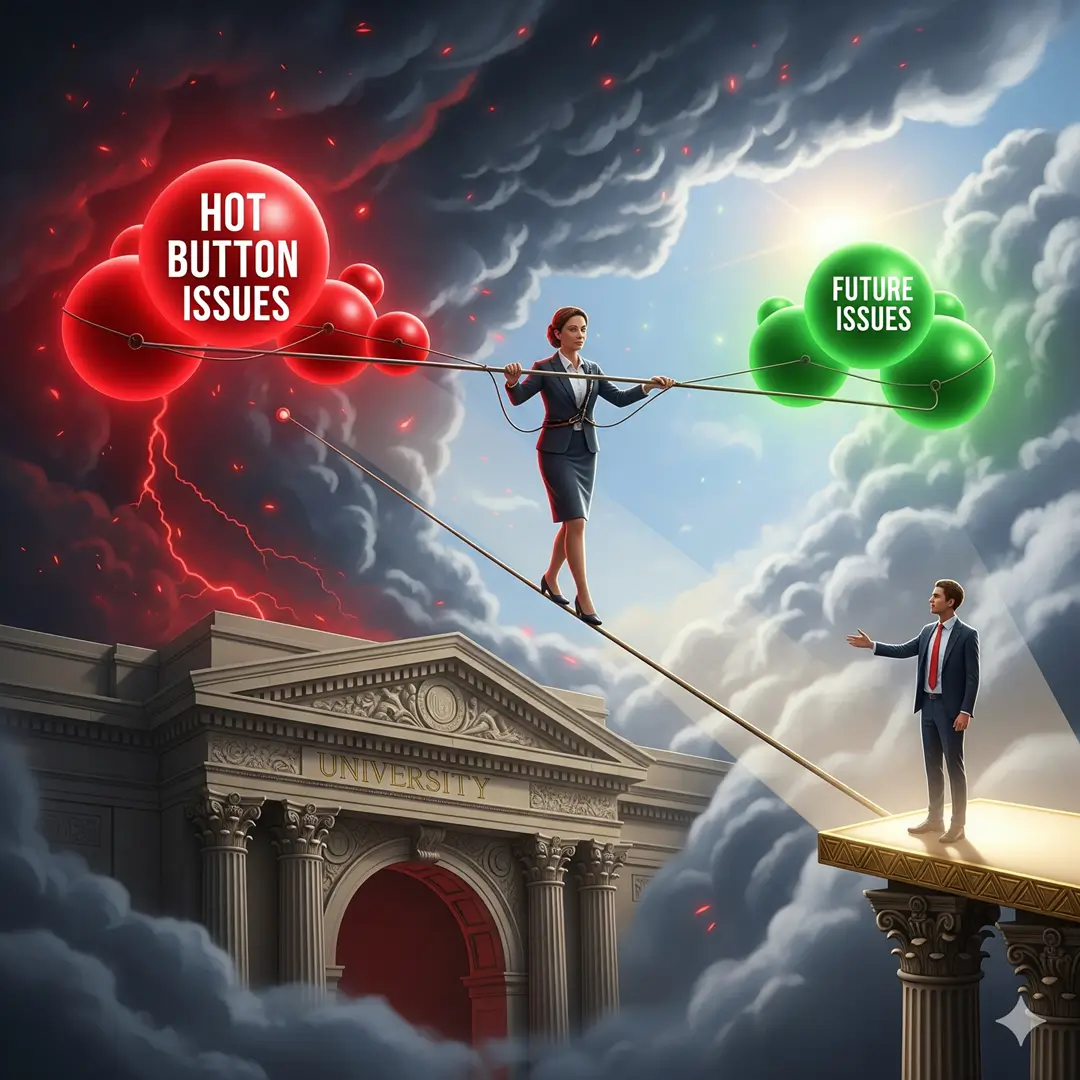
    Your challenges are analogous to using a balance pole to walk a tightrope. On one side of the pole: hot-button issues that you ought to handle yourself rather than hand off. On the other: initiatives best left for your successor to own and shape. Your judgment in balancing these issues plays a large part in how you land the dismount.

    Common Activities

    Outgoing leaders who are both future-focused and institutionally loyal use this phase to:

    • Finalize projects that are budget-savvy and benefit the institution
    • Resolve outstanding issues that could otherwise burden a successor
    • Transfer knowledge, process know-how, and “relationship nuggets” to the new leader
    • Fast-track operational moves that are necessary but unpopular (e.g., budget cuts or personnel changes)
    • Defer major long-term strategic shifts that leave space for the new leader to put their stamp on the institution

    Real-Life Example

    One outgoing president spent their final year consolidating six academic schools into three interdisciplinary ones. In general, this move eliminated three deanships, tamped down criticism of “senior leadership bloat,” and redirected resources toward new teaching opportunities that were coveted but costly. More specifically, this restructuring created a framework upon which the incoming president could build—a structure that encouraged interdisciplinary learning and team teaching. Both were well received by students and faculty alike.

    Closing Thoughts

    Not every presidency unfolds in five neat phases. Some leaders skip stages entirely, while others cycle through them in a different order—or revisit certain phases more than once. On paper, these phases look tidy; in lived experience, they are often messy, nonlinear, and unpredictable.

    What is consistent, however, is that almost all presidencies bring seasons of discovery, connection, pressure, and conflict—though not always in that order, and rarely with equal intensity. To endure even a handful of years in this role, presidents must embrace both the highs and the lows: generously accept praise, listen carefully to criticism, and make the tough calls that leave some cheering and others fuming.

    Longevity, contrary to some schools of thought, isn’t always the measure of success. Some universities thrive on steady, decades-long leadership. Others need a disruptor—someone to reset systems, structures, and policies for the next leader to refine and strengthen.

    In the end, what matters most is not how long you sat in the chair, but whether you used the phases you had to move the institution forward in ways that truly mattered.

    Frequently Asked Questions

    What should a university president focus on after announcing their departure?

    One of the most pressing areas of focus is communication. The departing president should communicate with the trustees and the senior team about the “transition communication plan.” A clear and well-sequenced set of communiquĂ©s (for internal and external stakeholders) goes a long way in quelling rumors and decreasing anxiety about the unknown.

    As the news is methodically shared, the outgoing leader should prioritize finalizing essential projects and resolving lingering issues. It’s smart to limit new long-term commitments that might encumber the successor. In the final weeks in office, some exiting presidents craft guidance documents or reflections to contextualize the current culture or key initiatives that are underway. Such documents are of benefit to an incoming president who is interested in maintaining continuity.

    How can an outgoing president set up their successor for success?

    In higher education, outgoing presidents rarely serve as formal mentors to their successors. A generous departing leader, however, makes themselves available to share information when asked by the incoming leader. This often means taking a “back seat”—providing institutional knowledge, historical context, or practical insights when the new president signals interest. The goal is not to shape the successor’s agenda but to clear pathways by answering questions candidly and ensuring no critical information is lost. Done well, this restraint respects the authority of the incoming president while still supporting institutional continuity.

    Which decisions should be left for the incoming president to make?

    Strategic, long-term decisions that shape the institution’s future should be deferred to the new leader. Major personnel restructurings or permanent cabinet-level hires should also be avoided unless absolutely necessary. If a senior position opens, the sitting president can appoint an interim instead of making a lasting hire. Large-scale projects—such as launching a new degree program, committing to a capital campaign, or establishing major partnerships—that lock the institution into a particular direction are best paused until the successor is on board. Ultimately, the incoming president deserves the space to set the vision, tone, and agenda. Unless an urgent issue requires immediate action, transformative decisions belong to their tenure, not the outgoing president’s final months.

    Why do organizational dynamics shift once a president announces retirement or transition?

    The announcement of a presidential departure triggers significant uncertainty—among those disappointed by the news, those pleased by it, and those somewhere in between.
    Senior administrators, in particular, may experience anxiety around job security. This in turn, may prompt some internal jockeying for power and influence. At the same time, faculty and staff may be weighing how quickly or slowing to bring issues forward. Those who believe the incoming leader will lean more strongly in the direction they want to move will likely stall bringing forward issues to the existing administration. Meanwhile, others who have aligned with the outgoing president, may push agendas forward immediately. This group hopes the current leader will accelerate making a decision in their favor.

    How can outgoing leaders ensure continuity during a leadership handoff?

    Departing presidents should work with the board to map out a thoughtful transition plan. Key stakeholders can be invited into its design and implementation to foster trust and transparency. The outgoing leader should also make sure their assistant or chief of staff organizes and communicates where critical documents—such as cabinet retreat notes, board assessments, enrollment and financial modeling, donor briefings, and annotated climate-survey results—are stored and how they can be accessed.

    Continuity also depends on relationships. While outgoing presidents don’t typically make direct introductions, they can provide confidential context about key external partners—major donors, community leaders, and government officials—including where those relationships stand and what sensitivities may exist. Additionally, the way an outgoing president speaks about those who remain and those coming in can build confidence and assurance through the transition.

    What makes a transition successful?

    Successful transitions occur when two key conditions are met: the departing president shows grace in handing off the leadership torch and the incoming president shows respect, both privately and publicly, for prior efforts and achievements.


    Phases 3 & 4 of a University Presidency: The Center Stage and Tough Decisions Phases

    In the first part of this series, I described the president-elect and new president phases of the presidential journey. These are the opening acts, with leaders waiting in the wings before stepping onstage to establish their presence. In this part of the series, I turn to the next two phases. Here, the leader takes center stage, where the spotlight shines brightly. At times, that light highlights the positive results the president is helping to deliver. At other times, it casts a harsh glare on decisions that are difficult to make and even harder to accept.

    Phase 3. The President — Settling in and delivering on aims and intentions

    Timing

    This phase generally begins after your first full academic year (or thereabouts) and can last several years. It’s the stretch when the novelty—and perhaps a bit of the goodwill—wears off. As expected, you now need to deliver measurable results across myriad areas that are not always in sync with each other.

    Description

    The prefix “new” is gone. You are now the president. On some campuses you alone are seen as the administration. By either name, you hold both the authority and the accountability that come with the title.

    In this phase, faculty, staff, students, alumni, and the board expect you to follow through on intentions, advance strategic priorities, and solve problems—some of which may have lingered for decades. The broader community looks to you to improve “town-gown” relationships. Business leaders expect you to position the university as an economic driver and, perhaps, a hub for cultural activity.

    This is the point where you routinely translate your leadership philosophy to the concrete practices associated with shared governance, enrollment management, revenue diversification, the student learning experience, community partnerships, and more.

    Common Activities

    During this phase, you typically:

    • Design or refine and implement the strategic plan.
    • Build multi-year budget scenarios.
    • Negotiate contracts that generate external funding or internal savings (leases, summer conferences, outsourcing services).
    • Restructure or expand shared governance, ensuring that faculty, staff, and students all have a formal seat at decision-making tables.
    • Work with your cabinet and other stakeholders to make structural or personnel changes (combining academic departments, adding or eliminating satellite campuses, rearranging vice-presidential portfolios).

    Real-Life Example

    In 2020, eight presidents I know took office just as the pandemic upended enrollment patterns. Three of these leaders inherited institutions that had long enjoyed stable or rising net tuition revenue. Their predecessors had never needed multi-year budget scenarios; single-year planning had always been sufficient.

    That changed overnight at each of these places. Fall 2020 enrollments dropped sharply due to COVID restrictions, and for the first time ever, the boards required their new presidents to produce three- or four-year budget projections. At each university, the task created significant strain among vice presidents and their teams, who were suddenly asked to identify enrollment and fundraising targets in a time of deep uncertainty.

    When the final enrollments fell short of budgeted projections, the three boards reacted differently. Two adopted a “wait and see” approach, allowing their presidents time to adapt to the changing environment and the missed target. The third board asked the new president to immediately reduce expenses to align with the lower revenues. The outcomes diverged: the presidents who were given the time to plan for strategic reductions were relatively well received. The one who was forced to make immediate cuts within her first six months got off to a rocky start, and the path was bumpy throughout her tenure.

    Phase 4. The “Damn” President — Making hard, necessary calls that are not popular

    Timing

    This phase can surface at any point after the honeymoon period. Ideally, a president spends a meaningful stretch of time in the more routine “president” phase before this one begins. Yet, with the internal and external headwinds buffeting universities nationwide, this phase often arrives far too soon for many of today’s leaders. It emerges when the president finds themself at the helm as a crisis unfolds or an unexpected change takes precedence. In these moments, the leader is thrust into an even brighter spotlight and expected to make difficult decisions that inevitably unsettle some portion of the broader community. Depending on the scope of the challenges, this phase may last months—or even years.

    Description

    This is the phase that tests your resolve. The early goodwill has faded. The easy wins are behind you. Now you face decisions that will define your presidency—and in some cases, your legacy.

    Common Activities

    In this phase, you may be called upon to:

    • Address structural deficits or market shifts.
    • Close under-enrolled programs or cut faculty lines.
    • Realign administrative functions or reallocate resources to programs and services that have a high return on investment.
    • Navigate high-stakes legal cases where “both sides” speak loudly and often.

    Every move is scrutinized. Even the most well-intentioned decisions may spark anger, protest, or mistrust.

    Real-Life Example

    I recall one leader who inherited a campus with a lopsided approach to shared governance. Faculty had both voice and vote at key decision-making tables—including the governing board itself—while staff and students had no formal role at all.

    The board asked the new president to re-examine the governance model to make it more inclusive. In response, he created a representative advisory task force including board members, administrators, faculty, staff, and students. He also engaged two sets of consultants: one specializing in shared governance and another in higher-education law. Together, they gathered campus input, reviewed industry best practices, and drafted recommendations for the president and board.

    All but one of the recommendations were endorsed unanimously by the task force. The consultants advised shifting the “faculty trustee” to a “faculty advisor” role, removing the vote but preserving voice, and creating the same advisory seats for staff and students. The faculty on the task force balked at this recommendation while others found it quite reasonable. The recommendation went forward to the board, which voted overwhelmingly, to enact the change.

    For the president, however, it marked the start of a “damned if you do, damned if you don’t” era. Faculty felt sidelined, even as staff and students celebrated inclusion. The decision defined this leader’s tenure, which lasted just four years.

    Frequently Asked Questions

    What happens after the “honeymoon phase” of a university presidency ends?

    Expectations shift from promise to proof. The “new” label drops, and presidents are expected to deliver measurable results across key operational and strategic areas including these: budget, enrollment, fundraising, revenue diversification, governance, and community partnerships.

    Because the “rubber meets the road” in this phase, the roles assumed by key players—such as the board, the president, the provost, and the faculty—are clarified and differentiated in practice, not just in theory. If the president needs to make tweaks to role responsibilities, this can accelerate the beginning of the “damn president” phase (discussed here in this FAQ).

    How do presidents manage competing demands from faculty, staff, students, and boards?

    Having a broadly understood and embraced definition of shared governance is the first step to managing competing demands. Sometimes, such a definition already exists; other times it must be co-created. One of the best and boldest examples I have seen is the definition jointly crafted at California Lutheran University by faculty, staff, students, administrators, and board members:

    Shared governance is a values-based system that facilitates and clarifies the complementary responsibilities that constituents assume in identifying, aligning, and implementing routine processes and strategic priorities. At Cal Lutheran, this system is designed to advance the university’s mission and promote a common good that prioritizes student learning and the student experience. This definition is accompanied by a decision-making matrix co-created by a broad swath of the university community.

    Why is multi-year budget planning so important for higher education leaders?

    Single-year budgeting—especially at tuition-driven institutions with small endowments and limited discretionary funds—has become a high-risk approach to financial management. Volatile enrollments, rising personnel and benefit costs, the temporary boost from the Higher Education Emergency Relief Fund (HEERF), and frequent policy shifts with unfunded mandates all point to the need for multi-year, scenario-based plans.
    These plans should bring many managers to the table and require them to record revenue projections and expenses for at least three years. Granted, projections will change over time. But the exercise of populating expense and revenue lines itself is illuminating. Both those who enter the numbers and those who interpret them will better understand the university’s current and future financial positions.

    What structural changes might a president consider in this phase?

    Common moves include: reorganizing academic units, consolidating or redefining administrative portfolios, adding entry- and mid-level student support positions (such as advisors), reconfiguring incentive programs to reward performance, and bolstering accountability systems. Leaders should also strengthen town–gown relationships that position the university as a regional driver of workforce development.

    How do external crises, like a pandemic, affect a president’s ability to lead?

    Crises compress timelines and force rapid decision-making in an industry that has long valued process, inclusivity, and deliberation. In early 2020, universities across the country pivoted almost overnight to online instruction. In many cases, these decisions were made and communicated before faculty could be consulted—a pace wholly uncharacteristic of higher education. Not surprisingly, both the processes and outcomes were poorly received at a good number of those institutions.

    The following year brought additional pandemic-related challenges, most notably significant enrollment declines. Presidents were then tasked with aligning expenses to reduced tuition revenue, which often required deep budget cuts. 

    Leading—and living through—major cuts is difficult for everyone.

    Why do some university presidents face backlash and others don’t when making tough decisions?

    A campus’s reaction to presidential decision-making depends on several variables. Were the decisions shaped by an inclusive, transparent, and data-driven process? Did the president have the community’s trust beforehand? Did stakeholders believe the decision was necessary? How and when was it communicated, and were the steps leading to it clearly explained? Did it affect jobs, wages, job security, workplace norms, or other deeply valued aspects of campus life? What was the prevailing campus climate—goodwill and satisfaction, or despair and change fatigue—at the time?

    Recent examples show presidents drawing both criticism and praise for similar decisions about campus protests and governance. These episodes highlight how the same action can be welcomed on one campus yet resisted on another, depending on context, expectations, and climate.

    How does shared governance complicate decision-making in higher education?

    Shared governance is built on values like trust, transparency, timeliness, collaboration, communication, and equity. It clarifies the complementary responsibilities—such as providing input, making recommendations, granting approval, or exercising veto authority—that different groups assume as part of the decision-making process. When each group fulfills its defined role, the process can be inclusive and mission-centered.

    Complications arise when urgency collides with process. Faculty, staff, students, and boards may all value shared governance, but they move at different speeds and view issues through different lenses. A decision that feels time-sensitive to the administration may feel rushed to faculty, while a carefully deliberated faculty proposal may seem too slow to trustees. These mismatched expectations can create friction, even when all parties are acting in good faith.

    In practice, presidents often navigate competing timelines, overlapping expectations, and contested authority. Clear scopes and transparent consultation help, but they cannot eliminate conflict. By design, shared governance slows decision-making in the name of inclusivity—which strengthens outcomes but complicates leadership, especially when crises demand speed.

    What kinds of unpopular decisions might a president be forced to make?

    The list is long. Examples include: closing low-demand or costly programs, reducing positions, reallocating funds to higher-impact areas, increasing tuition, modifying budget models, enforcing unpopular federal or state policies, implementing furloughs or benefit reductions, or terminating a popular employee. Recent, widely covered program eliminations underscore the intensity of campus and public reaction to such calls.

    How can presidents balance long-term institutional health with short-term resistance? 

    Presidents must distinguish between opposition rooted in discomfort with change and opposition grounded in legitimate concerns. Balancing both requires pairing clear, evidence-based rationales with visible empathy for those affected. Small wins and incremental steps can help demonstrate progress while keeping the long-term vision intact. Ultimately, the president’s responsibility is to protect the university’s future—even if that means absorbing short-term criticism in service of institutional sustainability.

    What does it mean for a president to be in a “damned if you do, damned if you don’t” situation?

    These are moments when any decision will draw both praise and criticism. No matter what choice is made, one or more groups will be deeply upset. Consider the president who decides to sunset and “teach out” a struggling music performance major. The board, CFO, and others focused on fiscal pressures may support the move as a way to stem a resource drain. At the same time, it is likely to provoke outrage from faculty in the program, alumni who cherished their experience, and students currently enrolled in the major.

    In such situations, backlash is unavoidable. The true measure of leadership lies not in universal approval but in whether the decision is made transparently and ethically in the best interest of the overall organization.

    Phases 1 & 2 of a University Presidency: The Transition Phases

    Phase 1. President-Elect—“I Don’t know you; You don’t know me”

    Timing

    This phase starts the moment the university announces its new president and ends on the first day the new president officially takes the seat.

    Description

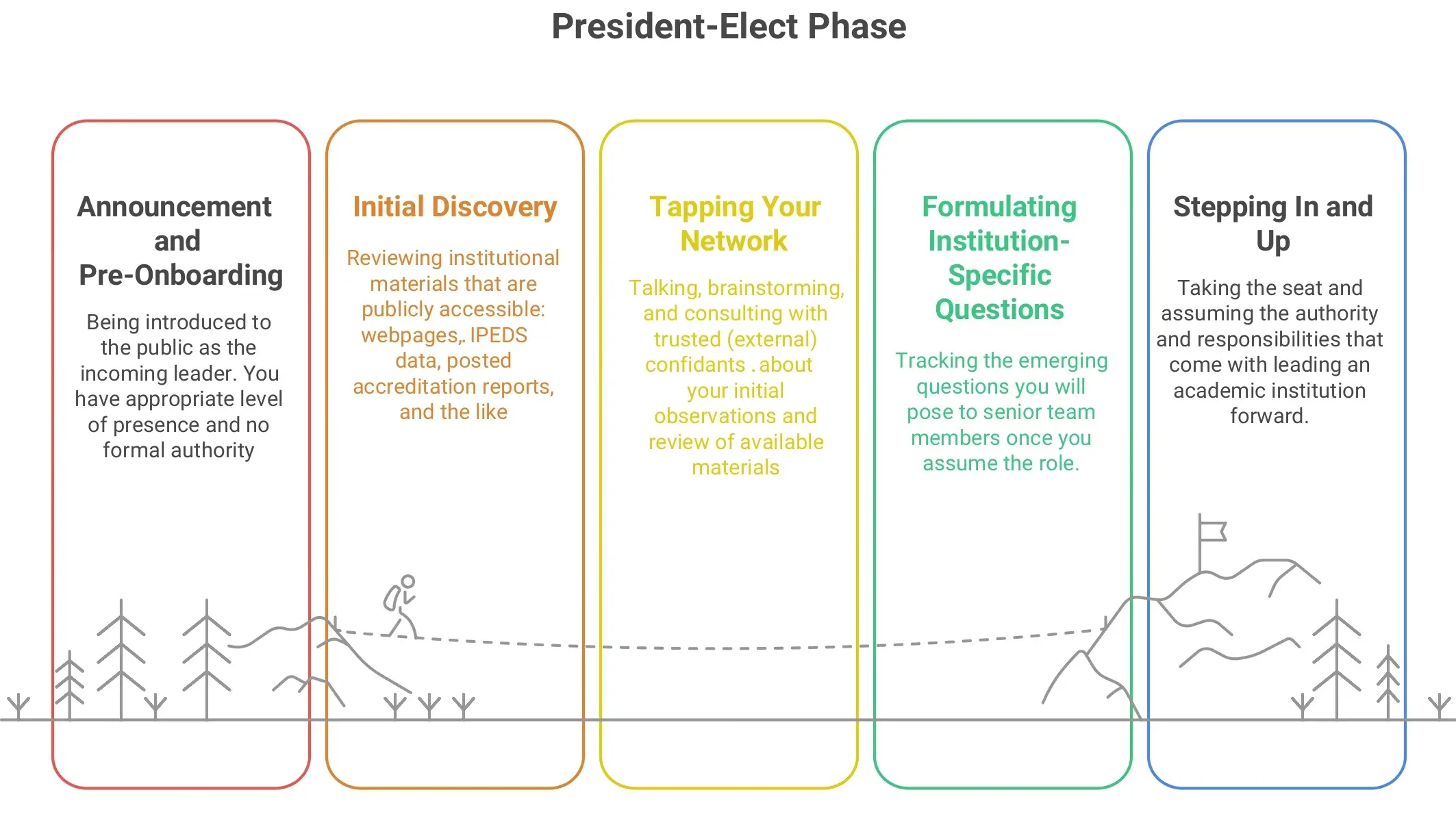
    This is the behind-the-scenes, early discovery stage. Without formal authority, you make no official decisions and respect the fact that a university has one president at a time—and it’s not yet you. Conversations you have with soon-to-be colleagues should be cleared by the sitting president and, perhaps, the board chair. No meetings should be arranged behind the current president’s back.

    Common Activities

    As part of the initial discovery phase, you review publicly available materials: websites, social media platforms, alumni magazines, recent and past “news” posts, and the like. Additionally, you are apt to request copies of budget reports and forecasts, accreditation reports, enrollment strategies, fundraising metrics, bond or debt summaries, collective bargaining agreements, climate surveys, and similar.

    If you are fortunate enough to have a Presidential Transition Partner, they can assist in reading, reviewing, and annotating these documents.

    Keep a list of emerging questions and issues that will guide conversations with the senior team once you take the helm. These questions and their answers should help reveal where the institution is strongest and where it is most vulnerable.

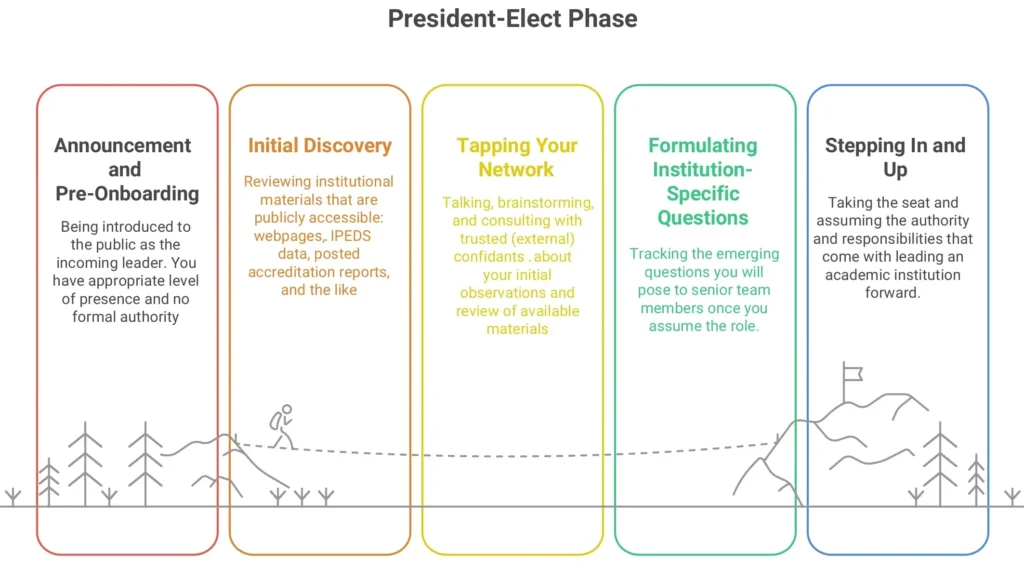
    President-Elect Phase

    Real-Life Example

    In one case, a president-elect inherited an institution under heightened accreditation scrutiny. With an external peer team scheduled to visit campus within the first 60 days of her tenure, the president-elect read all recent internal and external accreditation reports, familiarized herself with the accreditation standards of that particular commission, and began mapping out possible areas to highlight during the imminent campus visit.

    Phase 2. The New President — “Getting to know you, getting to know me.”

    Timing

    This phase typically overlaps with the first 12–18 months in the role. But in some cases, the incumbent is still viewed as the “new” president for two full years or so.

    Description

    Often, this is the sweetest phase of all—some even call it the “honeymoon period.” It is generally marked by goodwill and curiosity: you are giving internal and external constituents the benefit of the doubt, and they are extending the same generosity to you.

    Common Activities

    Within your first ninety days, you will likely embark on a learning and listening tour coordinated by your Onboarding Staff and Presidential Transition Partner, if available. This tour allows you to get out and about, meeting a broad swath of campus and community constituents.

    You visit faculty and staff in their own spaces and places (including remote ones), giving them a chance to tell you a story or ask a question. In turn, this allows you to respond with emerging observations and early answers that communicate your interest and awareness—without prematurely committing you or the institution to actions you’re not yet ready to confirm.

    You will also attend receptions, lunches, and socials with internal community members, donors, alumni, parents, and community VIPs. It’s wise to have a “knowledge escort” walk you around the room, making introductions and helping you connect the dots between established interests and potential impact.

    Most new presidents use the first 12–18 months to assess their direct reports. At universities where significant change is required, the president must have a team of senior colleagues willing and able to not only support but also lead the anticipated transformations.

    Real-Life Example

    During one presidency, I spearheaded a boutique fundraising campaign to create a “Possibility Fund.” This fund awarded small grants ($500–$2,500) to faculty, staff, and students who proposed high-impact, low-cost improvements to university life. It was a meaningful way to reward creative ideas and log in a few early wins.

    Frequently Asked Questions

    What should a university president-elect focus on before officially taking office?

    The pre-start period is about listening and learning, often from afar. This is not the time to make any decisions. A president-elect should focus on understanding content and context. This means you will review available documents, websites, alumni magazines, news stories, and the like. The goal is to build a foundation of awareness so you are not coming in cold.

    How does a president-elect balance curiosity with respect for the sitting president?

    It requires following the leader and taking your cues directly from the sitting president. Some departing presidents are ready to fold their successor into a few meetings here and there; others want their “replacement” to stay away until it’s their turn at the helm. You stay on the side until you are invited onto the stage, and you enter at the pace set by the director: the sitting president.

    What are the most important documents to review during the transition phase?

    Start with the strategic plan, accreditation reports, financial statements, enrollment scenarios, and board meeting minutes. You’ll also want to look at collective bargaining agreements, donor agreements, and campus climate surveys. These documents reveal the institution’s priorities, pressure points, and promises.

    Why is it critical for a president-elect and new president to keep a list of emerging questions?

    Writing down questions helps you track themes across conversations and documents. It shows stakeholders that you’re paying attention and provides a running list to revisit as you learn more. It also prevents premature commitments while keeping curiosity alive.

    Can a president-elect meet with faculty and staff before their official start date?

    Yes—if it’s done in coordination with the sitting president. Visiting people in their own spaces, including remote settings, gives them a chance to tell you their stories. In turn, you can share early impressions without overstepping. These early encounters build goodwill and ease your transition.

    What is typically expected of a university president in their first 90 days?

    The first 90 days are about presence and engagement, not sweeping changes. Trustees, faculty, and staff expect to see you listening carefully, showing up at key events, and reflecting back what you’ve heard. You’re setting a tone of commitment, respect, and readiness to lead.

    Why is the first year of a presidency often called the “honeymoon period”?

    Because the level of goodwill is usually higher in early stages than later ones. Most Constituents want to extend a warm welcome to the new leader and help them succeed. Most new presidents are given grace for their early missteps. But the honeymoon does not last forever. It’s wise to use this window to build trust, log a few visible wins, and create momentum before the harder decisions come.

    How can new presidents build trust with faculty, staff, and students?

    Trust is built through consistent presence, predictable follow-through, and genuine care for the human being. That means showing up at events, being transparent in communication, and closing the loop on commitments. Even small gestures—handwritten notes, quick replies, or walking across campus with someone—signal that you care.

    What role do receptions and community events play in early leadership?

    These gatherings are essential for relationship-building. Attending receptions, lunches, and community events shows stakeholders you value them. Having a “knowledge escort” with you can help connect the dots between names, issues, and opportunities. Each introduction is a chance to make a connection on a shared need or interest.

    How should a new president evaluate their senior leadership team?

    Most presidents use the first 12–18 months to assess their cabinet. At institutions facing major change, it’s critical to have senior leaders who not only support your agenda but also actively lead transformation. Look for alignment with institutional values, willingness to collaborate, capacity to execute, and courage to speak truth to power.

    The Five Phases of a University Presidency: An Overview of Each Phase

    A few days ago, I started my third university presidency, and a colleague asked me how it felt to be the “new” president again. The question got me thinking about the arc of this role, and I quickly found myself conceptualizing the five distinct phases that many university presidents encounter.

    After 40 years in higher education, I’ve seen these phases play out in many presidencies, including in my own. The five phases are marked by common and general characteristics, but the actual lived experiences that each leader navigates within these phases are anything but.

    The Five Phases of a University Presidency

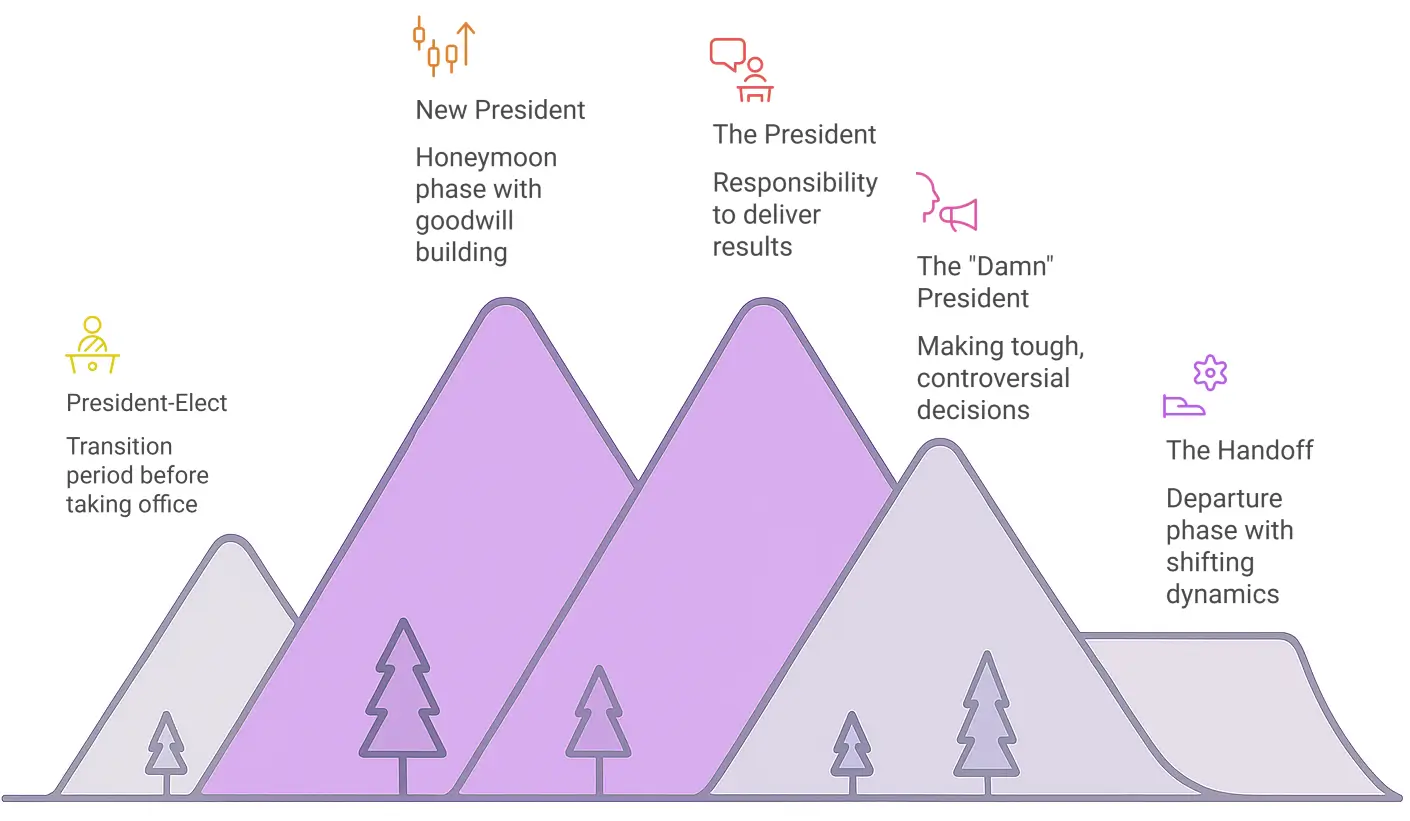
    From what I have observed and experienced, the five phases of a university presidency include the following:

    1. The President-Elect Phase—I don’t know you; you don’t know me
    2. The New President Phase—the honeymoon period, where I am getting to know you and you are getting to know me
    3. The President Phase—settling in and delivering results
    4. The “Damn” President Phase—making the hard calls
    5. The Handoff Phase—leaving the institution

    You might cycle through some phases more than once, or find yourself thrust into a later stage faster than you’d like, but most presidents do find themselves going through all or most of these phases during their tenure.

    Each carries its own energy, challenges, and opportunities. Some phases you’ll love—others will test every ounce of resolve you have. But understanding these phases yourself and making them explicit to members of the community is a healthy way to think about, talk about, and live into the role. 

    Phase 1: President-Elect—I Don’t Know You; You Don’t Know Me

    This behind-the-scenes phase starts the moment your appointment is announced and ends when you officially take the helm. You’re operating without formal authority, which means you make no official decisions and respect the fact that a university has one president at a time—and it’s not yet you.

    Your days are filled with discovery work: reviewing websites, budget reports, accreditation documents, enrollment data, anything that helps you understand what you’re inheriting. I always tell new presidents to keep a running list of emerging questions—these will guide your early conversations with your senior team.

    In a situation I know well, the president-elect inherited an institution under accreditation scrutiny, with a peer review team scheduled for a “special visit” within her first sixty days. To ready herself for that high-stakes visit, she spent her transition period reading the former accreditation reports, familiarizing herself with commission standards, and mapping out areas to highlight during that crucial campus visit. That preparation aided her in leading the campus through a stressful interim review.

    Phase 2: New President—Getting to Know You, Getting to Know Me

    This is often the sweetest phase of all—what many call the “honeymoon period.” Typically spanning your first 12–18 months, this phase is marked by mutual goodwill and curiosity. You’re giving everyone the benefit of the doubt, and they’re extending the same generosity to you.

    You’ll spend these months on learning tours: meeting faculty and staff in their offices, attending donor receptions, and visiting with community leaders. It’s your chance to offer “early observation” and “a sense of what you are experiencing” without committing yourself or the institution to anything prematurely.

    During one presidency, I launched what I called a “Possibility Fund” in this phase. It was a boutique fundraising campaign where donors contributed money that I could then “give” to faculty and staff via a grant program. Faculty and staff submitted short proposals for a high-impact, low-cost improvement that they were willing to implement on campus. I was then able to award small grants ($500-$2,500) to those with the most viable ideas. It was a great way to build community and morale early in that presidency.

    Phase 3: The President—Settling In and Delivering

    The “new” label drops off after your first full academic year or so, and now you’re simply “the president”—or on some campuses, “the administration.” This phase can last several years as you face pressure to deliver on the intentions you outlined during your early tenure.

    In this phase, you design strategic plans, build multi-year budgets, negotiate bargaining agreements, and make the structural changes your institution needs. You’re translating your leadership philosophy to the day-to-day practices associated with shared governance, enrollment management, financial sustainability, and community partnerships.

    In reflecting on this stage, I recall conversations I had with three presidents who took office right as the pandemic hit in 2020. Each of their boards suddenly demanded multi-year budget scenarios—something unprecedented for these stable institutions. Two boards gave their presidents time to navigate the uncertainty; one pushed for immediate cuts. The outcomes were not at all surprising. The presidents given breathing room found their footing and built strong relationships with their teams. The third got off to a rocky start that defined much of her tenure.

    Phase 4: The ‘Damn’ President—Making the Hard Calls

    This phase tests your resolve. The early goodwill has faded, the easy wins are behind you, and now you’re making decisions that will define your presidency—and sometimes your legacy. Depending on your institution’s challenges, this phase can emerge quickly or arrive after years of smoother sailing.

    This is a phase where you would find yourself closing programs, cutting positions, realigning departments, or dealing with high-stakes situations that divide your campus. Every decision gets scrutinized, and even well-intentioned moves can spark protests or public criticism.

    I know one president who inherited a campus where faculty had voting rights on the governing board, but staff and students had no formal voice in major decisions. After a year-long shared governance review involving task forces and consultants, the board adopted recommendations to give faculty, staff, and students advisory roles—voice but no vote. Many faculty felt demoted; but a number of staff celebrated a change that they saw as overdue. That decision marked the beginning of a “damned if you do, damned if you don’t” phase that lasted the rest of that president’s four-year tenure.

    Phase 5: The Handoff—Sitting Duck or Accelerator

    Once you announce your departure, organizational dynamics shift immediately. Some constituents start looking right past you, hoping you’ll defer decisions to your successor. Others rush to get their priorities addressed before you leave.

    The challenge is walking a tightrope: handling the hot-potato issues that shouldn’t be dumped on your successor while leaving room for the next president to put their own stamp on long-term initiatives. 

    One outgoing president I know spent his final year consolidating six academic schools into three interdisciplinary ones. The reconfiguration was meant to eliminate administrative bloat, create salary savings for his successor, and signal an academic shift toward interdisciplinary work. 

    What I’ve Learned About Presidential Phases

    Not every presidency unfolds in five tidy stages. Some leaders skip phases entirely; others revisit them multiple times. What’s predictable is that most presidencies bring seasons of discovery, connection, pressure, and conflict—though not always in that order, and not always with equal intensity.

    To last even a few years in this role, you must be willing to take the highs with the lows, generously accept praise, learn from criticism, and make the complex calls that have some cheering and others screaming. There are places where a long tenure is exactly what an institution needs, but longevity isn’t always the goal.

    Sometimes a university needs someone who’ll make changes—set up new systems and structures for someone else to strengthen. What matters most isn’t how long you sit in the chair, but whether you use whatever phases you encounter to move your institution forward in ways that matter.

    The Presidential Transition Partner: A New Member of a University President’s Onboarding Team

    The early days of a university presidency can feel like stepping onto a challenging new trail—filled with excitement and a bit of trepidation. To help new presidents navigate the trail successfully, most institutions have an official onboarding process coordinated by an ad hoc presidential transition team, sometimes called the “transition committee,” the  “transition advisory council”, or the “start-up guide.” While the titles and names of these teams and processes vary from institution to institution, their primary responsibility is the same: help pave a smooth and navigable changeover path.

    This article is written as a complement to the emerging literature on this topic. Given that the presidential transition team is the subject of much discussion, this piece focuses on the idea of adding a new, external member to the team. For now, I have dubbed this member the “Presidential Transition Partner,” describing them as both the president’s cartographer and sherpa. I see the PTP as helping chart the terrain, set a sustainable pace, and point out the critical signposts ahead. In some cases, the PTP may be charged with leading the internal team or serving as the direct liaison between that team and the incoming president.

    Who is the Presidential Transition Partner?

    The Presidential Transition Partner (PTP) is a recently retired academic president who works side-by-side with the incoming leader for approximately three months before and three months after their official start date. Selected by the president-elect and, depending on institutional culture, approved by the governing board, the PTP provides steady guidance through the early stretch of the presidency. The relationship the PTP has with the internal presidential transition team is usually defined by the president-elect in consultation with the chair of the governing board.

    The Unique Role of a Presidential Transition Partner: Not an Advisor or Coach

    Best for practices for onboarding today’s university presidents often highlight the value of an advisor or coach. While there is great value-add in engaging such professionals, the Presidential Transition Partner is not exactly an advisor or a coach. The PTP is a “doer,” a delivery person. They come to this unique post with substantial first-hand experience and expertise. With no learning curve or start-up time, they hit the ground running. From day one, they assume responsibility for helping the incoming president undertake foundational work that would otherwise be “left for later” or piled onto the new president’s already heavy load.

    Drawing on my experience both serving as and being supported by a Presidential Transition Partner (PTP), I’ve identified several core responsibilities that are essential to the role:

    Key Functions of a Presidential Transition Partner

    • Curating essential institutional information from the college website, posted policies, accreditation reports, and public datasets (e.g., federal scorecards).
    • Synthesizing high-level themes from these sources and walking the president-elect through areas of concern or opportunity.
    • Assessing the status of strategic planning and offering guidance on how to engage with current, emerging, or sunsetting plans.
    • Annotating budget materials, ensuring the new president understands key financial challenges and opportunities—or can get the help they need to do so.
    • Summarizing key sections in governing and operating documents such as university bylaws, employee handbooks, and collective bargaining agreements (CBAs).
    • Helping plan a leadership retreat for cabinet members, rooted in the president’s evolving goals and shaped by early insights gathered during the onboarding process.

    Why a PTP is Not an Internal Member of the Team?

    Brings First-Hand Presidential Experience

    A former president understands the breadth of institutional governance, the pressure of external constituencies, and the complexities of internal operations. They bring both professional expertise and lived experience that few current staff members can offer.

    Provides Objectivity Without Internal Agenda

    Unlike current administrators who understandably may want to impress their new leader, the PTP is not vying for a position, recognition or job security/promotion. They are uniquely positioned to speak hard truths, ask the right questions, and offer honest feedback—without having to do the political calculus of how this may affect them in the long term.

    Offers Protective Cover

    The PTP gives the new president a neutral way to ask sensitive questions or request clarity.

    “The PTP and I are reviewing some of the budget reports. She asked me about a cash flow trend that looked a bit problematic. Can you, [CFO X] please help me understand the details/discrepancies/missing pieces in this report?”

    Does More Than Think and Advise

    The PTP doesn’t just recommend actions for the new leader—they roll up their sleeves and do some of the work themselves. They review key institutional plans, reports, metrics, governing documents, and employee manuals, then synthesize themes, assess the status of current initiatives, flag areas of concern, and prepare targeted follow-up questions for the president. Together, the PTP and president discuss not only what the information says, but what it means—perhaps collaborating on early drafts of high-level plans to address anticipated challenges and opportunities.

    By doing this work before or just as the president arrives on campus, the PTP accelerates the president’s learning curve, equipping them with fact-based insights, data-driven perspectives, and a clearer view of the institutional landscape from day one.

    Serves as Sounding Board for Reflection and Strategy

    During the first few months of the presidency, some internal and external constituents will want to “casually” meet with the new president. Whether explicitly or implicitly, these stakeholders are interested in positioning their program as important. Following these meetings, the PTP can serve as a sounding board and perspective-shaper for the president. The two of them can revisit conversations through a strategic and long-term lens that is not always in focus during the “meet and greet” engagements.

    Builds Board and Confidence

    With a seasoned professional embedded in the transition, trustees and other key players gain confidence that early presidential decisions are being shaped with discernment, preparation, and context.

    What the PTP Is Not

    The PTP is not an executive coach, interim administrator, or crisis consultant. They neither hold line authority, an operational role, nor budgetary control. They function as an engaged and expert contributor—a trusted colleague who rolls up their sleeves to handle early summary, analysis, and review work. Part worker-bee, part presidential whisperer, part leadership “angel.”

    Other Key Elements to Consider

    Selection & Compensation

    The incoming president selects the PTP, usually with governing board approval. Compensation is typically modest—a part-time consultancy funded by the institution or board. Some retired presidents have even expressed willingness to serve in this role pro bono.

    Confidentiality & Ethics

    The PTP frequently operates under an official nondisclosure agreement and discloses any potential conflicts of interest, especially if connected to prior leadership or major donors.

    Evaluation & Feedback Loop

    At the six-month engagement mark, the president and PTP review what worked, what didn’t, whether the agreement should be extended, and how the model could be improved for future use.

     Potential to Scale

    This model could be adapted across institutions or systems—a “counseling cadre” of experienced presidents offered through associations, leadership development firms, or transition networks. It could also be used as part of the onboarding process for provosts, CFOs, and other executive officers of the university.

    Why Adding a Presidential Transition Partner to the Presidential Transition Team Makes Sense

    The Presidential Transition Partner supports the incoming president during the most formative phase of their journey: the initial ascent. By adding an action-oriented guide with first-hand presidential experience to the internal transition team, the new leader gains the best of both worlds.

    • From inside: the support, institutional knowledge, and network access of an internal presidential transition team.
    • From outside: the objectivity, presidential perspective, and nuanced insights of a seasoned peer.

    Rather than replacing the valuable work of transition committees, advisory councils, or professional coaches and advisors, the PTP enhances and complements those efforts—bridging the gap between offering suggestions and giving advice, and actively assisting the president in early tasks such as reviewing policies and bylaws, analyzing budgets, and summarizing key articles in faculty and staff handbooks or collective bargaining agreements. In this way, the PTP becomes one more integral member of a larger onboarding ecosystem, ensuring that the president’s early months are anchored in both collaboration and informed decision-making.

    Distributed Leadership in Higher Education: Antioch University as a Model of Remote Leadership

    The COVID-19 pandemic accelerated the shift toward hybrid and remote work in higher education. Once rare and prevalent only in online universities, remote work became the sector-wide norm overnight as faculty, staff, and administrators assumed their respective responsibilities via Zoom-enabled technology. The rapid move from a physically cohesive workspace to a dispersed, remote one made it essential for university leaders to develop a set of “distributed leadership” skills that were rarely used by academic administrators prior to the pandemic.

    Five years later, many universities are approving hybrid work schedules for at least some employees and managers. Still, many institutions have yet to develop a tailored distributed leadership model to equip chairs, deans, and vice presidents for leadership success in a remote work environment. “Approving” or “allowing” remote work isn’t nearly enough—institutions must intentionally design a distributed leadership model aligned with their unique culture. 

    To do the latter, we can learn from institutions whose administrators have honed remote leadership long before the pandemic reshaped the workplace. This blog spotlights Antioch as one such university.

    With five physical campuses across the country, three academic schools, a robust online presence, interactive hybrid modalities, and an adult degree completion program, Antioch’s infrastructure has long required its leaders to be both geographically dispersed and tightly aligned. Long before the global pandemic forced a virtual pivot, Antioch was hiring and preparing faculty, staff, and administrators to lead within a distributed environment. 

    As Antioch’s incoming president, I am inheriting a dispersed leadership model that many institutions are only now beginning to navigate. Over the past three months of my president-elect tenure, I have read extensively and listened carefully to my soon-to-be colleagues about leading from a distance. This blog shares some of the lessons I’ve gleaned. I hope they will resonate with other higher education officials seeking to lead remotely without becoming disconnected.

    Remote Leadership Is Not Remote Control 

    The first thing I’ve learned from my Antioch “study” is that leading across geography is not about delegating from afar or keeping things moving on autopilot. In line with insights from global leadership studies (Zander, Mockaitis, & Butler, 2012) and virtual team management research (Gilson et al., 2015), Antioch’s leaders are not less present—they are present in different, intentional ways. 

    Antiochians build and sustain genuine relationships that allow them to show up consistently across “schools” and “campuses.” They foster trust by being responsive and reliable. Antioch vice presidents, deans, and faculty leaders regularly hold one-on-one and small-group meetings with colleagues working from home offices spread across time zones. They participate (most often, virtually) in academic and university events that are frequently “bookended” by a meet-and-greet, a check-in, or a debrief with participants logged in from around the country. 

    Presence here is not defined by physical proximity but by meaningful engagement. Antioch’s leaders are connected to, not detached from their teams. They lead, not by flicking an “automatic pilot” switch but by having their fingers on the pulse of activities and interactions.

    Lead with Values, Not Just Schedules 

    When leadership is geographically dispersed, clarity of purpose is vital. A tightly shared sense of mission, vision, and values acts as the connective tissue for distributed teams operating across multiple zip codes. 

    A compelling finding from Choudhury, Foroughi, and Larson (2021) in the remote workforce literature is that distributed organizations outperform others when they cultivate and reinforce a values-based culture. Antioch has a palpably mission-driven culture. It centers on social justice, student-centered learning, and community impact. As president, an early and ongoing responsibility will be to clearly articulate and visibly embody Antioch’s defining mission and values, ensuring they remain the glue that binds us across time and space.

    Communication Is Key in Distributed Leadership

    One of my long-standing apothegms is that “communication is to higher ed what location is to real estate.” In real estate, it’s location, location, location. In higher education, especially in distributed environments, it’s communication, communication, communication. 

    Though I have always understood how important communication is in a university setting, my new colleagues have emphasized that strong and timely communication is even more critical when your team is dispersed. That sentiment aligns with the enduring 2004 recommendations developed by Kirkman, Rosen, Tesluk, and Gibson for distributed teams that aimed to be high-performing:

    • Be predictable: Establish regular rhythms—weekly updates, monthly reflections.
    • Be transparent: Share successes and shortcomings with clarity and honesty.
    • Be supportive: Send a thank-you email or make a call to acknowledge work done well.

    In my first 90 days, I’ll host Zoom-based Leadership Learning Sessions with faculty, staff, and students across all campuses. These will not be dog-and-pony shows or top-down updates. They will be mutual learning forums—spaces where people feel heard and leaders feel approachable.

    Context Matters: Leading Distributed Teams Where You Are 

    Antioch executives do not lead from a single campus or within a single structure. As mentioned above, our university’s context is a layered one. We operate campuses in Seattle, WA; Santa Barbara, CA; Los Angeles, CA; Yellow Springs, OH; and Keene, NH. We also house three academic schools: the School of Interdisciplinary and Professional Studies; the Graduate School of Nursing and Health Professions; the School of Counseling, Psychology, and Therapy.

    This means executive leaders (at the cabinet level) must work with and solicit input from campus-based and school-based leaders alike. Campus leaders are experts on the local student experience, operational oversight, and regional community engagement. School leaders understand the interests, concerns, and aspirations of faculty and staff in the various disciplines (often spanning multiple campuses) that make up their school.

    My role as president will be to nurture the distinct strengths of both groups while ensuring their efforts are aligned with Antioch’s overarching strategy and values.

    Adaptive leadership theory (Heifetz, Grashow, & Linsky, 2009) reminds us that strong central leadership is not about making every decision—it’s about creating the conditions that allow others to lead effectively within their contexts. That’s especially true at Antioch, where our contexts are varied, our geography is broad, but our mission is shared.

    Be Visible through Impact

    Perhaps the most subtle challenge of remote leadership is being emotionally in tune when you can’t be physically present. Leaders in distributed organizations can become visible by sending handwritten notes to colleagues, participating in a synchronous classroom discussion, starting small group meetings with thoughtful check-ins, and giving a public shout-out in system-wide Zoom meeting.

    These personal touches may be small, but they go a long way in signaling personal attentiveness and appreciation. They show that leading from afar can be a deeply connected practice, not a mechanical maneuvering.

    I’ve always been moved by the phrase, “Change occurs at the speed of trust.” As I prepare to take the helm at Antioch, I am adding the italicized words that will make that maxim even more instructive “
and trust must travel well—across schools, across campuses, and across the miles between us.”

    Look to Institutions That Have Led in this Space

    Antioch’s distributed model is not just an artifact of its past—it’s a window into the future of higher education. As hybrid work becomes a permanent part of our sector, great leaders will be those who have a track record for leading effectively in all kinds of environments, including virtual ones. Indeed, future deans, directors, vice presidents, and presidents will be asked not just whether they can lead—but whether they can lead from anywhere.

    I look forward to reading more on the topic, and to connecting with those of you who have been leading in this space for years. As I begin this leg of my journey, I aim to lead from all kinds of spaces and places—without ever losing sight of our students, the faculty who teach them, and the staff who support them.