Federal higher education policy revisions rarely unfold at a steady pace. Sometimes, they evolve incrementally—through guidance, rulemaking, and quiet recalibration.
At other times, fiscal pressure, political will, and public skepticism converge to surface strains that precipitate dramatic policy revisions and regulatory interventions.
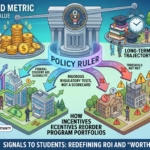
The 2025–2026 federal student aid reforms represent such a moment. They are best understood not as a single statute, but as a cluster of legislative changes, negotiated rulemaking outcomes, and administrative actions. This cluster does more than adjust existing programs; it resets the terms by which educational value and post-completion outcomes are defined and assessed across students, institutions, and the state.
That shift moves federal aid policy beyond routine program maintenance. It reframes the policies’ foci from student access—primarily for low- and moderate-income students seeking entry into postsecondary education—to program and student evaluation. Key outcomes being evaluated include earnings and repayment trajectories. While this shift addresses some long-standing concerns, it also raises new ones.
At the center of these changes are three policy developments: the expansion of Workforce Pell Grants, the introduction of earnings-based accountability measures, and revisions to federal student loan repayment structures. Taken together, these policy modifications generate consequences that warrant examination.
This three-part series offers the following analyses:
Blog 1 focuses on Workforce Pell Grants and the expansion of short-term, workforce-aligned credentials. It considers how extending federal aid to programs as brief as eight weeks changes which students can access postsecondary education, how institutions structure credentials, and how students evaluate their options.
Blog 2 turns to earnings-based accountability. It explores how the use of graduate earnings and repayment rates as policy metrics reshapes program evaluation, influences institutional decision-making, and raises questions about how different fields of study are valued.
Blog 3 examines changes to the federal student loan system, including new borrowing cap structures. It reveals how these caps allocate access to professional education capital, which, in turn, shapes labor supply.
The aim of this series is not to render a single judgment on these reforms. It is to examine how they work, where they create opportunity, and where they introduce tension. The series also invites educational leaders to join forces, sharing how they are responding in ways that are both financially responsible and educationally grounded.
FAQs
What are the 2025-2026 Federal Student Aid reforms?
The reforms are a cluster of legislative and administrative actions focused on Workforce Pell expansion, earnings-based accountability for institutions, and student loan repayment adjustments.
How do Workforce Pell Grants differ from traditional Pell Grants?
Unlike traditional Pell Grants, Workforce Pell extends eligibility to short-term, high-demand vocational programs (some as short as 8 weeks) focused on immediate employment outcomes.
What is earnings-based accountability?
It is a policy framework that evaluates the value of a degree or credential based on the post-graduation earnings and debt-to-income ratios of its students.