How Workforce Pell Grants Expand Short-Term Credentials and Reshape Access to Federal Aid
A Policy Shift Worth Naming
Higher education policy at the national level does not always move quickly. Sometimes, it evolves through incremental adjustments. Other times, fiscal pressure and public skepticism converge to produce more visible change. This is one of those moments.
The 2025–2026 reforms, codified under the One Big Beautiful Bill Act, introduce major changes to Workforce Pell Grants, earnings-based accountability, and federal student loan repayment. Together, these changes signal the present-day metrics by which elected officials and policy makers will assess educational value. Increasingly, these metrics prioritize student employment outcomes, graduate earnings, and time to credential.
One of the most consequential student financial aid shifts is the one regarding Workforce Pell. This blog reviews key changes regarding this shift.
What Workforce Pell Does for Students and Programs
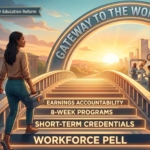
Until recently, the Traditional Pell program offered grants (that need not be repaid) primarily to eligible undergraduates seeking an associate’s or bachelor’s degree from accredited colleges and universities. Workforce Pell Grants extend federal aid into short-term, workforce-aligned programs, some as brief as eight weeks.
From a student perspective, the Workforce Pell expands access to postsecondary education. Students can now receive grant support for programs that lead more directly and more quickly to employment. For non-degreed working adults and those with limited financial margin, this creates a meaningful entry into postsecondary education. It can also serve as a reentry point, for bachelor-degree earners who decide to pursue an eligible short-term credential in one of the areas covered by the program.
Notably, the policy redefines program eligibility. Qualifying programs must align with high-demand occupations and meet strict benchmarks: a 70% job placement rate and earnings that exceed tuition costs.
This condition move financial outcomes such as student earnings and career placement to the center of those determinations.
How Workforce Pell and Earnings Measures Are Redefining Value in Higher Education
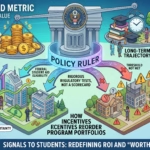
Completion, earnings, and repayment are no longer one set of outcomes among many. They now function as the primary basis for determining which programs expand and which contract. Over time, this reweights institutional decision-making toward programs that can demonstrate clear, near-term financial returns for students.
Other aims an institute might value such as civic engagement, intellectual development, and community impact may remain central to institutional mission. They are not directly measured, however, within the policy framework. As a result, they carry less weight in decisions about investment, design, and scale.
This shift does more than adjust metrics; it alters the operating environment. As earnings-based measures and Workforce Pell eligibility criteria take hold, postsecondary programs—including healthcare certificates, technical training, and selected degree pathways—are evaluated through a narrower set of outcomes. That evaluation, in turn, shapes which programs attract funding, how institutions allocate resources, and what students perceive as viable options.https://lorivarlotta.com/graduate-programs-with-purpose-antioch-universitys-national-model-for-mission-driven-learning-with-social-impact/
What This Signals to Students
Policy does not operate in the abstract. It shapes what students can actually afford to pursue. When grant aid is tied to employment outcomes, it reinforces the Repayment Assistance Plan (RAP) era’s focus: the primary purpose of postsecondary education is measurable economic return.
Under those conditions, shorter, job-focused programs become more visible and more viable. For the first time, students can use federal aid to pay for programs that last a matter of weeks, not years. An eight-week credential that once required out-of-pocket payment can now be financed through Pell. Until now, federal grant aid has largely been tied to longer, degree-granting programs.
That shift matters. Students are not only weighing cost; they are also weighing which credentials are worth pursuing. And in a system that places greater emphasis on earnings, “worth” begins to mean “pays.” Students respond accordingly, focusing on what they can afford to study and how long they can afford to stay in school.
Implications for Institutions: Stackable Credentials, Short-Term Programs, and the Future of Degrees
Workforce Pell concurrently shapes who enrolls, what programs colleges and universities build, and how institutions structure postsecondary credentials.
A likely response is the expansion of stackable credentials and short-term certificate programs. Colleges and universities are increasingly designing programs in layers, where short-term, job-focused credentials serve as entry points into longer academic pathways. An eight- or twelve-week certificate can function as the first step toward an associate’s, bachelor’s, or even graduate degree. When designed well, these pathways allow students to enter quickly, gain workforce-relevant skills, and continue their education over time as resources permit.
A second, more complex dynamic is the potential shift from degree programs to non-degree credentials. As federal aid begins to cover shorter programs, some four-year institutions—especially those facing enrollment pressure—may expand their use of certificates, badges, and other workforce-aligned credentials. In some cases, these offerings will complement traditional degrees. In others, they may begin to replace portions of them, particularly in fields where employers accept shorter forms of training.
This distinction is consequential. Stackable credential pathways extend and expand educational attainment. Substituting short, narrowly-focused programs for longer, more comprehensive ones can compress it.
The impact will vary across the higher education ecosystem. Community colleges and workforce training providers are well positioned to scale short-term programs quickly. Four-year colleges and universities may adopt a hybrid approach, balancing degree programs with shorter credentials. Graduate and clinical programs, particularly in regulated fields like healthcare and counseling, are less likely to shorten but may still be affected as earlier stages of the pipeline evolve.
Across the system, these changes are already reshaping the structure of postsecondary education. Entry points are multiplying. Time to credential is shortening. The line between degree and non-degree programs is blurring.
Tuition-driven institutions will aim to demonstrate the workforce relevance of their programs, ideally without reducing educational value to earnings alone. The challenge is to respond to new federal aid incentives while maintaining program coherence, academic quality, and a broader definition of student success.
Working Within the Shades of Grey: Workforce Pell and the Future of Educational Value
Workforce Pell addresses a real access problem. It lowers financial barriers and shortens time to credential.
It also narrows the time horizon and centers a particular definition of value. The result is not the elimination of other forms of learning, but their repositioning within a policy environment that privileges what can be measured quickly and economically.
That tension is not easily reconciled. Expanding access through shorter, workforce-aligned programs responds to student interests and labor market demands. At the same time, it raises questions about what remains visible, fundable, and scalable when value is defined primarily through earnings and repayment.
For the foreseeable future, Workforce Pell is part of the financial framework now in place. Institutions that participate in federal aid programs will need to operate within it, interpreting its regulations and translating them into practice at each juncture.
The challenge ahead is not merely compliance, but stewardship. Leaders will need to articulate and demonstrate the critical and creative ways they can work within this framework without allowing it to circumscribe educational purpose, compress time horizons, or narrow the range of outcomes that higher education is meant to advance.
Frequently Asked Questions about Workforce Pell Grant
What is a Workforce Pell Grant?
A federal grant for short-term programs (8–15 weeks) in high-demand fields like healthcare, IT, and skilled trades.
When do the 2026 Student Aid changes take effect?
Most provisions of the new reforms, including Workforce Pell eligibility, take effect on July 1, 2026.
Does Workforce Pell affect my lifetime eligibility?
Yes. Workforce Pell usage counts toward your total Pell Lifetime Eligibility Used (LEU).