When higher education leaders talk about the “moment,” we should do so in ways that do not reinforce a common but inaccurate narrative that suggests the enrollment cliff, equity issues, and public pressures arrived suddenly or will recede quickly. They did not. The demographic contraction has been building for more than a decade.
Inequities across K–12 systems have been widening for even longer. And doubts about the value of higher education have been simmering since at least the 1980s, when tuition began rising far faster than inflation and family income.
These forces do not constitute a moment. They are the defining conditions of our time. Many institutions are scrambling to recalibrate. Antioch University and the Coalition for the Common Good, however, are structured to meet these conditions head-on.
The Higher Education Reality Today
Across the country, fewer high school graduates are entering college. Among those who do, many arrive with uneven preparation when compared to peers from one, five, or even thirty years ago. National reading and math scores have dropped to historic lows. ACT scores continue to fall.
Economic instability is intensifying, with nearly half of students in some states qualifying for free or reduced-price meals. These shifts reach well beyond admissions. They affect students’ academic trajectories, the support systems they rely on, the faculty time needed to assist them, and the financial planning essential to institutional stability.
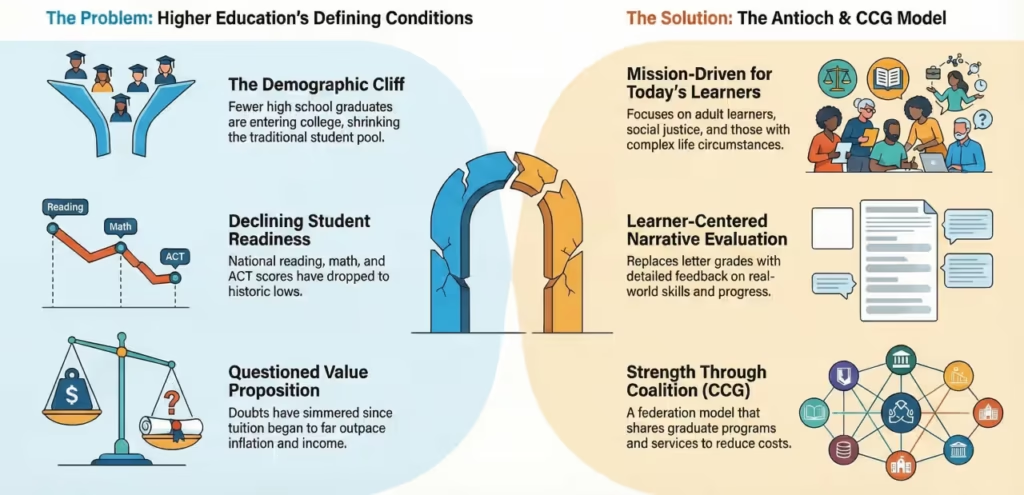
They also make the demographic cliff steeper and more perilous by reducing both the size of the incoming student body and the level of preparation students bring with them. When understood together, these dynamics signal a long-term recalibration for higher education. They point to a future in which success depends less on historical assumptions about who will enroll and more on an institution’s capacity to understand who learners actually are and what they need to thrive.
What Antioch Has Long Understood
While many institutions are just now confronting the implications of this reality, Antioch has been educating for it all along. Three elements of Antioch’s identity align directly with what this decade demands.
1. A Mission Centered on Justice, Access, and Equity
Antioch’s commitment to social mobility and public purpose predates the current crisis by more than a century. We do not need to retrofit our values or reinvent our rhetoric. Our programs already serve learners whose educational paths are shaped by uneven preparation, complex life circumstances, and structural inequities.
2. An Academic Portfolio Linking Passion to Purpose
Antioch’s largest graduate programs are in counseling, psychology, health, leadership, and environmental studies. These are the fields communities rely on heavily as inequities widen and support systems fray. Students drawn to these professions understand the impact they have on people and communities. They choose Antioch not simply to “skill up” and get a job promotion but to become part of a learning community that is rigorous, relevant, and rooted in purpose.
3. A Learner-Centered Model and Narrative Evaluation
At the front end, Antioch does not rely primarily on GRE scores or years-old undergraduate transcripts. We read the realities behind the résumé. We design programs for adult students who work, care for families, lead in community organizations, or translate insight into real-world problem solving.
During the academic journey, Antioch evaluates learning through real-world assessments: structured observations, role-playing, and demonstrated skills. Faculty do not assign letter grades. They write detailed narratives that capture each student’s progress, strengths, and areas for growth.
Prioritizing adult learners, meeting them where they are, and assessing them via detailed narratives that capture nuances become even more essential as traditional pipelines contract.
How the Coalition for the Common Good Strengthens Our Position
The Coalition for the Common Good (CCG) has been designed to amplify Antioch’s strengths and create pathways for undergraduate students at partner institutions to earn an AU graduate degree. The CCG does this in structural, not symbolic, ways.
Shared Graduate Programs
CCG affiliates transfer their graduate programs to Antioch, creating a common platform that increases scale, improves quality, and reduces duplication. At a time when demographic decline shrinks regional markets, the Coalition opens broader pathways for students who want direct, accelerated, mission-aligned graduate degrees.
Shared Services to Reduce Costs
The CCG’s shared services organization is being built so that member institutions can access scaled HR, IT, compliance, and legal support. The sharing of such services lowers overhead expenses for each member institution. This lowering allows the individual universities to reinvest in student-facing priorities that are often being reduced at the very time they need to be bolstered.
Financial Resilience Through a Federation Model
While other institutions compete for shrinking pools of students, the Coalition aligns around shared purpose, shared programs, and shared efficiencies. This creates a network that can withstand volatility better than any one campus could on its own.
Looking Forward: A Coalition Built for What’s Ahead
Many universities still frame today’s challenges as the problem of the day. Antioch and the CCG treat them as defining features of the era ahead.
- Demographics: Many institutions hope the demographic cliff will flatten. We assume it will not.
- Readiness: Many campuses wonder how to adapt to declining readiness. We were founded to educate in precisely those conditions.
- Value: Many leaders are now asking how to strengthen the value proposition. Our value proposition has been consistent for 170 years: preparation for purposeful work, democratic engagement, and victories for humanity.
Higher education cannot meet this enduring new normal by recycling models built for abundance. It must confront the realities of scarcity, volatility, and inequity with candor and courage. Antioch and the Coalition for the Common Good are not immune from these pressures. But we are structured, staffed, and mission-driven in ways that align with the realities of today, not with an idealized version of the past.
Frequently Asked Questions
Q: How is Antioch University addressing the higher education demographic cliff?
A: Antioch University focuses exclusively on adult learners seeking to complete the bachelor’s degree and/or earn a graduate degree rather than relying on traditional high school pipelines. Through the Coalition for the Common Good, Antioch partners with undergraduate institutions to build direct pathways for students to earn mission-driven, market-wise graduate degrees.
Q: What is the Coalition for the Common Good (CCG)?
A: The CCG is a federation of undergraduate institutions that transfer their graduate programs to Antioch University so that their students have direct and clear pathways to graduate school. As part of the transfer, the undergraduate universities get a share of the revenue the transferred program generates. They are also able to participate in the CCG’s shared service organization called CCG Services, Inc. This organization is designed to provide scaled services in areas such as HR, IT, and legal services. This reduces overhead and allows institutional members to spend more time, money, and attention on academics.
Q: Do faculty at Antioch University use letter grades to assess students?
A: No. Antioch faculty use detailed narrative evaluations rather than letter grades to assess student learning. This system captures and describes a student’s progress, strengths, and development through observed competencies, assessments of role plays, and demonstrated skills.