An analysis of the major higher education challenges in 2025—demographics, collaboration, regulation, democracy, and ROI—with guidance for university presidents and governing boards.
If 2025 taught us anything, it is that higher education is not contending with a passing squall. It is navigating a new climate—one shaped by demographic contraction, rising price sensitivity, adult-learner expectations, intensified federal scrutiny, and profound civic volatility. Tuition-driven colleges that ended the year on relatively stable footing did so not through luck, but through clarity: clarity about whom they serve, how they operate, and why their missions matter.
This analysis is written for university presidents, trustees, cabinet leaders, and governing boards who are ending this year by formulating strategic decisions for 2026 and beyond.
What follows are five observations from 2025—and five concrete responses higher-education leaders can take as they prepare for the future of higher education.
The institutions ending 2025 on stable footing did so not through luck, but through clarity.
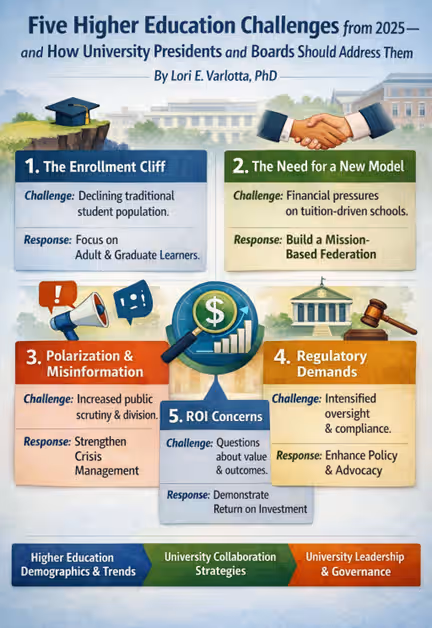
Challenge 1: The Enrollment Cliff and Evolving Market Dynamics
For more than a decade, higher-education leaders have been warned about the demographic cliff—the decline in traditional college-age students rooted in the 2008 Great Recession’s drop in U.S. births. That decline has now arrived, but 2025 made clear that demographics are only part of the story.
The enrollment cliff has been rendered more precarious by:
- intensified skepticism about the cost and value of degrees,
- shifting college-going behaviors,
- strong labor markets pulling young adults directly into work, and
- major federal changes to graduate-aid structures, loan caps, and compliance requirements.
Together, these forces have reshaped the higher-education marketplace in lasting ways. Institutions planning for a rebound anchored primarily in 18-year-olds risk misreading both the market and the moment.
Strategic Response: Centering Adult and Graduate Learners
Adult and graduate learners are no longer peripheral to institutional strategy; they now define one of the few growing segments of the college-going population. From a financial perspective, adult learners offer a steadier enrollment pathway. From an academic perspective, they bring purpose, lived experience, and a commitment to applied, community-embedded learning.
To respond, presidents and boards should consider:
- Designing academic pathways that reduce time-to-degree, including stackable credentials, shared-credit models, and accelerated graduate routes.
- Investing in adult-centered advising and student success, with evening and weekend access, integrated academic and career counseling, virtual check-ins, and one-stop service models.
- Partnering directly with employers and workforce boards to co-design curricula, embed industry-recognized credentials, and secure paid internships or practicums for working adults.
- Aligning academic rigor with real-world application through low-residency models, project-based learning, supervised fieldwork, and community-embedded practica.
Adult learners are not an adjacent population. They are the population in front of us—and a critical pathway to both mission fulfillment and financial resilience.
Challenge 2: The Shift from Self-Sufficiency to Collaborative Economic Models
In 2025, institutional self-sufficiency became increasingly difficult for tuition-dependent colleges and universities. The year saw accelerated interest in shared services, federated academic models, cross-institutional efficiencies, and joint pathways.
The Coalition for the Common Good (CCG)—co-founded by Antioch University and Otterbein University—offers one emerging model. Within this federation, undergraduate institutions maintain separate boards and accreditations while accessing shared services and graduate-degree pathways operated by Antioch University. The model is designed to preserve institutional identity while enabling scale, quality, and sustainability.
Collaboration is no longer a strategic option. It is an economic reality.
Strategic Response: Building Higher-Education Federations
Forward-looking presidents and boards are moving beyond mergers, acquisitions, or limited back-office consolidations. Instead, they are pursuing collaborations structured as long-term investments rather than concessions.
Key features of effective collaboration include:
- Mission before money: Participation begins with shared values, not short-term savings.
- Quality alongside efficiency: Shared services should strengthen—not thin—IT, legal, risk management, and compliance capacity.
- Student success and institutional flourishing: Decisions are evaluated by their impact on learning, opportunity, and local vitality.
Well-designed academic pathways—such as GEAPs and joint programs—expand undergraduate yield and graduate enrollment. Federated governance structures, when carefully constructed, can strengthen independence rather than erode it.
In an era of fixed costs and fluctuating enrollment, collaboration has become a defining expression of presidential foresight.
Challenge 3: Political Polarization and the “Public Spotlight” on Leadership
In 2025, polarization, misinformation, and declining trust in national and regional media placed many university presidents under an unflattering spotlight. Decisions once understood as internal governance matters increasingly unfolded in public view, narrowing the margin for error in presidential leadership.
A bright public light illuminated topics historically managed within institutions. These topics included everything from invited speakers, homework and curricula, academic freedom, DEI initiatives, research and grant hypotheses, student conduct, and presidential statements, and more. Decisions related to such topics such were more likely than ever to be interpreted through partisan lenses, amplified through social media, and assessed by external actors with limited tolerance for nuance, context, or institutional process.
In addition to impacting the president’s reputation, this public pressure also increased legal, regulatory, and governance exposure. 2025 showed us that civic controversy increasingly triggered complaints, investigations, or litigation tied to free speech, civil rights, consumer protection, accreditation, and federal compliance—even when institutional procedures were appropriate.
Strategic Response: Preparing Boards for Crisis Governance
Presidential vulnerability has increased—not because leaders are less capable, but because the role now carries greater external risk. Shorter presidential tenures and higher turnover, particularly among first-time presidents and presidents from underrepresented groups, point to the need for more deliberate board engagement.
To respond, presidents and governing boards should:
- Build shared situational awareness. Boards should receive regular briefings on emerging issues, external sentiment, and early indicators of risk, treating reputational exposure as a governance concern, not a communications task.
- Clarify roles in advance. Institutions should establish who speaks, when, and on whose behalf during periods of heightened scrutiny to reduce confusion and escalation.
- Prepare for visible board leadership. Trustee silence during targeted presidential criticism is often interpreted as hesitation. Boards should be ready to offer timely, values-anchored support when attacks are unfair or factually inaccurate.
- Practice crisis governance. Periodic scenario planning and tabletop exercises help boards integrate fiduciary responsibility, public communication, and leadership support before pressure arrives.
In polarized environments, presidential effectiveness depends not only on individual judgment, but on whether boards are prepared to lead with clarity and resolve.
Challenge 4: The Increasing Burden of Federal Compliance and Risk
Title IX changes, FLSA threshold adjustments, third-party servicer rules, gainful-employment reporting, cybersecurity mandates, expanded Borrower Defense to Repayment (BDR), and immigration delays collectively produced the most demanding regulatory environment in a generation.
These federal policy shifts increased labor costs, intensified documentation requirements, created uncertainty for graduate programs, and elevated institutional risk exposure.
Response 4: Shift From Reactive Compliance to Anticipatory Governance
Suggested Change- Strategic Response: Moving to Anticipatory Governance
Rather than responding episodically, presidents and boards should strengthen governance practices that surface risk early and support evidence-based decision-making.
Key actions include:
- Clarifying decision authority through formal decision-making matrices.
- Reviewing public claims that imply outcomes, ensuring statements about licensure, cost, debt, time-to-degree, and employment are supported by current evidence.
- Conducting targeted, cross-functional risk reviews focused on high-exposure areas rather than campus-wide audits.
- Sharing legal interpretation and compliance intelligence with peer institutions.
- Engaging regulators deliberately, with designated institutional spokespeople and measured, evidence-based communication.
The goal is not perfect paperwork, but early detection and responsible correction.
Challenge 5: Redefining ROI for the Modern Student and Family
In 2025, prospective students and families asked a more exacting return-on-investment question: Is this degree worth it—for me, my family, now, and over time?
Earnings remain part of the calculus, but they no longer stand alone. ROI has widened to include economic mobility, career durability, civic participation, community leadership, and alignment with personal purpose. Students increasingly evaluate whether programs provide options, not guarantees—skills that transfer across roles, credentials that signal competence to employers, and learning experiences that connect education to lived and professional realities.
This broader ROI lens also reflects heightened skepticism. Families want evidence that institutions understand the labor market, respect students’ time and financial constraints, and design programs that deliver value beyond aspiration. Institutions that rely on dated assumptions about degree value risk losing credibility in a marketplace that now demands proof, transparency, and relevance.
Response 5: Demonstrate ROI Through Outcomes that Students and Communities Value
Strategic Response: Demonstrating ROI Through Valued Outcomes
Presidents and boards should respond by making ROI an institutional practice rather than a rhetorical claim. That means:
- Defining ROI broadly and explicitly, articulating how academic programs advance mobility, employability, civic contribution, and long-term adaptability—not simply short-term earnings.
- Investing in career infrastructure, including employer partnerships, applied learning, internships, and alumni networks that connect students to concrete opportunities during and after enrollment.
- Tracking outcomes over time, using longitudinal data to understand how graduates fare across careers, communities, and civic life—not just at first placement.
- Articulating the “double value” of degrees, showing how individual advancement and community benefit reinforce one another through public-interest work, regional partnerships, and mission-aligned professions.
- Integrating ROI into governance and accountability, embedding outcome evidence into program review, accreditation narratives, and board-level decision-making rather than isolating it within marketing or enrollment functions.
ROI is not a slogan or a promise. It is the cumulative evidence that an institution delivers on its mission—to students, to communities, and to the public it serves.
Closing Reflection: What 2025 Revealed—and What Leadership Must Do Next
The challenges facing higher education are not temporary or discrete. They are structural and interconnected, requiring sustained leadership rather than episodic fixes.
Our charge as presidents and board members is to lead with clarity—to design institutions that are academically strong, operationally coherent, financially disciplined, and unmistakably student-centered.
The work ahead calls for discernment rather than defensiveness, collaboration rather than isolation, and evidence rather than assumption. Leadership choices that strengthen academic quality and financial stability also build public trust and educational opportunity.