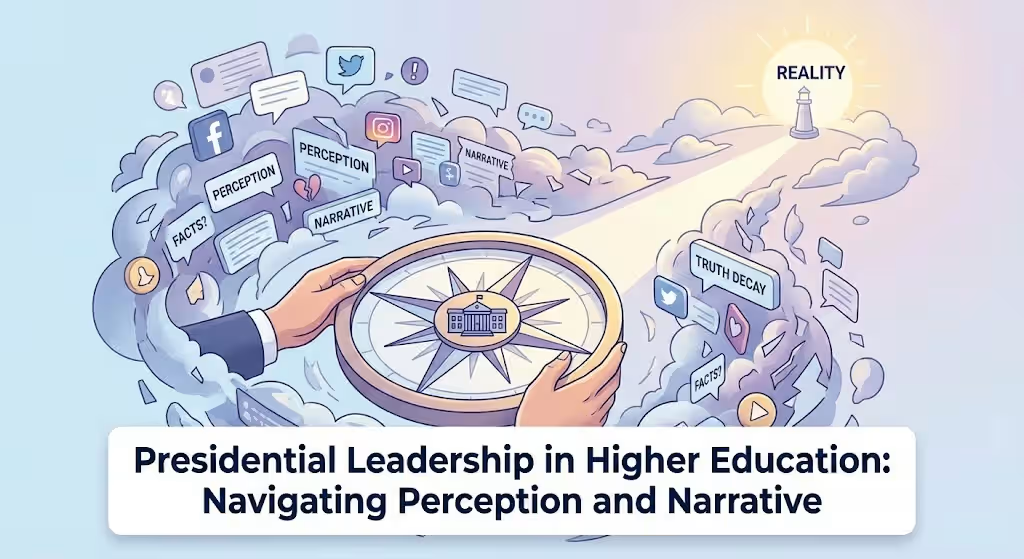
Presidential Leadership in Higher Education: Navigating Perception and Narrative

The Rise of Narrative-Driven Leadership in Higher Education

Presidents are often trained to believe that sound decisions, grounded in evidence and made in good faith, will ultimately speak for themselves. Unfortunately, that assumption rarely holds today.

In this environment, presidential leanings, hypotheses, and observations are immediately distributed, interpreted, and critiqued. Campus and community perceptions form quickly and give rise to narratives—often before the decision is even finalized and the rationale, constraints, or tradeoffs are formulated or understood. Though frequently partial or misshapen, perceptions create narratives, and narratives harden quickly. In short order, they circulate as fact, regardless of accuracy.

These realities are not communication failures. They are the conditions of higher education today.

The Impact of Perception on University Governance and Risk

Perception is no longer merely adjacent to reality; it is frequently treated as reality itself in the ways university members interact with each other and in the the ways media cover emerging plans and decisions. What stakeholders believe to be true about presidential intent, institutional health, or leadership competence shapes behavior, governance posture, and risk tolerance in ways that produce real outcomes. Local and social media sources put a particular “spin” on leaders and the perceived state of university affairs. Boards tightened control when there is perceived instability. Faculty and staff grow anxious in anticipation of “rightsizing.” Donor contributions slow in response to whatever angst they are seeing and reading about. These reactions occur in real time, based on what appears to be happening. There is no luxury of time; reactions are formed, shared, and reposted on the spot rather than developed after facts are confirmed.

If and when a more accurate and nuanced perspective takes shape, it is often too late. An early narrative has taken hold and prompted consequences that are already in motion.

Truth Decay: Why Narratives Function as Nonfiction in Academia

Narrative today does not function as a story. It functions as nonfiction.

Partial accounts circulate as complete explanations. Inference substitutes for evidence. Repetition confers legitimacy. Over time, these narratives are no longer perceived as interpretations; they are accepted as settled truth. As I explain here (Ten Ways for Higher Education Leaders to Meet and Define This Moment), these dynamics reflect what RAND has termed “truth decay”—the growing tendency to grant opinions and personal experiences the same intellectual weight as verified facts. One of the concrete manifestations of truth decay is not the absence of facts. It’s the erosion of shared agreement about how facts are weighed, contextualized, and communicated.

For presidents, the erosion of shared agreements means that they are exercising leadership as narratives are forming—often without their authorship or even their awareness.

Managing Presidential Vulnerability During Institutional Change

Presidents are hired to absorb institutional pressure. They are expected to make necessary decisions: those intended to protect accreditation, stabilize finances, restructure programs, and address misconduct. Even when these decisions are necessary, ethical, and well reasoned, they likely increase presidential vulnerability.

Why? Because decisions that surface uncomfortable realities, result in loss, or constrain autonomy often generate narratives of non-transparency, authoritarianism, commodification, or mismanagement. This is particularly the case when institutions are already under strain.

The problem is not the decision itself. It is the way university members often respond under stress. Under stress, faculty and staff may rally around perceived underdogs; band together to confront positional authority; conflate shared governance with direct democracy; or challenge decisions that clarify limits, tradeoffs, or reductions.

Strategies for Early Intervention in Campus Narratives

Presidents do not control perception. But they should model how inaccurate perceptions and the narratives they generate should be challenged.

Such modeling requires early intervention. Stepping up as president—and supporting cabinet members to do the same—means naming incomplete narratives, supplying missing context, clarifying decision authority, and explicitly distinguishing between what is known, what is uncertain, and what is being inferred. University leaders cannot expect faculty, staff, and students to counter truth decay if they do not serve as exemplars for the difficult and courageous work that such efforts require.

To be clear: both a university president and the institution they lead are ill-served by waiting for “the truth to come out.” By then, the narrative may already be shaping judgments, constraining options, and narrowing the space for responsible leadership.

In this context, even responsible leadership can be recast as failure.

The Mechanics of Misinformation in College Administration

Misinformed perceptions rarely begin with outright falsehood. Inaccurate narratives seldom recount complete fiction. More often, both originate in partial truths that are amplified, rearranged, or stripped of context.

A single data point is presented in isolation. A decision is shared without clarity about the constraints at hand. A delayed communication is interpreted as managerial avoidance. A candid disclosure is reframed as alarmism. Each fragment, taken alone, may contain a kernel of truth. Taken together, they can produce a narrative that no longer reflects institutional reality. It functions, however, as if it does.

Once misinformed perceptions circulate, the work of correction becomes more difficult. When perceptions go unexamined, or are implicitly reinforced through silence or partial reframing, they begin to shape the narrative-making process itself. In short order, interpretations harden, expectations form, and preferred outcomes are embraced as realistic goals. By the time a board or senior leader attempts to redirect or contextualize the narrative, it may already be governing how decisions are understood and judged.

Strategies for Early Intervention in Campus Narratives

Presidents do not control perception. But they should model how inaccurate perceptions and the narratives they generate should be challenged.

Such modeling requires early intervention. Stepping up as president—and supporting cabinet members to do the same—means naming incomplete narratives, supplying missing context, clarifying decision authority, and explicitly distinguishing between what is known, what is uncertain, and what is being inferred. University leaders cannot expect faculty, staff, and students to counter truth decay if they do not serve as exemplars for the difficult and courageous work that such efforts require.

To be clear: both a university president and the institution they lead are ill-served by waiting for “the truth to come out.” By then, the narrative may already be shaping judgments, constraining options, and narrowing the space for responsible leadership.

The Diagnostic Approach: Moving from Rebuttal to Response

Presidents often ask the most immediate and understandable question first:

How do I correct this inaccurate narrative?

A multifaceted question is more apropos in most cases:

What narrative is forming, what elements of truth or distortion does it contain, which members of the leadership team are best positioned to speak to the emerging inaccuracies, and how are those inaccuracies shaping governance behavior right now?

This level of examination matters. It moves leadership attention from rebuttal to diagnosis and response. It recognizes that narratives left uninterrogated often negatively impact the leader and the institution and exert influence on boards deal with the real and perceived issues at hand.

Narrative Stewardship: A Shared Responsibility for Senior Teams

Preparing a senior leadership team to redirect and reframe partial or misleading narratives is not an exercise in spin. It is a form of institutional stewardship—one that requires shared responsibility, coordination, and accountability across the executive team. In complex institutions, narratives rarely emerge from a single decision or communication. They form through accumulation: incomplete information, delayed context, informal interpretation, and selective amplification.

Narrative stewardship ensures that decisions are understood within appropriate institutional, financial, and governance context; that trustees, faculty leaders, and senior staff are operating from shared factual baselines; and that perception does not quietly substitute for evidence in consequential judgments. The work includes engaging faculty and staff in key meetings, allowing them to ask questions, providing clear responses, and challenging misconceptions without calling out or embarrassing individuals.

Effective narrative stewardship clarifies roles and collaboration. Presidents set direction and model transparency, and senior teams reinforce both through integrated and synchronous leadership. These leaders reinforce context at key junctures, correct drift as soon as the see or sense it and address misinterpretation within their own divisions. In highly functional universities, these responsibilities are distributed rather than centralized. It is the very distribution of authority and accountability that allows healthy institutions to navigate moments of stress before partial narratives get hardened and prompt responses that do not align with the reality.

The Role of Governing Boards in Protecting Leadership Narrative

In an environment where perception often functions as reality and narrative circulates as nonfiction, boards play a decisive role in shaping how a university responds to, tests, and challenges the narratives surrounding its institutional leadership and decision-making.

 Board action—or inaction—signals whether interpretations will based and reinforced by evidence or grow out partial or inaccurate information that circulates unchecked.

Boards do not merely receive narratives; they establish which narratives warrant scrutiny, which require additional context, and which demand correction. At critical moments, effective boards deliberately slow interpretation, insist on fuller context, and distinguish evidence from inference. By doing so, they model for the institution that governance judgment is not reactive and that accuracy matters more than immediacy.

Governance in this context requires more than formal oversight. It demands sustained attention to how narratives are forming, whose interpretations are being elevated, and whether board responses are anchored in institutional fact rather than cumulative assumption. When boards engage narratives with discipline and restraint, they create conditions that support sound decision-making and preserve leadership capacity under pressure.

Frequently Asked Questions About Presidential Leadership, Perception, and Narrative

Q. Why does perception matter so much in university presidential leadership today?

A: Perception increasingly functions as reality in higher education. What stakeholders believe about presidential intent, institutional health, or leadership competence shapes governance behavior, risk tolerance, donor confidence, and faculty response in real time. In an environment of accelerated information circulation, those beliefs often produce consequences before facts are fully established or contextualized.

Q. How do narratives form so quickly around presidential decisions in higher education?

A. Narratives form early, often while issues are still unfolding. Partial information, isolated data points, inferred motives, and delayed context combine to produce initial explanations that ground the narrative. Repetition, reposting, and social media circulate the narrative broadly. The widespread distribution and amplification confer perceived legitimacy, allowing early interpretations to harden into “settled truth” even when they remain incomplete or inaccurate.

Q. How and when can a university president tell when perceptions substitute for institutional reality?

A. Too often, this is a tendency that occurs at the outset rather than emerging over time. It is evident when interpretations spread faster than verified information and reactions precede formal discussion. Indicators include questions framed around assumed motives, responses to anticipated outcomes rather than announced decisions, and pressure to respond to narratives rather than to conditions. In such moments, perception is not adjacent to reality—it is already governing behavior.

Q. Why can well-reasoned and ethical decisions still increase presidential risk?

A: Decisions that surface constraints, losses, or tradeoffs often trigger stress responses. Regardless of their quality, such decisions can generate accusations of non-transparency, overreach, or mismanagement that quickly frame the early narrative. The risk lies less in the decision itself than in how it is interpreted, circulated, and reinforced as the prevailing narrative.

Q. What are the early warning signs that narratives are beginning to shape university board behavior?

A. Narratives begin shaping board behavior when oversight shifts from inquiry to reaction. Indicators include reliance on informal information, elevation of anecdote over evidence, shortened decision timelines, or increased focus on how decisions will be perceived rather than what the institution requires. Left unexamined, these assumptions can quietly harden into governance posture.
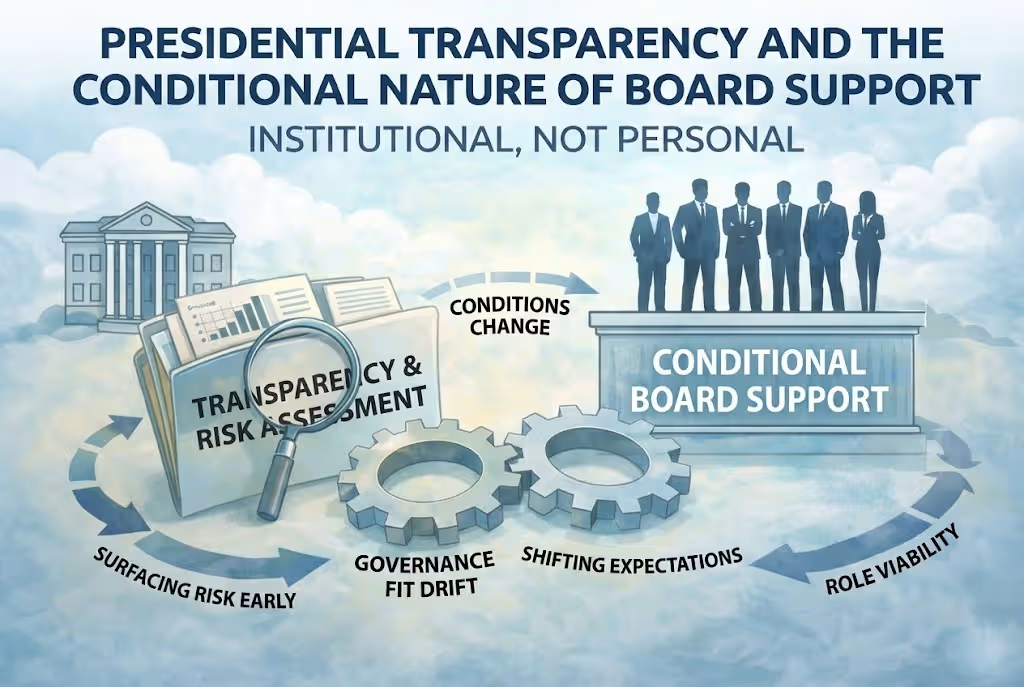
Presidential Transparency and the Conditional Nature of Board Support

Early in a presidency, and especially when conditions are stable, the confidence a board expresses toward a president can feel relational. Alignment feels durable. Board affirmation is often experienced as personal regard rather than institutional support. Those perceptions may be accurate. Even so, they reflect only part of the institutional reality.

Why Board Support is Institutional, Not Personal

Boards support presidents because, at a given moment, they believe the president is the right leader to meet the institution’s needs, keep the institution financially viable, and advance its strategic direction. Under nonprofit corporation law, board members exercise strategic and fiduciary responsibility. Their duties of care, loyalty, and obedience are owed to the organization itself, not to individual leaders or personal interests. As such, board support is inherently conditional—tied to the institution’s evolving needs, perception of fiscal sustainability, risk tolerance, and assessment of what the presidency must deliver in a given moment.

How Stability Masks the Reality of Support

When enrollment is steady, finances are manageable, and external scrutiny is low, the distinction between institutional loyalty and personal support often blurs. Conversations feel expansive. Trust feels mutual. Presidential support feels assured.

Under these conditions, presidents reasonably infer that transparency and performance will sustain board confidence. The relationship feels reciprocal and enduring. This interpretation is neither naĂŻve nor misguided. It is simply contingent on conditions holding.

The Shift: Conditions Change and Governance Becomes Stressed

When conditions worsen—financial strain, enrollment decline, political pressure, or reputational risk—the board’s fiduciary focus sharpens. Risk tolerance diminishes, prior assumptions are revisited, and institutional exposure is reassessed.

In these moments, the presidency is evaluated less as a relationship and more as a governance mechanism for navigating uncertainty. Support can shift quickly, even when presidential competence, effort, and integrity remain intact. This shift is rarely framed explicitly. It is often experienced as sudden.

What changes most immediately is not intent, but posture. The board’s focus turns from long-term horizons to near-term risk management, from partnership to protection. Governance becomes more directive, and expectations for decisiveness increase—even as the conditions required to support that decisiveness erode.

Why Transparency Does Not Guarantee Alignment

Presidents repeatedly hear—at professional conferences, in articles about board culture, and across leadership circles—that being highly transparent with the board builds trust. Those same sources suggest, again and again, that such trust engenders and sustains board support. Over time, these messages are frequently internalized as a governance truth.

Transparency does matter. But it does not, by itself, guarantee continued board support.

Being transparent about risk neither ensures that presidents and boards will interpret that risk in the same way nor agree on how or when it should be addressed. Naming exposure does not produce consensus about response. Candor can, in fact, accelerate reassessment.

Candor and consensus do not always coincide, and the distance between them can place presidents under strain.

Transparency Can Build Trust and Accelerate Risk Assessment 

Presidents are expected to be transparent with their boards, especially under stress, and the timing, framing, and level of detail in that transparency matter greatly. Presidents who surface risk early and describe conditions plainly often do so out of institutional responsibility, believing that clarity fosters trust and shared problem-solving. Paradoxically, this level of transparency can place presidents in a more vulnerable position than peers whose reporting preserves a sense of manageability through more cautious or optimistic framing.

This is not because boards punish honesty. It is because the explicit articulation of risk potential alters governance behavior. 

How Risk Exposure Triggers Fit Drift

Once risk is fully exposed, boards cannot disregard what they have been told; many feel compelled to act decisively to protect the institution. The board’s fiduciary responsibility moves to the foreground. Their risk tolerance becomes more circumscribed. And they begin to view the presidency less through the lens of relationship and more through the demands of institutional protection.

This dynamic is one of the primary ways fit drift begins to take hold: expectations morph in response to newly visible risk, while corresponding adjustments in support, readiness, and decision-making clarity lag behind.

Transparency is necessary for informed governance, but it is not singularly sufficient to sustain alignment and support as conditions change.

The Speed of the Governance Pivot

What is often most unsettling to presidents is not that boards act in institutional interest but the speed with which their posture changes.

Support that once felt relational becomes procedural. Informal check-ins give way to executive sessions, outside counsel, and tightly managed communication channels. Conversations that were exploratory become prescriptive. Presidents who interpret early warmth as durable backing are especially vulnerable here. The shift feels personal because it is abrupt. The driver, however, is structural.

The Discernment Question Every President Must Ask

When board support cools, presidents often ask a transactional and personalized question first:

How do I win them back?

A more systematic and probing question is harder yet more illuminating:

Have the board’s expectations of what the institution now needs from this role, and what the board is prepared to provide the sitting president, shifted in ways that narrow my ability to lead effectively?

This two-part question shifts the frame from self-preservation to role viability. It moves the focus away from persuasion and toward structural assessment. Rather than asking how to restore confidence in an individual leader, it asks whether the board can make available what the role requires at this moment for effective leadership.

The answer is not always comfortable. Sometimes the gap can be closed through recalibration, clarification of authority, or renewed alignment around priorities. At other times, the board’s expectations have shifted in ways that fundamentally redefine the role itself. In those moments, discernment—not endurance—becomes the more responsible act.

A Governance Reality About Board Support

Board support is institutional. It is contingent. And it can morph quickly under stress.

Presidents who fare best are those who recognize this early, separate self-worth from governance responsibilities, and respond with deliberation rather than defensiveness. Sometimes that response is recalibration. Sometimes it is negotiation. Sometimes it is preparation for transition.

What matters is not longevity in office but positional agency throughout one’s presidency.

Next: Essay Four turns to perception—why it shapes presidential vulnerability whether leaders attend to it or not, and how unmanaged perception often accelerates governance strain.

FAQ

How transparent should a president be with their board?  

Transparency is a core element of healthy governance, even though it does not guarantee presidential preservation. Presidents should aim to be as transparent as possible in ways that are timely, accurate, purposeful, and oriented toward solutions. Transparency is most effective when disclosures about risk are paired with clear context and clarity about what the board is being asked to understand, decide, or support; absent that clarity, transparency can invite more directive governance and narrow presidential room to act.

What should boards and presidents be explicit about when institutional conditions change?

Boards and presidents should be explicit about what has changed and why, which risks now need to be top of mind, who is responsible for addressing those risks and communicating risk-management strategies, and the timelines for implementing risk-reduction decisions. Naming changing conditions and risks early helps prevent confusion, misaligned expectations, and unfair judgments about leadership performance.

Which assumptions need to be revisited when risk tolerance tightens?

When risk tolerance diminishes, boards and presidents should revisit assumptions about how quickly decisions can be made, how much discretion the president has, what resources are truly available, and how stable board backing will be. Making these assumptions explicit helps prevent misalignment and reduces the likelihood that governance strain is misread as a leadership failure.

When does transparency strengthen governance—and when does it decrease a president’s room to act?

Transparency strengthens governance when disclosures are tied to clear roles, decision authority, and shared expectations about response. It decreases a president’s delegated authority and agency, however, if risk is surfaced without proposed risk management strategies and parallel clarity about who will act, how quickly, and with what institutional support.

How should a presidency be evaluated when transparency destabilizes, rather than bolsters, the role?

A presidency should be evaluated by whether the leader acted with integrity, surfaced material risk responsibly, and exercised sound judgment in service of the institution—even when those choices narrowed personal authority or shortened tenure. In today’s environment, agency is as much or more a marker of presidential success as longevity. Successful presidents retain as much agency as conditions appropriately allow; they continue to act with purpose until the end. Staying in a role stripped of meaningful authority is not a marker of effective leadership

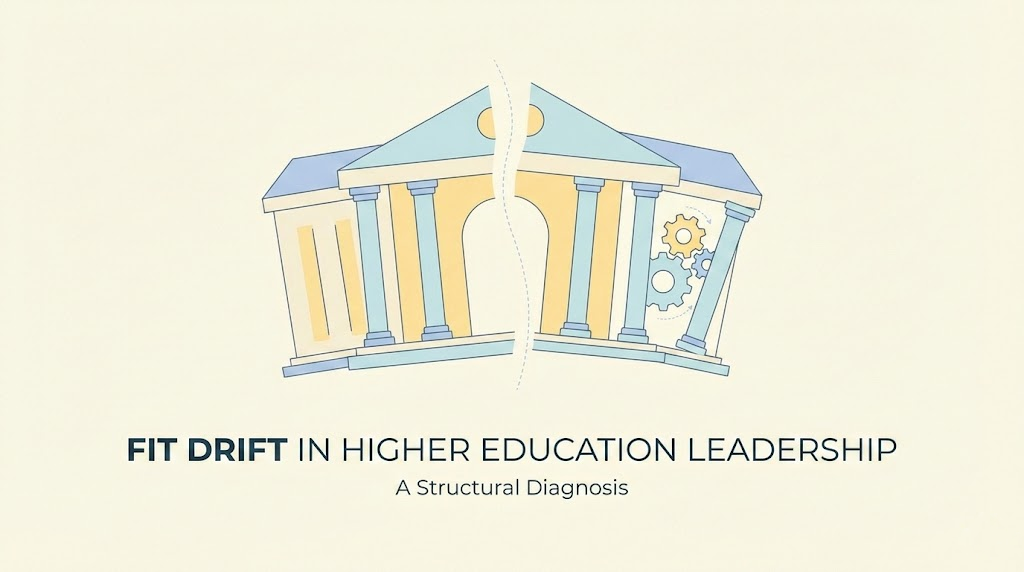
Fit Drift in Higher Education Leadership: A Structural Diagnosis

In higher education, “fit drift” names a structural asymmetry—a misalignment that evolves as expectations of the presidency increase and governance readiness, decision-making authority, and institutional support fail to proportionally adjust. Fit drift is not a diminishment of presidential commitment or competency, but it does limit presidential effectiveness.

What Is Fit Drift in Higher Education?

In higher education, fit drift names a structural misalignment or asymmetry—not a change in personality, commitment, or competence of the officeholder. It occurs when internal or external conditions significantly shift the expectations placed on the presidency while governance practices, decision-making channels, leadership support, and institutional readiness remain static or adjust unevenly.

The resulting disconnect leaves even capable presidents exposed as expectations rise and authority, support, and resources no longer move in concert.

Fit drift is neither a verdict on presidential performance nor a personality change. It often coincides with a leadership phase where internal or external conditions deteriorate and presidents are asked to design and implement changes that are necessary, difficult, and unpopular.  

Why Naming and Addressing Fit Drift Matters in University Governance

Fit drift is often felt by presidents before it is formally recognized by boards or campuses. It rarely arrives with a single decision or visible rupture. Instead, it accumulates through small, compounding shifts in authority, expectations, support, and institutional readiness for change.

Naming and addressing fit drift does three important things simultaneously:

  1. It gives language to a pattern presidents often recognize but struggle to describe without personalizing it.
  2. It reframes vulnerability as structural rather than individual.
  3. It establishes a diagnostic category rather than a moral judgment.

Without this language, governance strain is too easily interpreted as a weakness of leadership style or temperament rather than an asymmetry between presidential expectations, change readiness, and support.

The Catalyst: When Institutional Conditions Shift

As described here, most presidencies begin with relative coherence. Board confidence is visible. Decision pathways feel familiar. Authority appears proportional to expectations. Governance relies on shared assumptions rather than constant renegotiation.

Then conditions shift.

Enrollment softens. Finances tighten. Political scrutiny intensifies. Community pressure escalates. Presidents are expected to move faster, decide more quickly, and absorb greater risk. Boards appropriately reassess institutional exposure. Expectations of the presidency rise.

What does not always adjust at the same time or to a proportional degree is institutional readiness for the change being demanded: clarity about who decides what, how decisions move through governance structures, what support accompanies difficult actions, and how risk is shared rather than concentrated.

Change may be broadly acknowledged as necessary, while acceptance of specific changes remains uneven across the board, administration, and campus.

The Consequence: Degraded Presidential Authority

In this environment, presidential authority may remain formally intact, but its on-the-ground usability degrades.

Decision-making becomes conditional and inconsistently applied. Formal governance channels are supplemented—or quietly bypassed—by informal ones. Support becomes situational rather than structural.

Accountability increases while authority and backing fragment.

This asymmetry is a defining feature of fit drift.

Early Warning Signs of Fit Drift for University Presidents

University presidents are often socialized to persist, adapt, and absorb. That orientation can delay recognition that a structural shift is underway.

Common early signals include expanding expectations without corresponding resources, ambiguous or inconsistently applied decision rights, increased board involvement in operational matters, shifts from prospective guidance to retrospective judgment, and the quiet replacement of formal governance processes with side conversations.

Individually, these signals may seem manageable. But when they occur collectively and persist without explicit discussion, they are a sign of fit drift.

Why Do Good Presidents Lose Board Support?

Often, they do not—at least not at first.

What shifts initially is not confidence in the individual, but the board’s assessment of institutional risk and readiness. As conditions intensify, governance posture may change from personally connected to professionally detached. Support becomes more procedural than organic. Overall direction setting which may have been exploratory becomes prescriptive.

These changes reflect altered governance conditions, not diminished temperament or talent. When board members fail to recognize its structural nature, emerging strain is read as a presidential shortcoming. This means a governance problem is misdiagnosed as presidential failure.

Addressing Fit Drift Before Governance Hardens

Addressing fit drift early allows boards and presidents to work deliberately on conditions rather than assign blame.

Institutional readiness can be reassessed. Decision pathways clarified. Support for willing and able presidents strengthened. Facilitated governance conversations about risk tolerance, authority, and capacity can help restore alignment before positions, postures, and new patterns solidify.

When those efforts do not succeed, the most responsible outcome may be a planned transition—timed, structured, and governed in ways that protect institutional stability and preserve the dignity of both the presidency and the person who holds it.

A Final Governance Reality About Fit and Fit Drift

Fit drift is not soley, or even largely, about personality or performance. It is about whether governance structures, institutional readiness, and presidential support remain in sync with the changing conditions of today’s environment.

Presidential fit is not permanent. It is contingent. And sometimes the most responsible course is not persistence, but clarity—and, when necessary, exit with agency.

FAQ: Fit Drift in Higher Education Leadership

1. What is “fit drift” in higher education?

Fit drift names a structural misalignment or asymmetry that arises when expectations of the presidency shift while governance practices, decision-making clarity, and institutional support fail to adjust in step.

2. What are the early warning signs of fit drift for university presidents?

Common signs include expanding expectations without added authority or resources, unclear and inconsistent decision pathways, increased informal governance, and accountability that grows without corresponding institutional backing.

3. Is fit drift a sign of presidential incompetence?

No. Fit drift reflects changing institutional conditions and governance dynamics, not deficiencies in competence, commitment, or leadership capacity.

4. Why do good university presidents lose board support?

Often they do not lose support outright. Many boards readjust their positions and postures in response to heightened risk. This can unintentionally reduce the president’s concrete authority and create strain if not explicitly addressed.

5. Can a university president recover from fit drift?

Sometimes. Early recognition, explicit governance recalibration, and shared clarity about authority and support can restore alignment. When that is not possible, a structured transition may be the most responsible outcome.

University-Presidential Fit is Structural Not Personal

Presidential Fit in Higher Education: More Than Just a Feeling

Presidential “fit” is often treated as a matter of chemistry—shared values, interpersonal ease, cultural alignment. These elements matter. But, in practice, presidential fit is as much a structural condition as it is a feeling or relational connection. In today’s higher education environment, that structural condition is largely defined by the extent to which the president, the board, and the campus are aligned around the institution’s readiness for change.

Fit exists when authority, expectations, accountability, and support remain aligned as the board, administration, and faculty design and implement change. When those elements are in sync, top leaders can be effective. When they are not in line, presidents are still expected to lead despite the absence of the environmental and governance conditions required for success. This phenomenon, which I have named “fit drift,” is discussed at length in the next essay in this series.

The Core Components of Structural Fit

Presidential fit describes the alignment between what an institution expects of its president and the authority, support, and decision-making clarity it provides in return. In this context, alignment goes hand-and-hand with change readiness—shared clarity about the scale, pace, and governance implications of the change the institution needs to undertake. Fit is present when decision rights are clear, governance pathways are respected, institutional backing is consistent, and accountability is paired with sufficient authority and resources to make necessary change.

Fit is not merely a feeling of ease. It is also an operational condition that enables presidents to effectively advance the mission of the university they serve.

The Strategic Importance of Reframing Fit as an Organizational Phenomenon

This reframing does at least three things: 

  • It pragmatically reframes presidential evaluation around structural alignment rather than individual disposition.
  • It establishes fit sustainability as a shared governance responsibility rather than the sole burden of the officeholder.
  • It provides a baseline against which change readiness and change implementation can be assessed.

Without a definition of fit grounded in lived governance conditions, presidential fit is easily (and too narrowly) reduced to a question of “mission match,” when in fact it reflects a broader set of structural conditions that shape leadership effectiveness.

Reframing fit in this way also clarifies that change readiness does not depend solely, or even primarily, on the personal willingness of the president. It is an institutional condition, reflected in whether the board, the campus, and the administration share a realistic understanding of what change will be required—and are structurally prepared to support it.

The Lifecycle of Fit: Early Governance Conditions

Most presidencies begin with a period of relative coherence. Board confidence is visible. Decision pathways feel straightforward because expectations, authority, and roles are reasonably aligned and have not yet been strained by sustained disagreement or external pressure. Early agreement and goodwill make governance feel navigable, a pattern I explore in Phase 1 and Phase 2 of a University Presidency: Transition.

Authority appears proportional to expectations in part because it has not yet been tested by high-stakes tradeoffs, contested decisions, or prolonged stress. Governance operates smoothly because the board, president, and faculty have not yet diverged sharply on matters that surface competing values.

Fit, at this stage, appears stable because relational trust and structural alignment are reinforcing one another, and existing governance arrangements are sufficient for the demands being placed upon them.

Maintaining Alignment When Conditions Hold

In periods of relative stability, fit is reinforced through routine governance practices and sustained working relationships. Expectations remain legible. Support is predictable. Disagreements are managed within established processes and resolved without escalating into institutional rupture.

In these conditions, presidents lead within authority that is both trusted and usable, and boards govern through channels that feel legitimate because they are familiar and functional. Alignment persists not because disagreement is absent, but because governance structures and relationships are adequate to hold it.

How to Sustain Presidential Fit Over Time

Presidential fit endures when institutional readiness for change and governance execution keep pace with expectations. That readiness includes clarity about who decides what, how decisions move through governance structures, what support accompanies risk, and how accountability is shared rather than concentrated.

When these elements remain aligned, leadership remains viable even as pressure increases.

The Reality of Conditional Fit

Presidential fit is not permanent. It is contingent and requires periodic recalibration as institutional conditions, governance demands, and external pressures evolve.

In the current era, that recalibration increasingly turns on change readiness: whether governance structures, presidential support, decision rights, and campus expectations remain aligned with the level of change the institution now requires. When alignment weakens, strain accumulates and fit slackens, oftentimes, before it is named and addressed.

Next: Blog 3 describes what happens when this alignment quietly shifts—what I call fit drift—and why addressing it early matters for governance, leadership, and institutional stability.

FAQ Questions

1. What is presidential fit in higher education?

Presidential fit is as much a governance condition as it is personal compatibility, style, or mission match. Structurally, fit exists when institutional expectations are aligned with the authority, support, decision-making clarity, and shared readiness for change across the board, administration, and campus.

2. Is university presidential fit just about personality?

No. Personal chemistry and relational connections are important and can make early interactions comfortable. Presidential fit is more than this, however. It is sustained—or undermined—by governance structures, decision rights, and institutional support. Personality traits influence perception; governance conditions and structure help determine ongoing viability.

3. Why is presidential fit considered a governance condition?

Because fit depends on how authority, accountability, and support are designed and exercised over time. Boards shape fit through delegation practices, approval pathways, and the consistency with which governance roles are executed.

4. Why does presidential fit often seem stable at the beginning of a tenure?

Early in a presidency, goodwill is high and governance systems have not yet been tested by sustained pressure or contested decisions. Apparent stability often reflects untested alignment rather than durable structural fit.

5. Is university presidential fit permanent?

No. Presidential fit is conditional and requires periodic recalibration as institutional conditions, governance demands, and external pressures evolve. Without adjustment, misalignment can accumulate even when leadership performance remains strong.

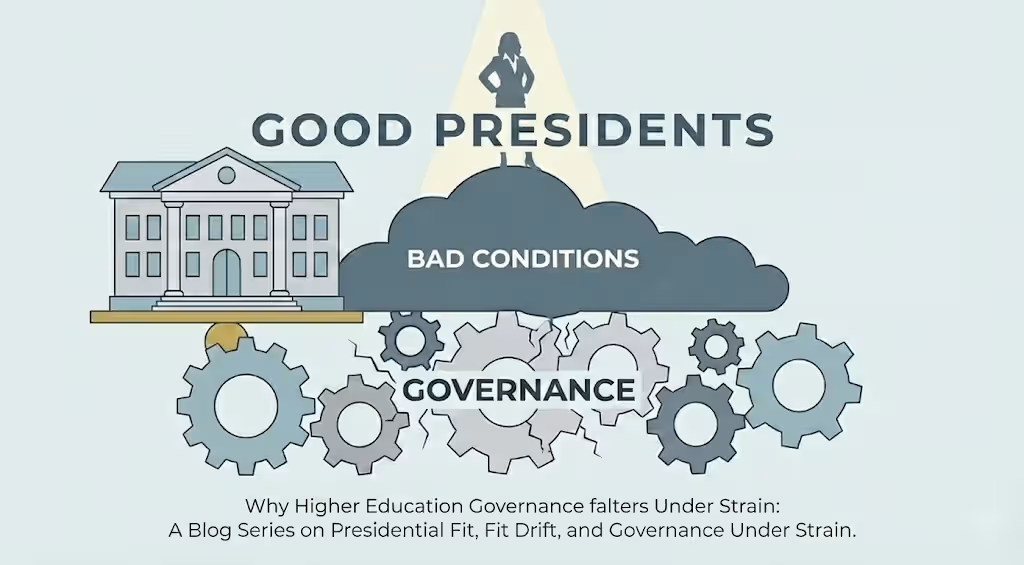
Good Presidents, Bad Conditions: Why Higher Education Governance Falters Under Strain

A Blog Series on Presidential Fit, Fit Drift, and Governance Under Strain

By Lori E. Varlotta, PhD

The Structural Nature of Presidential Strain

University presidencies rarely become untenable in a single moment. More often, strain accumulates over time, conditions intensify, and governance structures that once supported leadership no longer remain aligned with what the moment requires. This is a dynamic I explore in The Demands of Center Stage: Delivering Results and Making Tough Decisions.

Across higher education governance, boards and university presidents are increasingly encountering this kind of accumulated strain. Too often, however, they lack a shared language to name and describe its structural—rather than personal—dimensions.

Five Conditions Shaped by Structure as Much as Relationships

This series describes the structural dimensions of five interrelated conditions that shape presidential effectiveness and vulnerability:

  1. presidential–institutional fit;
  2. fit drift;
  3. transparency and board support;
  4. perception and narrative; and
  5. the management of goodwill.

These conditions are often interpreted as reflections of personal style, temperament, or competence. In practice, they are equally rooted in structural dimensions that sometimes remain unexamined: the alignment (or misalignment) between presidential authority and board expectations; institutional readiness for change; the execution of governance; and the adequacy of presidential support.

I explore related themes in The First 100 Days of a University Presidency: Curiosity, Generosity, and Discernment, where early structural signals often predict later outcomes.

Summary of Blog Series: From Blame to Foresight in Higher Ed Leadership

This series is not about bad presidents. It is about organizations under stress and about what happens when governance structures, decision-making clarity, and support mechanisms do not keep pace with changing conditions. Drawing on my experience as a three-time university president and my work advising other presidents, these essays aim to name patterns that are widely experienced, rarely named with precision, and too often misread as individual failure.

The goal is not to blame. It is to provide foresight so that presidents and boards can recognize what is emerging early and respond deliberately rather than defensively. For more on this topic, please see Presidential Succession Planning: From Troubling Turnover to Transition and Transmission.  

Next: Blog 2 examines why presidential “fit” is structural, not sentimental—and how it begins to unravel.

Frequently Asked Questions

1. What is “fit drift” in higher education leadership?

In higher education, fit drift describes a structural misalignment that occurs when conditions change and presidential expectations escalate, but corresponding adjustments in institutional readiness, presidential support, and decision-making clarity fail to keep pace.

2. What are the key conditions for university presidential effectiveness?

University presidential effectiveness depends not only on experience and judgment, but on structural alignment: clear authority, disciplined governance, sustained board support, institutional readiness for change, and sufficient goodwill to absorb strain over time.

3. What is structural misalignment in university governance?

Structural misalignment in university governance occurs when roles, approval pathways, expectations, and support mechanisms no longer comport with changing conditions. When unexamined, these governance incongruencies are often misattributed to presidential performance rather than system design.

4. How can university boards identify governance strain early?

University boards can identify governance strain early by naming and describing fit drift, recognizing expanded approval layers, attending to inconsistent delegation, determining whether heightened scrutiny is necessary and resolving ambiguity about decision authority. 

5. What is the difference between personal failure and structural misalignment in higher education leadership?

Personal failure in higher education leadership typically includes a lack of professional judgment, inadequate capability, and/or acts of personal or professional misconduct. Structural misalignments, on the other hand, reflect systematic or governance conditions that make it difficult to keep presidential authority and support in sync with university resources, public pressures, campus readiness for change, and board support.


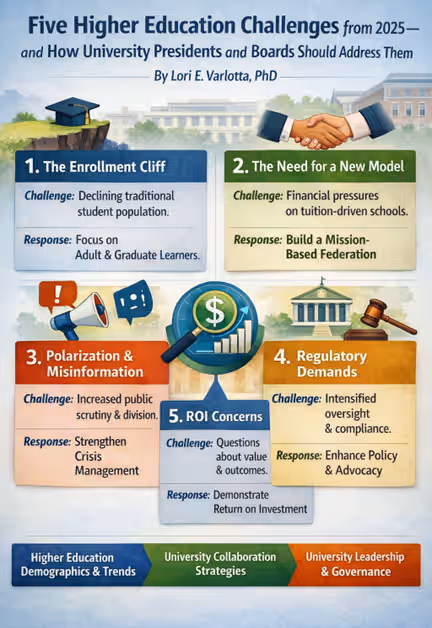
Five Higher Education Challenges from 2025—and How University Presidents and Boards Should Address Them

An analysis of the major higher education challenges in 2025—demographics, collaboration, regulation, democracy, and ROI—with guidance for university presidents and governing boards.

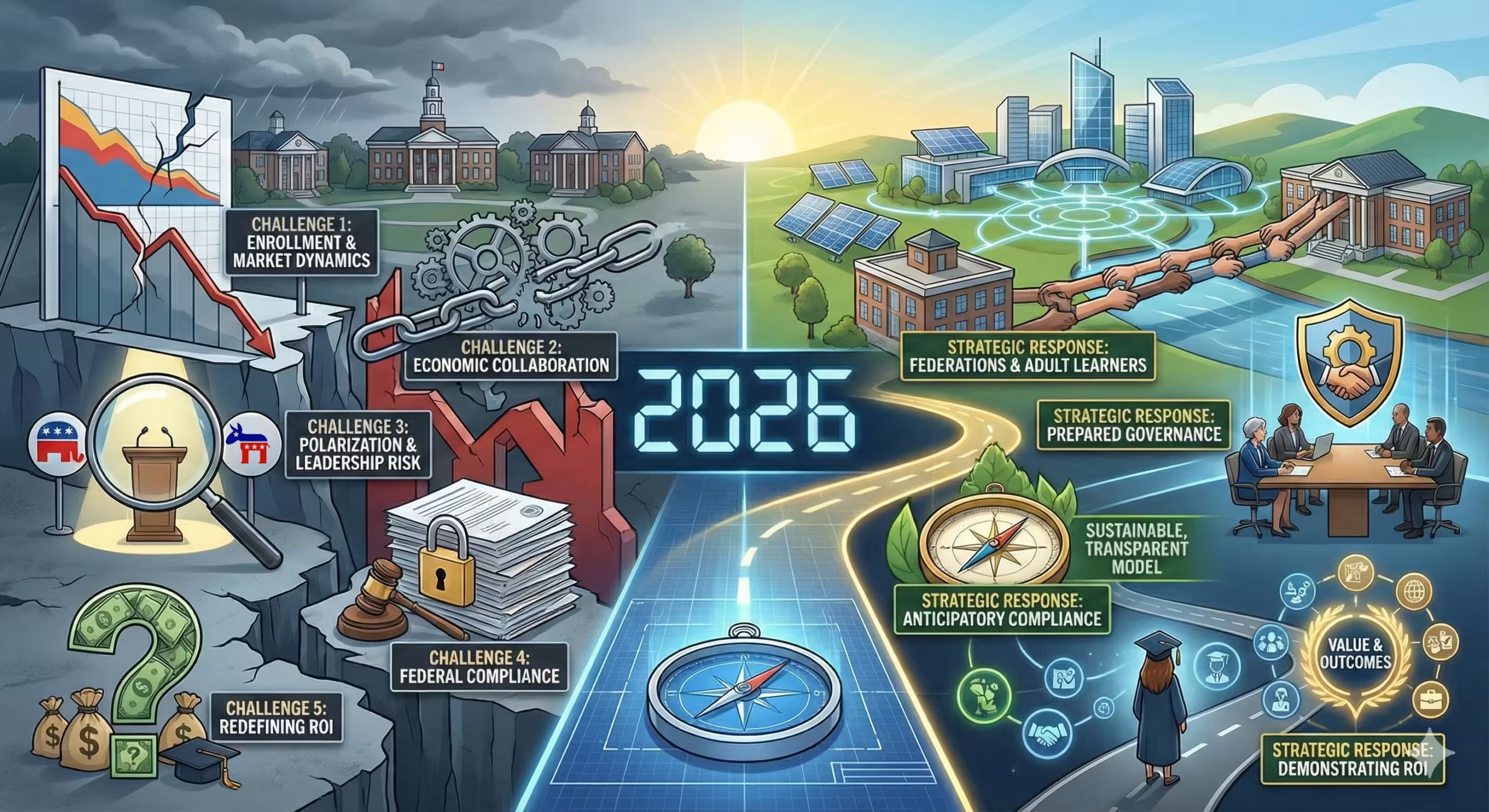
If 2025 taught us anything, it is that higher education is not contending with a passing squall. It is navigating a new climate—one shaped by demographic contraction, rising price sensitivity, adult-learner expectations, intensified federal scrutiny, and profound civic volatility. Tuition-driven colleges that ended the year on relatively stable footing did so not through luck, but through clarity: clarity about whom they serve, how they operate, and why their missions matter.

This analysis is written for university presidents, trustees, cabinet leaders, and governing boards who are ending this year by formulating strategic decisions for 2026 and beyond.

What follows are five observations from 2025—and five concrete responses higher-education leaders can take as they prepare for the future of higher education.

The institutions ending 2025 on stable footing did so not through luck, but through clarity.

Challenge 1: The Enrollment Cliff and Evolving Market Dynamics

For more than a decade, higher-education leaders have been warned about the demographic cliff—the decline in traditional college-age students rooted in the 2008 Great Recession’s drop in U.S. births. That decline has now arrived, but 2025 made clear that demographics are only part of the story.

The enrollment cliff has been rendered more precarious by:

  • intensified skepticism about the cost and value of degrees,
  • shifting college-going behaviors,
  • strong labor markets pulling young adults directly into work, and
  • major federal changes to graduate-aid structures, loan caps, and compliance requirements.

Together, these forces have reshaped the higher-education marketplace in lasting ways. Institutions planning for a rebound anchored primarily in 18-year-olds risk misreading both the market and the moment.

Strategic Response: Centering Adult and Graduate Learners

Adult and graduate learners are no longer peripheral to institutional strategy; they now define one of the few growing segments of the college-going population. From a financial perspective, adult learners offer a steadier enrollment pathway. From an academic perspective, they bring purpose, lived experience, and a commitment to applied, community-embedded learning.

To respond, presidents and boards should consider:

  • Designing academic pathways that reduce time-to-degree, including stackable credentials, shared-credit models, and accelerated graduate routes.
  • Investing in adult-centered advising and student success, with evening and weekend access, integrated academic and career counseling, virtual check-ins, and one-stop service models.
  • Partnering directly with employers and workforce boards to co-design curricula, embed industry-recognized credentials, and secure paid internships or practicums for working adults.
  • Aligning academic rigor with real-world application through low-residency models, project-based learning, supervised fieldwork, and community-embedded practica.

Adult learners are not an adjacent population. They are the population in front of us—and a critical pathway to both mission fulfillment and financial resilience.

Challenge 2: The Shift from Self-Sufficiency to Collaborative Economic Models

In 2025, institutional self-sufficiency became increasingly difficult for tuition-dependent colleges and universities. The year saw accelerated interest in shared services, federated academic models, cross-institutional efficiencies, and joint pathways.

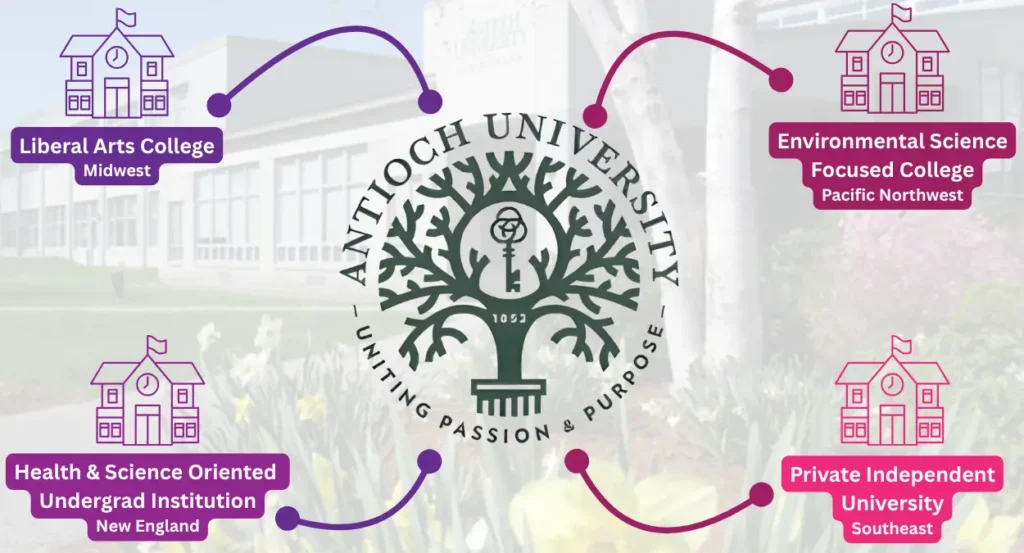
The Coalition for the Common Good (CCG)—co-founded by Antioch University and Otterbein University—offers one emerging model. Within this federation, undergraduate institutions maintain separate boards and accreditations while accessing shared services and graduate-degree pathways operated by Antioch University. The model is designed to preserve institutional identity while enabling scale, quality, and sustainability.

Collaboration is no longer a strategic option. It is an economic reality.

Strategic Response: Building Higher-Education Federations 

Forward-looking presidents and boards are moving beyond mergers, acquisitions, or limited back-office consolidations. Instead, they are pursuing collaborations structured as long-term investments rather than concessions.

Key features of effective collaboration include:

  • Mission before money: Participation begins with shared values, not short-term savings.
  • Quality alongside efficiency: Shared services should strengthen—not thin—IT, legal, risk management, and compliance capacity.
  • Student success and institutional flourishing: Decisions are evaluated by their impact on learning, opportunity, and local vitality.

Well-designed academic pathways—such as GEAPs and joint programs—expand undergraduate yield and graduate enrollment. Federated governance structures, when carefully constructed, can strengthen independence rather than erode it.

In an era of fixed costs and fluctuating enrollment, collaboration has become a defining expression of presidential foresight.

Challenge 3: Political Polarization and the “Public Spotlight” on Leadership

In 2025, polarization, misinformation, and declining trust in national and regional media placed many university presidents under an unflattering spotlight. Decisions once understood as internal governance matters increasingly unfolded in public view, narrowing the margin for error in presidential leadership.

A bright public light illuminated topics historically managed within institutions. These topics included everything from invited speakers, homework and curricula, academic freedom, DEI initiatives, research and grant hypotheses, student conduct, and presidential statements, and more. Decisions related to such topics such were more likely than ever to be interpreted through partisan lenses, amplified through social media, and assessed by external actors with limited tolerance for nuance, context, or institutional process.

In addition to impacting the president’s reputation, this public pressure also increased legal, regulatory, and governance exposure. 2025 showed us that civic controversy increasingly triggered complaints, investigations, or litigation tied to free speech, civil rights, consumer protection, accreditation, and federal compliance—even when institutional procedures were appropriate.

Strategic Response: Preparing Boards for Crisis Governance

Presidential vulnerability has increased—not because leaders are less capable, but because the role now carries greater external risk. Shorter presidential tenures and higher turnover, particularly among first-time presidents and presidents from underrepresented groups, point to the need for more deliberate board engagement.

To respond, presidents and governing boards should:

  • Build shared situational awareness. Boards should receive regular briefings on emerging issues, external sentiment, and early indicators of risk, treating reputational exposure as a governance concern, not a communications task.
  • Clarify roles in advance. Institutions should establish who speaks, when, and on whose behalf during periods of heightened scrutiny to reduce confusion and escalation.
  • Prepare for visible board leadership. Trustee silence during targeted presidential criticism is often interpreted as hesitation. Boards should be ready to offer timely, values-anchored support when attacks are unfair or factually inaccurate.
  • Practice crisis governance. Periodic scenario planning and tabletop exercises help boards integrate fiduciary responsibility, public communication, and leadership support before pressure arrives.

In polarized environments, presidential effectiveness depends not only on individual judgment, but on whether boards are prepared to lead with clarity and resolve.

Challenge 4: The Increasing Burden of Federal Compliance and Risk

Title IX changes, FLSA threshold adjustments, third-party servicer rules, gainful-employment reporting, cybersecurity mandates, expanded Borrower Defense to Repayment (BDR), and immigration delays collectively produced the most demanding regulatory environment in a generation.

These federal policy shifts increased labor costs, intensified documentation requirements, created uncertainty for graduate programs, and elevated institutional risk exposure.

Response 4: Shift From Reactive Compliance to Anticipatory Governance

Suggested Change- Strategic Response: Moving to Anticipatory Governance

Rather than responding episodically, presidents and boards should strengthen governance practices that surface risk early and support evidence-based decision-making.

Key actions include:

  • Clarifying decision authority through formal decision-making matrices.
  • Reviewing public claims that imply outcomes, ensuring statements about licensure, cost, debt, time-to-degree, and employment are supported by current evidence.
  • Conducting targeted, cross-functional risk reviews focused on high-exposure areas rather than campus-wide audits.
  • Sharing legal interpretation and compliance intelligence with peer institutions.
  • Engaging regulators deliberately, with designated institutional spokespeople and measured, evidence-based communication.

The goal is not perfect paperwork, but early detection and responsible correction.

Challenge 5: Redefining ROI for the Modern Student and Family

In 2025, prospective students and families asked a more exacting return-on-investment question: Is this degree worth it—for me, my family, now, and over time?

Earnings remain part of the calculus, but they no longer stand alone. ROI has widened to include economic mobility, career durability, civic participation, community leadership, and alignment with personal purpose. Students increasingly evaluate whether programs provide options, not guarantees—skills that transfer across roles, credentials that signal competence to employers, and learning experiences that connect education to lived and professional realities.

This broader ROI lens also reflects heightened skepticism. Families want evidence that institutions understand the labor market, respect students’ time and financial constraints, and design programs that deliver value beyond aspiration. Institutions that rely on dated assumptions about degree value risk losing credibility in a marketplace that now demands proof, transparency, and relevance.

Response 5: Demonstrate ROI Through Outcomes that Students and Communities Value

Strategic Response: Demonstrating ROI Through Valued Outcomes

Presidents and boards should respond by making ROI an institutional practice rather than a rhetorical claim. That means:

  • Defining ROI broadly and explicitly, articulating how academic programs advance mobility, employability, civic contribution, and long-term adaptability—not simply short-term earnings.
  • Investing in career infrastructure, including employer partnerships, applied learning, internships, and alumni networks that connect students to concrete opportunities during and after enrollment.
  • Tracking outcomes over time, using longitudinal data to understand how graduates fare across careers, communities, and civic life—not just at first placement.
  • Articulating the “double value” of degrees, showing how individual advancement and community benefit reinforce one another through public-interest work, regional partnerships, and mission-aligned professions.
  • Integrating ROI into governance and accountability, embedding outcome evidence into program review, accreditation narratives, and board-level decision-making rather than isolating it within marketing or enrollment functions.

ROI is not a slogan or a promise. It is the cumulative evidence that an institution delivers on its mission—to students, to communities, and to the public it serves.

Closing Reflection: What 2025 Revealed—and What Leadership Must Do Next

The challenges facing higher education are not temporary or discrete. They are structural and interconnected, requiring sustained leadership rather than episodic fixes.

Our charge as presidents and board members is to lead with clarity—to design institutions that are academically strong, operationally coherent, financially disciplined, and unmistakably student-centered.

The work ahead calls for discernment rather than defensiveness, collaboration rather than isolation, and evidence rather than assumption. Leadership choices that strengthen academic quality and financial stability also build public trust and educational opportunity.

Meeting Higher Education’s New Normal: How Antioch and the CCG Are Built for the Demographic Cliff

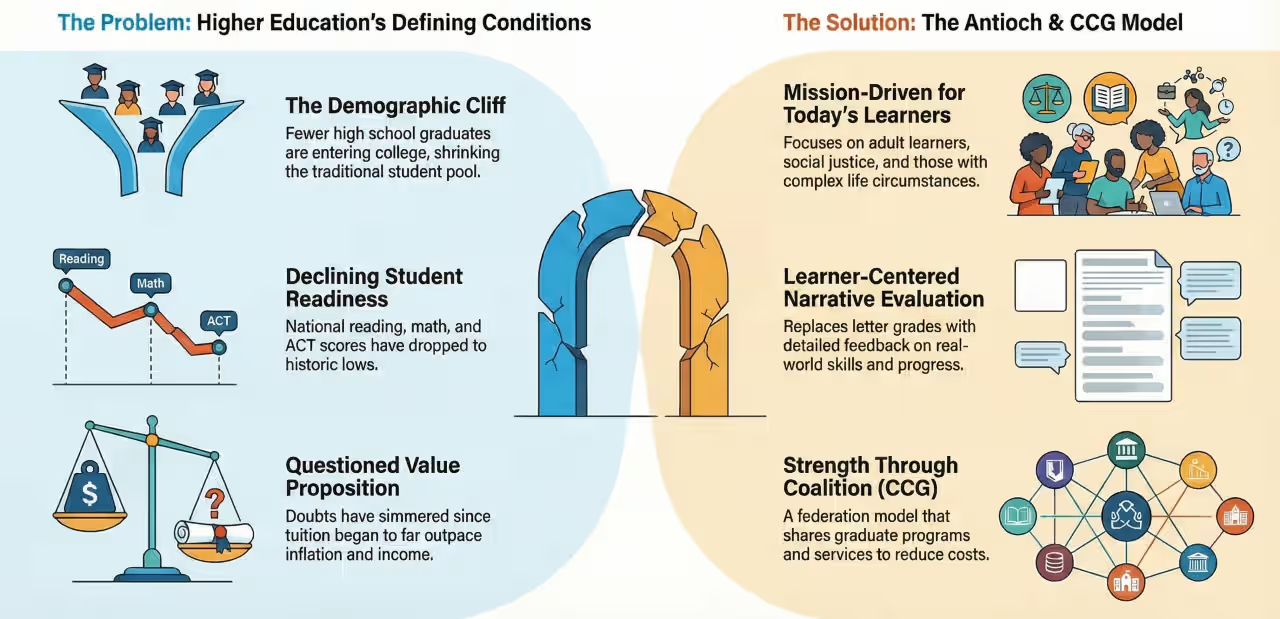
When higher education leaders talk about the “moment,” we should do so in ways that do not reinforce a common but inaccurate narrative that suggests the enrollment cliff, equity issues, and public pressures arrived suddenly or will recede quickly. They did not. The demographic contraction has been building for more than a decade.

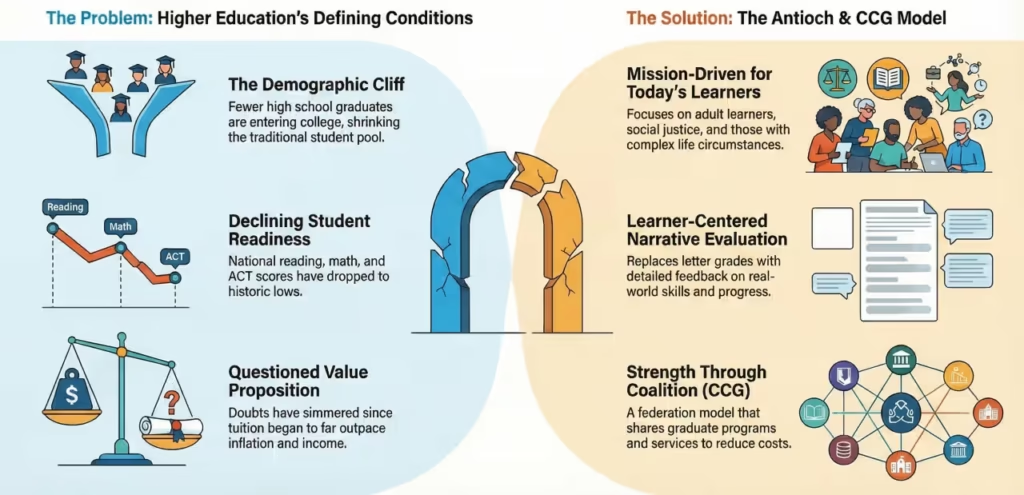
Inequities across K–12 systems have been widening for even longer. And doubts about the value of higher education have been simmering since at least the 1980s, when tuition began rising far faster than inflation and family income.

These forces do not constitute a moment. They are the defining conditions of our time. Many institutions are scrambling to recalibrate. Antioch University and the Coalition for the Common Good, however, are structured to meet these conditions head-on.

The Higher Education Reality Today

Across the country, fewer high school graduates are entering college. Among those who do, many arrive with uneven preparation when compared to peers from one, five, or even thirty years ago. National reading and math scores have dropped to historic lows. ACT scores continue to fall.

Economic instability is intensifying, with nearly half of students in some states qualifying for free or reduced-price meals. These shifts reach well beyond admissions. They affect students’ academic trajectories, the support systems they rely on, the faculty time needed to assist them, and the financial planning essential to institutional stability.

They also make the demographic cliff steeper and more perilous by reducing both the size of the incoming student body and the level of preparation students bring with them. When understood together, these dynamics signal a long-term recalibration for higher education. They point to a future in which success depends less on historical assumptions about who will enroll and more on an institution’s capacity to understand who learners actually are and what they need to thrive.

What Antioch Has Long Understood

While many institutions are just now confronting the implications of this reality, Antioch has been educating for it all along. Three elements of Antioch’s identity align directly with what this decade demands.

1. A Mission Centered on Justice, Access, and Equity

Antioch’s commitment to social mobility and public purpose predates the current crisis by more than a century. We do not need to retrofit our values or reinvent our rhetoric. Our programs already serve learners whose educational paths are shaped by uneven preparation, complex life circumstances, and structural inequities.

2. An Academic Portfolio Linking Passion to Purpose

Antioch’s largest graduate programs are in counseling, psychology, health, leadership, and environmental studies. These are the fields communities rely on heavily as inequities widen and support systems fray. Students drawn to these professions understand the impact they have on people and communities. They choose Antioch not simply to “skill up” and get a job promotion but to become part of a learning community that is rigorous, relevant, and rooted in purpose.

3. A Learner-Centered Model and Narrative Evaluation

At the front end, Antioch does not rely primarily on GRE scores or years-old undergraduate transcripts. We read the realities behind the résumé. We design programs for adult students who work, care for families, lead in community organizations, or translate insight into real-world problem solving.

During the academic journey, Antioch evaluates learning through real-world assessments: structured observations, role-playing, and demonstrated skills. Faculty do not assign letter grades. They write detailed narratives that capture each student’s progress, strengths, and areas for growth. 

Prioritizing adult learners, meeting them where they are, and assessing them via detailed narratives that capture nuances become even more essential as traditional pipelines contract.

How the Coalition for the Common Good Strengthens Our Position

The Coalition for the Common Good (CCG) has been designed to amplify Antioch’s strengths and create pathways for undergraduate students at partner institutions to earn an AU graduate degree. The CCG does this in structural, not symbolic, ways.

Shared Graduate Programs

CCG affiliates transfer their graduate programs to Antioch, creating a common platform that increases scale, improves quality, and reduces duplication. At a time when demographic decline shrinks regional markets, the Coalition opens broader pathways for students who want direct, accelerated, mission-aligned graduate degrees.

Shared Services to Reduce Costs

The CCG’s shared services organization is being built so that member institutions can access scaled HR, IT, compliance, and legal support. The sharing of such services lowers overhead expenses for each member institution. This lowering allows the individual universities to reinvest in student-facing priorities that are often being reduced at the very time they need to be bolstered.

Financial Resilience Through a Federation Model

While other institutions compete for shrinking pools of students, the Coalition aligns around shared purpose, shared programs, and shared efficiencies. This creates a network that can withstand volatility better than any one campus could on its own.

Looking Forward: A Coalition Built for What’s Ahead

Many universities still frame today’s challenges as the problem of the day. Antioch and the CCG treat them as defining features of the era ahead.

  • Demographics: Many institutions hope the demographic cliff will flatten. We assume it will not.
  • Readiness: Many campuses wonder how to adapt to declining readiness. We were founded to educate in precisely those conditions.
  • Value: Many leaders are now asking how to strengthen the value proposition. Our value proposition has been consistent for 170 years: preparation for purposeful work, democratic engagement, and victories for humanity.

Higher education cannot meet this enduring new normal by recycling models built for abundance. It must confront the realities of scarcity, volatility, and inequity with candor and courage. Antioch and the Coalition for the Common Good are not immune from these pressures. But we are structured, staffed, and mission-driven in ways that align with the realities of today, not with an idealized version of the past.

Frequently Asked Questions

Q: How is Antioch University addressing the higher education demographic cliff? 

A: Antioch University focuses exclusively on adult learners seeking to complete the bachelor’s degree and/or earn a graduate degree rather than relying on traditional high school pipelines. Through the Coalition for the Common Good, Antioch partners with undergraduate institutions to build direct pathways for students to earn mission-driven, market-wise graduate degrees.

Q: What is the Coalition for the Common Good (CCG)? 

A: The CCG is a federation of undergraduate institutions that transfer their graduate programs to Antioch University so that their students have direct and clear pathways to graduate school. As part of the transfer, the undergraduate universities get a share of the revenue the transferred program generates. They are also able to participate in the CCG’s shared service organization called CCG Services, Inc. This organization is designed to provide scaled services in areas such as HR, IT, and legal services. This reduces overhead and allows institutional members to spend more time, money, and attention on academics.

Q: Do faculty at Antioch University use letter grades to assess students?

A: No. Antioch faculty use detailed narrative evaluations rather than letter grades to assess student learning. This system captures and describes a student’s progress, strengths, and development through observed competencies, assessments of role plays, and demonstrated skills.

The First 100 Days of a University Presidency: Curiosity, Generosity, and Discernment

Navigating the Initial Surge: A Period of Mutual Curiosity

The first hundred days of a presidency go by quickly. Timelines compress, expectations expand, and many conversations feel like both an introduction and an audition. Faculty, staff, and students watch closely as the new president works to earn trust and grasp the institution’s pulse and purpose. When the campus stays open to the leader’s early questions and the president returns that openness by observing before concluding, the first one hundred days is a period of mutual curiosity. Such a state serves everyone well during the early transition.

From Motion to Meaning: The Role of Presidential Discernment

The early months are marked by a natural surge—a rush of meetings, receptions, and requests that can simulate progress. But experienced presidents know that movement alone does not clarify direction. Progress toward a collective vision begins with discernment: knowing whom to involve, how quickly to advance, and when to pause long enough to sense the institutional contours before setting a course.

Leading via a Listening and Learning Tour: Understanding the Institutional Landscape

In higher education, leadership begins not with pronouncements but with the sharing of observations and understandings that are often a key part of an early “listening and learning tour with university constituents. The tour is less about announcing plans than learning recurring hopes, quiet fears, and subtle contradictions that reveal where the real work will lie. The most effective presidents use the tour to convert motion into meaning and curiosity into comprehension. They pair generosity of spirit with rigor of thought, reading both the culture and the climate before attempting to rewrite either.

The Challenge of Pace: Balancing Purpose and Progress, Communicating All the While

The challenge of these early months is to balance pace with purpose while describing key activities and emerging thoughts to as broad an internal audience as possible. Move too quickly, and early choices rest on incomplete impressions; move too slowly, and the goodwill that greets a new presidency begins to wane. The art lies in letting the tempo of human trust set the tempo of institutional change.

Establishing the Tone: Building Confidence for the Future

Most presidencies open with constituents leaning forward—listening carefully, hopeful yet cautious. The first hundred days may not define the years ahead, but they do establish tone and rhythm. A presidency grounded in curiosity, generosity, and discernment signals not haste, but readiness—the kind of readiness that builds confidence and creates the conditions for everything that follows.

Frequently Asked Questions

1. Why are the first 100 days of a university presidency so significant?

They establish the trust, tone, and momentum that shape how the new leader will be received and supported.

2. What should a new president prioritize early on?

Listening across the institution should come first to gain a clear sense of culture, needs, and expectations.

3. How does discernment improve early decision-making?

After concluding the listening and learning tour, the new president should step back to carefully  review notes and analyze overlapping themes and concerns. This step precedes the explicit ‘reflection’ or ‘discernment’ period that comes next. Discernment must be shaped by the facts, figures, and lived experiences that surfaced during the listening and learning tour. These are key inputs that will help chart the long-term direction.

4. How can a president balance speed with purpose?

They must advance steadily while avoiding decisions based on incomplete impressions or pressured haste. They must communicate broadly and clearly emerging decisions and the timelines that guide them so that institutional stakeholders are kept in the loop.

5. What are characteristics shape a strong start to a presidency?

Curiosity, generosity, and thoughtful judgment signal readiness and inspire confidence across the campus.

The Coalition for the Common Good: A Model for Financial Sustainability, Business Innovation, and Student Success in Higher Education

How Universities Achieve Financial Sustainability Through Collaboration

Across higher education, leaders are rethinking how to strengthen mission-driven, tuition-dependent institutions in the face of demographic decline, cost escalation, and market volatility. The old playbook—incremental tuition hikes and deeper discounts—no longer delivers stability. Financial sustainability now depends on innovation, collaboration, and scale.

The Coalition for the Common Good (CCG)—founded in 2023 by Antioch University and Otterbein University—offers a practical model. Rather than merging, its members join a federation that allows each university to retain its own board, accreditation, and identity while sharing academic pathways and operational systems. The result is a coalition that lowers costs, expands opportunity, and preserves independent board governance while creating interdependent degree pathways.

This collaborative approach is grounded in progressive education principles and democratic values. Learn how experiential education shapes innovative higher education models.

Anitoch University Lori Varlotta

Shared Services Organization (SSO): Driving Innovation in Higher Education

Presidents and boards increasingly recognize that sustainability cannot rest on cost containment alone. The CCG’s Shared Services Organization (SSO) aims to show how business innovation in higher education can generate both efficiency and quality. By coordinating information technology, legal services, payroll, and other administrative systems, member institutions access enterprise-level tools that could be cost-prohibitive to sustain individually.

This shared-services framework helps redirect institutional resources toward what matters most at small independent colleges and universities: teaching, campus and community service, and the student experience. It transforms collaboration from a gesture of goodwill into a disciplined strategy for operational strength.

Value-Based Student Recruitment: Beyond Traditional “Discounting”

Long-term financial sustainability depends on thoughtful, value-based student recruitment. Through the CCG, undergraduate students at member colleges can earn multiple degrees all with a purpose. Students are able to travel affordable, accelerated pathways to Antioch’s justice- and leadership-focused graduate and professional degrees. Named Graduate Early Admissions Pathways (GEAPs) on one campus, these pathways create a seamless route from bachelor’s to master’s, reducing both time and cost to degree.

Value-Based Student Recruitment: Beyond Traditional “Discounting”

Long-term financial sustainability depends on thoughtful, value-based student recruitment. Through the Coalition for the Common Good, undergraduate students at member colleges can earn multiple degrees all with a purpose. Students are able to travel affordable, accelerated pathways to Antioch’s justice- and leadership-focused graduate and professional degrees. Named Graduate Early Admissions Pathways (GEAPs) on one campus, these pathways create a seamless route from bachelor’s to master’s, reducing both time and cost to degree.

Early outcomes are promising. Otterbein University, one of the founding partners, saw a 23 percent increase in new-student enrollment within two years of joining the CCG—growth driven not by deeper discounting but by greater value and visibility. See GEAP webpage for additional information

GEAPs exemplify experiential learning in action, connecting undergraduate and graduate education in meaningful ways. 

Explore how experiential adult education drives student success

Aligning Purpose, Scale, and Student Success

The CCG advances student success by connecting learners to a broader academic and professional ecosystem. Cross-registration among member universities will allow  students to take select online or hybrid courses taught by faculty across the network. Shared internship and employer partnerships will expand access to purposeful work. And because all programs operate under Antioch’s Higher Learning Commission accreditation, students gain both quality assurance and federal-aid eligibility.

A Model Worth Watching

The CCG offers an emerging model for small and mid-sized universities that want to double down on delivering mission- and student-centric opportunities while staying independent and becoming financially strong. It presents a new way of thinking about collaboration—one that goes far beyond back-office shared services while steering clear of the mergers and acquisitions that have become increasingly common across higher education.

See these short essays more details https://commonthread.antioch.edu/describing-the-ccg-in-four-short-essays/ 

Frequently Asked Questions

Q: What is the Coalition for the Common Good?

A: The Coalition for the Common Good is an innovative higher education system founded in 2023 by Antioch University and Otterbein University.

Q: How do Graduate Early Admission Pathways (GEAPs) work?

A: As imagined, GEAPs will allow undergraduate students to take graduate courses during their senior undergraduate year, earning credit toward both the bachelor’s and the master’s degrees. The model is being designed to reduce both the time to graduation and the cost of these two degrees.

Q: What services does the Shared Services Organization provide?

A: The SSO is being constructed to coordinate IT, legal services, payroll, and other administrative systems across member institutions.

Presidential Succession Planning: From Troubling Turnover to Transition and Transmission

Presidential turnover at colleges and universities is high. Between 2022 and 2024, more than one in five presidents and senior executives left their roles. At many of those institutions, the departure came sooner than expected and without a transition plan in place.

Boards cannot always prevent a president from stepping down earlier than anticipated. They can, however, require that the sitting president develops a viable succession plan—one that can be activated to keep the university moving forward when a planned or unexpected departure occurs.

This article delineates six recommendations for sitting presidents to consider as they plan their own succession. When used together, these recommendations might turn a moment of disruption into one of continuity and confidence.

1. Name the Reality and Normalize the Conversation

Continuity matters in higher education. It takes years, not semesters, to build programs, partnerships, and policies. When a presidency ends abruptly or without an orderly handoff, initiatives stall, confidence wanes, and institutional energy dissipates.

A president’s planned departure should not be expressed or experienced as rupture. It should be conceived and experienced like a relay—marked by the careful handoff of responsibility and insight.

Presidents and boards should design that handoff before the leader enters the starting—or, in this case, the “exiting”—blocks. The first act is acknowledgment. Turnover will occur sooner or later. Giving the president and vice presidents permission to discuss it out loud normalizes the conversation. It also frames succession planning as a sign of organizational evolution not of personal exit.

2. Build Strong Benches, Not Single Successors

Succession planning must go beyond naming a successor. It requires building the systems and people that carry knowledge, culture, and priorities forward.

The strongest universities cultivate leaders at every level through cross-training, mentoring, and opportunities to lead outside one’s “home” department. When mid-career deans understand enrollment drivers or department chairs learn to read the divisional budget, they become institutional thinkers, not just unit leaders. That shift embodies the essence of collective transmission: the passing of cumulative wisdom to a greater whole.

Equally vital are the knowledge keepers who hold institutional memory. Boards and senior teams must build electronic systems that capture the stories, experiences, and rationales of long-serving faculty and staff. As they step away, their personal observations, papers, meeting minutes, and the like should be stored in an easily accessible file, not locked away in an unknown, dark place. Future administrators would be well served to review these past treasures. 

3. Expect Boards to Routinize and Reimagine Succession Planning

Succession planning should not be delegated entirely to the incumbent president. Governing boards play an indispensable role that begins long before they are reading a resignation letter.

Effective boards treat succession planning as a standing agenda item—a periodic review of presidential readiness and institutional continuity. When boards and presidents discuss leadership succession as part of broader strategic planning, they signal that this work is essential to governance and growth, not ancillary to them.

Boards that take succession seriously also think beyond the predictable list of internal candidates. Too often, presidential succession plans start and stop with the provost, the CFO, or another senior cabinet member. Out-of-the-box thinking invites a wider lens. Some boards consider respected leaders from partner institutions, nonprofit executives whose missions mirror the university’s, or seasoned community leaders who could serve as a credible short-term president while a comprehensive search unfolds.

These types of considerations do not reflect unintentional “planning creep” but critical and creative planning that deliberately fosters out-of-the-box thinking. This proactiveness prepares boards to respond with steadiness and imagination when change occurs, ensuring that the presidency is filled by the type of leader who understands both the gravity of the role and the distinct context of the institution.

4. Consider an Interim as Part of the Overall Transition

Even the most intentional transitions can be disrupted by the unexpected: a health crisis, a governance impasse, or an external offer that is just too good to refuse. That is why every university needs two complementary plans—a long-term succession plan that guides leadership continuity over time and an interim plan that maintains stability if the presidency changes abruptly.

An interim plan clarifies who could assume short-term authority, how decisions will be managed, and what communication steps will preserve confidence across the community.

Interim appointments work best when they are not assembled in the heat of the moment. Charting them in advance, as a direction to follow and recalibrate as circumstances unfold, smooths what would otherwise be a very bumpy path. Advance charting steadies the institution, protects its people, and keeps attention fixed where it belongs—on students, staff, and mission.

5. Model Presidential Responsibility

Though it may feel awkward at first, presidents must model succession planning by planning for their own. Every leader who cares about institutional longevity should ask two questions early and often:

What am I building that will outlast me?

And who am I preparing to carry it forward?

Presidents model this responsibility not by naming a replacement but by cultivating readiness within their cabinets, their governance partners, and the wider institutional culture. They share context rather than hoard it, delegate meaningful work rather than symbolic tasks, and involve others in decision-making processes that reveal how institutional priorities are set and sustained. These habits make continuity a natural outgrowth of leadership, not an afterthought.

Presidents should speak candidly about succession not to spotlight their individual departure but to demonstrate organizational preparedness. In doing so, they normalize departure as part of the leadership arc. That transparency builds confidence across the community and quiets speculation about what might happen “if.” It affirms that the institution’s stability rests not on one person’s presence but on a shared embodiment of mission and a joint desire for continuity.

When presidents model the notion that succession is not a private concern but a collective discipline, they replace anxiety with agency and show that leadership is less about possession of power and more about the transfer of knowledge and empowerment of others to carry on.

6. Move Forward Amid Change

Presidential transitions test more than logistics; they test an institution’s ability to move forward in the face of change. Forward movement comes from discipline—the discipline to document, to delegate, to plan, and to revisit plans regularly. Presidents who approach succession in this way resist the extremes of panic on one side and denial on the other. Part of the legacy an effective president builds is a system capable of absorbing change without losing coherence.

By embedding succession planning into everyday leadership practice—rather than waiting for an impending departure—presidents can model the foresight they ask of others. Without such a plan, institutions lose more than leaders. They lose momentum, memory, and morale.

The statistics referenced in the first section of this blog are drawn from this article: https://hepinc.com/newsroom/examining-leadership-turnover-rates-in-higher-education-over-the-past-decade/